Written by Anisha George
The present political moment in India is another demonstration of the now routine politics of alienation and exclusion. On the one hand, the Election Commission has announced a revision of the voter list in Bihar, requiring elaborate paperwork that effectively stands to exclude millions of poor migrant workers spread across the country. On the other hand, multiple parties have made a great show over the language issue in Maharashtra — many migrants have recently been beaten up for not speaking Marathi — whose primary target lies in the vilification of poor immigrant workers. This is a growing trend across southern states where the opposition to Hindi imposition by the Centre has been countered by the imposition of state languages on precarious “outsiders”. Such disenfranchisement of the mobile poor at both origin and destination states in India is a threat to their basic citizenship rights.


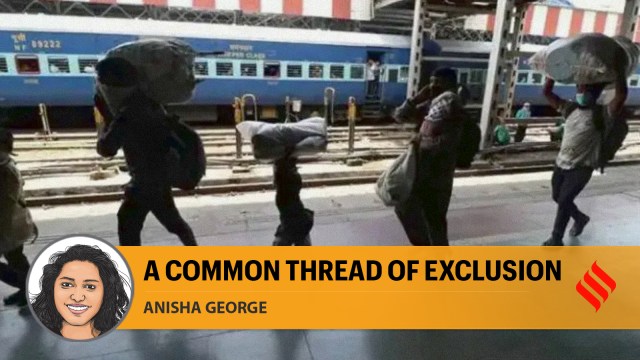
States that insist on workers learning their respective state languages are seeking to extract cultural assimilation in exchange for economic citizenship. However, the latter is scarcely forthcoming. Workers barely manage to find steady work in a single industry or city. Even if they do, their ability to build a life and livelihood in cities is further estranged by the costs of living that inhibit relocation with family and the lack of healthcare, food rations, and voting rights. It fails to provide them any form of social security or avenue for claims-making. Moreover, at the slightest sign of distress in cities — remember COVID-19 — migrants are pushed out without the slightest remorse. When destination states have nothing but irregular work at low wage rates to offer such immigrants, what is the moral, let alone constitutional, basis of demanding such cultural assimilation?
The political rights of labouring immigrants are an even more fraught subject. India seems to have squandered its demographic dividend by failing to provide quality education, employment or social security to its youth. As a result, we have a large mass of “footloose labour” wandering the breadth of the country for work. Further, imbalanced regional development in the country has meant that the historically better-off regions have continued to flourish at the peril of others. For instance, despite being a high remittance (domestic/international) state, Bihar has one of the lowest credit-to-deposit ratios in the country. More generally, the agrarian crisis and India’s jobless growth have served to push the working poor into the vast informal sector, which fails to provide any security of work or pay.
This cheap and precarious labour, then, is readily characterised as “economic predators” by destination states to cover up their own failings in reigning in market players and generating decent employment for the masses in general. State politicians mobilise such ethnolinguistic solidarities to paper over deep-rooted intra-state tensions of class and caste. The immigrant outsider, evidently nobody’s constituency, is an easy political target for dehumanisation. Politicians everywhere oppose the extension of urban housing and voting rights to poor immigrants and try to restrict citizenship claims to their points of origin. However, if more origin states undertake moves like Bihar, immigrants’ political rights back home also stand threatened.
This disenfranchisement of poor immigrants comes at a time when the country is yet to recover from the post-pandemic recession fully, and workers are yet to resume pre-pandemic levels of migration. While the loss of workers is perilous to destination states (and to economic growth), the loss of migration avenues is even more detrimental to workers (and to poverty reduction). Parties preying on the poor are against both democracy and politics.
The writer teaches at the Azim Premji University, Bengaluru. Views are personal


