Many argue that women’s burden of childcare and domestic work is the most important factor disadvantaging them in the labour market, both globally and in India. This “care work burden” or “motherhood penalty”, as some call it, is seen to underlie gender gaps in wages, lifetime earnings, career choices, and upward mobility. In India, women’s low labour force participation rate is also often explained in terms of the constraints imposed by childcare and domestic tasks, which fall mainly on them due to social norms.
But is this unchanging? I believe it is time to reassess this argument in light of notable demographic shifts, especially over the last decade, and concentrate our attention more fully on the demand-side constraints that women face (such as a dearth of suitable jobs), and barriers beyond households, especially the lack of safe transport, secure living spaces, and harassment-free workplaces.

Globally, for instance, total fertility rates (TFR) have fallen to replacement levels or below both in high-income and many middle-income countries. In India, as per the 2019-20 National Family Health Survey-5, the TFR is at 2.1 (replacement level) with only five states (Bihar, Jharkhand, Manipur, Meghalaya, and UP) having TFRs above 2.1.
Moreover, childlessness is growing. In the UK, 50 per cent of women who turned 30 in 2020 had not had children, and many will never have any. In the US, too, childlessness is rising. In India, the figures while very low, also show a slow rise, from 2.4 per cent childlessness among women born in the 1940s to 5 per cent among those born in the late-1970s (‘Increasing childlessness driven by higher female education in India’, Koyel Sarkar and Thomas Baudin, N-IUSS, May 23, 2022).
We have a long way to travel from an Independence Day speech about respecting women, delivered from the ramparts of the Red Fort, to creating decent jobs and respectful workspaces for them
Bina AgarwalProfessor, University of ManchesterWith few children, the time women spend in childcare will fall. And even if the intensity of care per child increases, especially as middle-class women focus on “quality time” and more extra-curriculum activities for kids, there are limits to this rise.
Some argue that the burden of elder care will replace that of childcare, given ageing populations. But, will it? Most people no longer live with their elderly parents, either in developed or developing countries. In the US, only 18 per cent of households were multigenerational in 2021 (Pew Research Centre survey). In the UK, 7 per cent of households were multigenerational in 2013-14. In India, only 16 per cent of families are deemed joint by the 2011 census.
In other words, the evidence does not suggest that eldercare is replacing the burden of childcare for most women, although this could vary by economic class, with poorer women being more burdened than middle-class ones. Among the latter, a growing number of elderly people live on their own, with children moving to other cities or abroad. They typically support parents financially, rather than via hands-on care.
Demographically, therefore, we can expect a decline in the extent to which childcare will restrict women’s labour market options in the future. Although we need more research, there is already emerging evidence of this. A 2019 study by John Bonggarts et al. (Population Studies) of 58 middle and low-income countries found that a fall in fertility and hence fewer children at home was linked with a significant increase in the percentage of women employed.
Improvement in basic infrastructure can further reduce domestic work burdens. In India, for instance, domestic work for rural women often includes arduous tasks such as fetching water and fuelwood. Piped drinking water and clean natural gas (already improving) will reduce this load.
Hence, while it remains essential to move social norms towards more equal sharing of housework by men, changing demographics (especially falling fertility) and basic technologies could reduce, to an extent, the importance of childcare and unpaid domestic work as constraints to women’s employment. This “rebooting” could help us focus on other constraints that remain strong.
In particular, for enhancing Indian women’s employment prospects we need greater emphasis on demand-side factors.
This would include training women in non-traditional skills with market demand, creating more public and private sector jobs for them closer to home, and raising awareness among employers — using substantial existing evidence — that hiring women can have a significant positive effect on productivity and work culture. Dovetailed with this, women need a diversity of measures to create secure accommodation in small towns and cities if they migrate for work, safe modes of public transport and zero tolerance for sexual harassment in workspaces.
I am not the first to say this, but what is new is factoring in demographic changes and shifting the emphasis. We need to persistently challenge the idea that most Indian women don’t join the labour force because they prefer housework to paid work, and ask for policies that proactively create jobs in which women would like to work.
We have a long way to travel from an Independence Day speech about respecting women, delivered from the ramparts of the Red Fort, to creating decent jobs and respectful workspaces for them. That is where the demographic dividend really lies.
The writer is professor of Development Economics and Environment, University of Manchester, UK

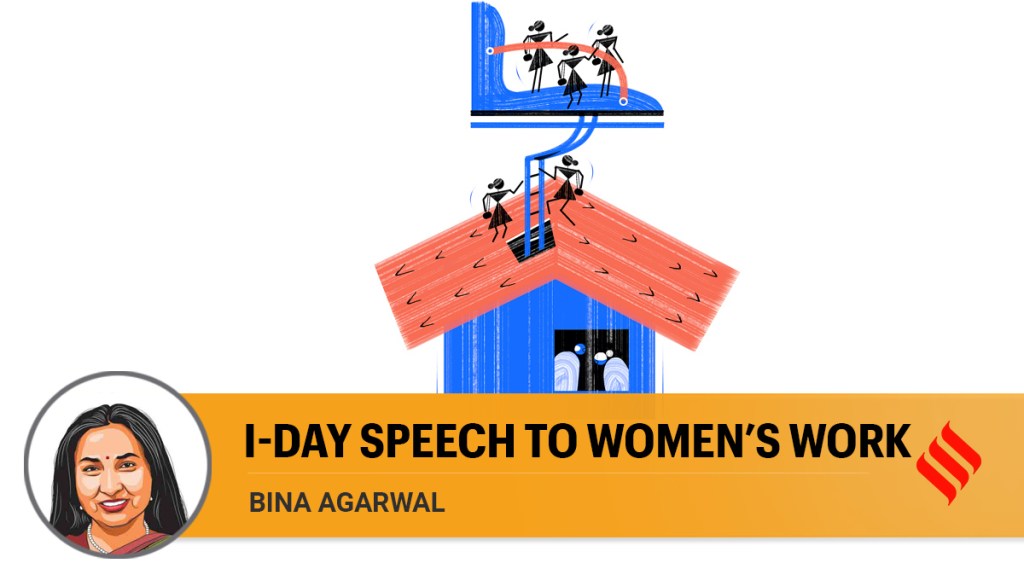 We need to persistently challenge the idea that most Indian women don’t join the labour force because they prefer housework to paid work, and ask for policies that proactively create jobs in which women would like to work. (Illustration: CR Sasikumar)


 Share


