5 min readOct 10, 2021 07:30 AM IST
First published on: Oct 9, 2021 at 04:00 AM IST
In villages around Corbett National Park in Uttarakhand, stories about Jim Corbett abound. Of how Corbett Sahib would celebrate local festivals, how he would turn up in local attire, or how he would join in the singing of the popular Kumaoni folk song Bedu pako baro masa. They still speak of the letters he would write to villagers after he left for Kenya, inquiring after their health, asking if their cow had given birth or if their roof still leaked. For them, Corbett is no outsider; perhaps, in many ways, he is less foreign than the tourist who comes from the “plains”.
When Union Minister of State for Environment, Forest and Climate Change Ashwini Kumar Choubey proposed changing the name of Corbett National Park to Ramganga, maybe he thought he was knocking off a foreign-sounding name and replacing it with an “authentic” Indian one. But Jim Corbett’s reality is a little more complex, one that straddles two worlds, in which he was both outsider and insider. Corbett was an Englishman and a patriot — he volunteered for both the World Wars but he wasn’t just any other Englishman in India. It was to him that villagers in the hills sent urgent messages when they wanted a man-eating leopard or tiger killed and it was him that workers at Mokameh Ghat in Bihar — where he worked with the railways — turned to in distress.

Corbett was a famed shikari, a wise businessman, a consummate storyteller, and a successful writer of books such as the Man-eaters of Kumaon (1944), The Man-Eating Leopard of Rudraprayag (1948) and The Temple Tiger (1955) (he was sometimes accused of overwriting and embellishing his tales) — and a naturalist who early on understood the need to protect tiger habitat.
It was his efforts and those of Malcolm Hailey, governor of the United Provinces, that resulted in the creation of Asia’s first national park in 1936. Named after Hailey, it was renamed Ramganga after India became free. It was rechristened Corbett in 1956, a year after his death, due to the efforts of Govind Ballabh Pant, freedom fighter, Uttar Pradesh’s first chief minister and the tallest leader to have come out of Kumaon. Pant was said to be one of the few or only friends Corbett had in the Congress. His relationship with freedom fighters was complicated. As Martin Booth writes in Carpet Sahib, his 1986 biography of Jim Corbett, “As regards Indians, Jim was popular with many of them, but hated by a few of position, especially those working towards Indian independence, who disliked his attitudes and saw in him a threat. He was, if anything, too popular. He not only killed man-eaters and ran a model village but he was also on the board of the association that looked after the welfare of Indian ex-servicemen and, in this role, he was (to the independence struggle) embarrassingly just, kind and understanding.”
As Corbett saw India’s imminent independence, he became uncertain of his and his sister Maggie’s future. Friends tried to persuade him to stay back, but Corbett feared they would become second-class citizens in Independent India, “the bottom of the queue” and would die alone. Booth writes, “His fears must have been partly groundless. He had enemies, it was true, but the overwhelming love the villagers of Kaladhungi held for both Jim and Maggie would have protected them.”
Nevertheless, Corbett decided to move to Kenya where he had family. But the yearning to return remained. An Englishman and a third-generation Indian, he flitted between two worlds, sometimes with ease, sometimes with uncertainty. The contradiction is best illustrated in My India, when in one sentence he talks of “Indians’’ and in the next about how “we who live in India” are “fatalists”. But to be one was not to cancel the other.
My father would often tell us this story about how Ayarpatta, where Corbett’s family home in Nainital stands, got its name. We could never quite figure out whether he was joking or not but apparently once an Englishman asked a local resident what that place was. “Andhyar pat (pitch dark)”, he replied. “Oh, Ayarpatta”, said the Englishman and so the pitch-dark corner got a bright new name.
The Indians, too, took their revenge frequently on British names — Corbett, for instance, was routinely called “Carpet sahib”. And so, Corbett’s India muddled along, jumbling words and identities, and in doing so, creating something new. Let’s hope in our new India too, both Ayarpatta and Carpet Sahib can flourish and continue to surprise us with something new.
This column first appeared in the print edition on October 9, 2021 under the title ‘At home with Carpet Sahib’. Write to the author at devyani.onial@expressindia.com

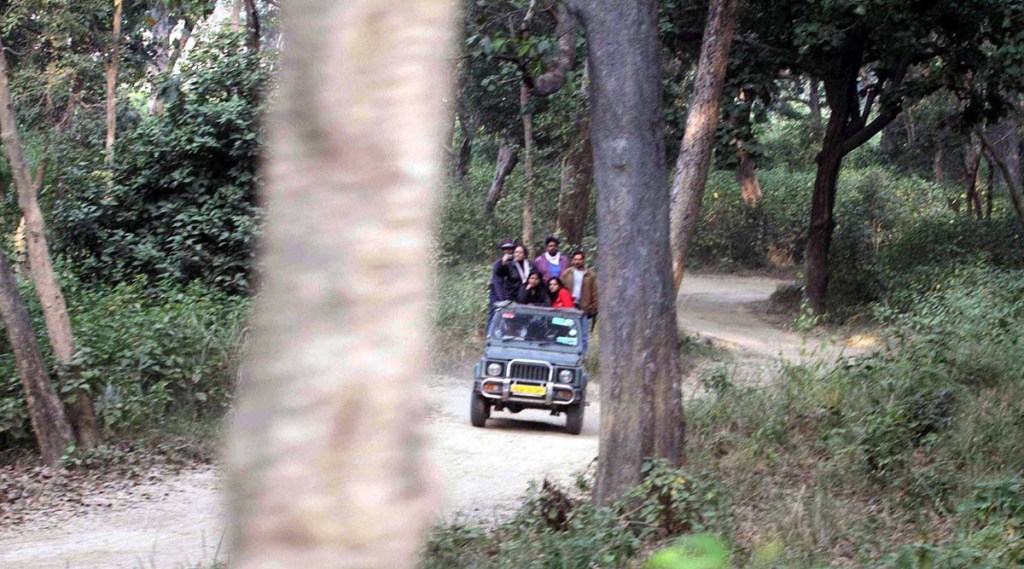 A safari at Corbett National Park (Express Archive)



 Share


