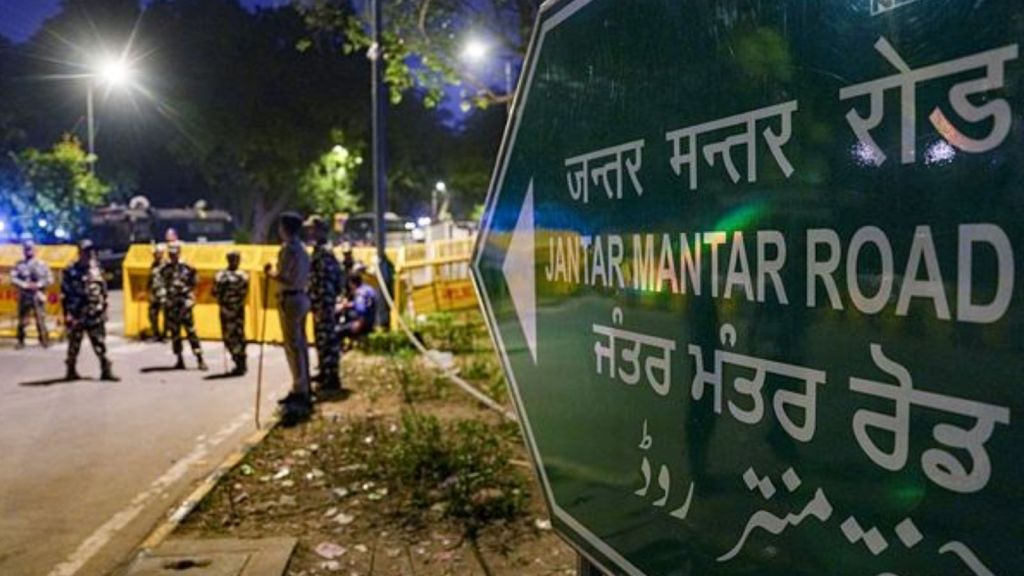
Let us be clear. Whoever has advised, recommended, or directed the Delhi Police to withdraw Jantar Mantar’s status as a designated site for public protest has inadvertently revealed the weakness of the state. The thinking process behind the decision exposes the growing fragility of a political establishment increasingly uncomfortable with the physical presence of dissent. Governments confident of their democratic legitimacy do not fear the gathering of citizens. They may disagree with protesters, challenge their arguments, or refuse their demands, but when citizen assembly becomes an object of governmental anxiety, we must ask whether the problem lies with the protesters or with the government’s understanding of democracy.
Consider a simple analogy. Regular medical examinations are necessary because monitoring a patient’s condition helps identify what might otherwise remain invisible. Protest performs comparable diagnostic and preventive functions in the life of a democracy. It reveals grievances, institutional failures, and the distance between official claims and citizens’ lived realities. To eliminate protest from public view is rather like removing diagnostic instruments because their findings make us uncomfortable.

There is something fundamental at stake in the controversy surrounding Jantar Mantar. It concerns the relationship between space, power and democratic citizenship. For those unfamiliar with the scholarship on protest movements, the location of a protest might appear incidental. Why should citizens insist on assembling at Jantar Mantar? Why not somewhere on the outskirts of Delhi, away from administrative buildings, traffic and the supposed inconveniences of everyday governance? Such questions misunderstand the political geography of collective action. Movements, much more than just occupying space, produce political meaning through their occupation of space. The location, history, accessibility, and proximity to institutions of power shape the message being communicated through protest.
The French philosopher Henri Lefebvre argued that space is socially produced. It is neither politically innocent nor merely a physical container within which social life unfolds. Space reflects relations of power, but it can also become a terrain on which those relations are questioned and challenged. This insight is particularly relevant to contemporary India. A demonstration near Parliament communicates something fundamentally different from an assembly on an isolated stretch of land several kilometres away. Both may involve identical slogans and demands. Yet, the former symbolically places citizens in conversation with those who govern them, while the latter risks transforming a political claim into a spectacle conveniently removed from the attention of power. Proximity, therefore, is part of the language of democratic accountability.
Charles Tilly’s work on contentious politics helps us understand why public demonstrations develop recognisable repertoires of collective action. Marches, sit-ins, occupations and assemblies are not arbitrary choices, as they emerge through historical interactions between citizens and authorities. Sidney Tarrow similarly reminds us that movements operate within political opportunity structures. The accessibility of public spaces, the state’s willingness to tolerate collective action, and the possibility of attracting wider public attention influence how movements emerge and sustain themselves. In restricting access to established protest sites, authorities – more than regulating traffic or maintaining public order – alter the opportunity structure within which democratic participation takes place.
Consider the history of protest across the world. Tahrir Square in Cairo became inseparable from the political imagination of the Egyptian uprising. Tiananmen Square acquired a significance that extended far beyond its physical boundaries. The occupation of Zuccotti Park during Occupy Wall Street transformed a small urban space into a symbol of economic inequality. Closer to home, Jantar Mantar has repeatedly served as a location where citizens sought to make themselves heard. These places differ enormously in political context and historical consequences. What connects them is the recognition that public space can become a medium through which citizens challenge the established distribution of political visibility.
Jantar Mantar occupies a distinctive position in India’s democratic geography. Over the decades, it has witnessed gatherings of farmers, students, workers, pensioners, women’s organisations, civil liberties groups and countless citizens whose concerns rarely find sustained attention within formal political institutions. Many of these movements have differed sharply in their ideological orientations. Their common denominator has been the conviction that citizenship includes the right to assemble, disagree, and demand accountability.
I have spent decades teaching a paper on protests and social movements, and my engagement with these questions has never remained confined to the classroom. Recent months have once again demonstrated that the theoretical distinction between institutional politics and contentious politics becomes painfully inadequate when citizens discover that established channels of representation are unwilling to hear them.
For many young protesters, Jantar Mantar is a place where their anxieties acquire collective expression and isolated experiences of injustice become shared political demands. Through collective assembly, that distress becomes a public question; this is precisely what democratic politics should encourage rather than fear.
The geographer Don Mitchell has argued that struggles over public space are deeply connected to struggles over the right to be politically visible. Public space becomes democratic because people can use it to make claims that established institutions might otherwise ignore. A government may formally acknowledge the right to protest while ensuring that protests occur only where they are unlikely to be seen, heard, or noticed. Such an arrangement preserves the vocabulary of democracy while steadily diminishing its substance. The constitutional right to peaceful assembly under Article 19(1)(b), subject to reasonable restrictions, cannot be understood independently of the practical conditions that make its exercise meaningful.
The Supreme Court’s jurisprudence has recognised both the importance of peaceful protest and the need to balance it with other public interests. That balance should not become a pretext for treating every visible expression of disagreement as an administrative inconvenience. After all, the purpose of democratic governance is not to ensure that power remains undisturbed but to ensure that power remains answerable. There is another dimension that deserves attention. Manuel Castells, writing about contemporary networked movements, explains how physical urban spaces and digital networks interact to create new forms of collective political agency. Even in an age of online mobilisation, the physical gathering of people retains enormous symbolic and emotional significance. A hashtag may communicate anger, but a public assembly makes that anger palpable through human presence.
There is a larger lesson here for those exercising power. A protest site may be restricted through an administrative notification. Barricades may be erected, permissions may be denied, and citizens may be pushed farther from the institutions they seek to address. But no notification can extinguish the social conditions that generate collective dissent. Indeed, the history of social movements suggests that attempts to suppress peaceful and accessible forms of protest can sometimes produce the opposite of their intended effect.
Grievances do not disappear merely because the space available for expressing them has contracted. Jantar Mantar should, therefore, be understood not as an embarrassment to the capital but as one of its democratic assets. It reminds those in office that the Republic belongs equally to those who applaud the government and those who question it. You may denotify a protest site, but you cannot denotify dissent and more importantly, you certainly cannot denotify the democratic conscience of a people.
The writer is Member of Parliament (Rajya Sabha), Rashtriya Janata Dal



 Share


