6 min readJan 31, 2022 09:33 AM IST
First published on: Jan 31, 2022 at 04:45 AM IST
Vadodara was known as a cosmopolitan city in the 20th century. I moved there in 1980, and was surprised to see two striking instances of communal boycott and to read about a third instance that had occurred decades before my time in the city. The one before my time involved the young B R Ambedkar, who had returned from the US after completing his studies at Columbia. He had to take shelter in the house of a Parsi as no Hindu was willing to let out his house to the young lawyer despite being summoned by the Maharaja of Baroda as the Law Officer of Baroda state. Pained by the attitude, Ambedkar decided to leave the city in less than two weeks. The one instance I saw closely relates to the legendary theatre director Habib Tanvir who arrived in Baroda in 1985 for a year-long stay leading to the production of a new play. Like Ambedkar, Tanvir had to wind up his planned stay in Baroda as Hindus were not willing to rent a house to a Muslim, and the Muslims did not want a Leftist anywhere near them. In the 1980s, the RSS had already started making Gujarat its social laboratory. Its full scale erupted before the public eye later.
The third instance of social boycott that I know relates to J S Bandukwala. A nuclear physicist, he had come to Vadodara in the early 1970s to teach at M S University. He was ostracised by his own community, not so much for who he was but for what he thought. In an interview with Ajaz Ashraf, Bandukwala narrates: “After completing my studies in the United States, I returned to India in 1972. I chanced upon the Bohra Syedna [spiritual head of the Bohra sect of Muslims] in Vadodara. He was praying in a garden. I stopped to pay my respect to him, and started talking to two of his family members. I was dressed in pants and a shirt. When they heard that I was a Bohra, they aggressively asked me how I could come to meet the Syedna in the clothes I was in. When a Bohra meets the Syedna, he is supposed to wear the traditional Bohra dress, stand and approach him in a particular way. They said, ‘You are supposed to be Abde Syedna,’ which means the slave of Syedna. My response was that it was not possible for me to be the slave of anyone but Allah. They tried to put pressure on me but I was not willing to compromise.”

During the 1980s, I used to teach at the English department of M S University. It was but natural for me to get drawn to Bandukwala who was in the science faculty. I have seen his amazing journey in life over these decades and have felt impressed and inspired by his quiet courage and his ability to speak out fearlessly even in the face of the worst threats to his life. During the last 50 years, till he passed away on Saturday, the professor continued to speak simple truth to power and paid a heavy price for it.
When he was a young lecturer and the warden of a boy’s hostel on the Baroda University campus, his house was vandalised by students. When he decided to contest elections, the university authorities refused to sanction his leave. As a rare case in the history of the university, Bandukwala decided to forfeit his salary for his work on the campus. He started teaching children from poor families without taking fees from them, as well as some students from affluent families to keep his finances going. After the small residential flat he occupied as a lecturer was vandalised by goons on the campus, the university authorities shifted him to a slightly larger flat meant for professors. After spending some time there, he quietly shifted to a house he had built in Sama. That house was attacked by a large mob during the 2002 Gujarat riots. I remember him telling me how the most precious things, such as his family albums and personal letters, were burnt before his eyes. Friends helped him to escape the mob of rioters which would have killed him that day.
After the riots, he sent his children away from Vadodara; and after the death of his wife, he lived the life of a lonely but unflinching crusader. He continued to work with the community, funded the education of innumerable children, wrote and published articles on issues of vital interest for social harmony and, most of all, refused to be intimidated. Throughout his life, he continued to face fatwas from Muslim clerics and threats and harassment from Hindu fanatics. Besides, given his identity, thoughts and social engagement, he remained outside the social circles that make up the hugely materialistic and somewhat bohemian society of Vadodara. For most of the time, the who’s who of Vadodara pretended to have forgotten that J S Bandukwala continues to live in a small flat in Pratapgunj until they were forced to acknowledge his presence when important thinkers and social leaders from all parts of the world came to visit him. A conscience keeper, neglected by his own city and applauded by the world, an inspiring friend and a courageous crusader for human dignity and equality, JSB left this world on January 29. He left a large gap in Vadodara’s moral core and a big imprint on the collective memory of an India caught in communal strife.
The writer is a cultural activist and a former colleague of J S Bandukwala at the M S University of Baroda

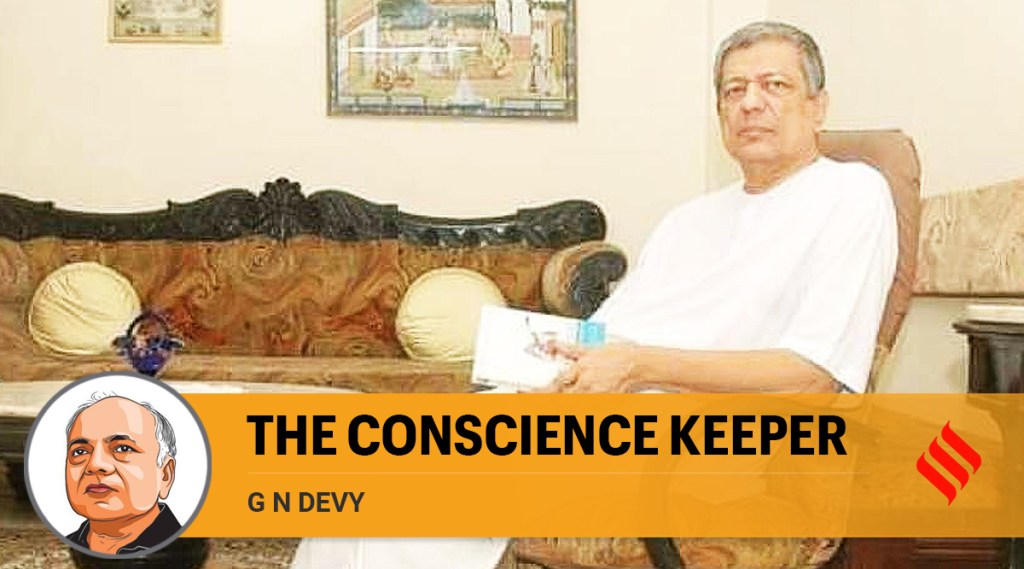 Throughout his life, J S Bandukwala continued to face fatwas from Muslim clerics and threats and harassment from Hindu fanatics.



 Share


