5 min readJan 8, 2026 01:24 PM IST
First published on: Jan 2, 2026 at 05:24 PM IST
The Islamic regime in Iran is experiencing its most significant nationwide protests since the 2022 “Woman, Life, Freedom” movement. The current unrest, which began in late December, was triggered by a severe economic crisis, but has rapidly expanded into a broader challenge to the clerical establishment. The protests were ignited by merchants in Tehran’s Grand Bazaar after the Iranian rial hit a record low of approximately 1.45 million rials per US dollar compared with 0.82 million rials a year ago. On the other hand, inflation has climbed above 40 per cent, leaving many Iranians unable to afford basic goods. According to many analysts and economists, this problem highlights the significant challenges faced by Bazaar traders who are unable to compete with rivals benefiting from state resources.
Since 1979 and even during the eight-year war with Iraq, the Bazaar’s ability to absorb economic shocks and find survival mechanisms helped the Iranian regime remain alive despite difficult situations. But now, due to an unprecedented economic failure, the Bazaar has abandoned its quietist stance in favour of active resistance against the regime.

Consequently, what started less than a week ago as gatherings by shopkeepers has now turned into open protests and nighttime confrontations with the security forces beyond the Bazaar. Historically, the Bazaar has played an important role in regime changes in Iran, from the Constitutional Revolution of 1906 to the overthrow of the Shah in 1979. Though it is too early to tell if the protests will lead to major change in Iran, what is certain is that this time, even the merchants who are not frequent protesters are calling for regime change. It looks like the Iranian regime is at a total impasse, characterised by severe economic crisis, international isolation, and an inability to manage domestic challenges. Strangely, though the Iranian regime maintains a coercive grip on power, the ruling establishment has become weaker and is more fragile than ever. While a major diplomatic impasse persists over Iran’s nuclear programme, Iran continues to struggle with the reinstatement of UN and stringent US sanctions. This pressure is coupled with the Iranian people anticipating new Israeli military actions, following the 12-day war of June 2025. If the US President Donald Trump decides to join the war against Iran, it will likely have higher casualties and cause greater destruction than the 12-day war. This could trigger a severe response from Tehran, especially because it maintains an arsenal of roughly 2,000 heavy ballistic missiles and has previously targeted US airbases in the Middle East. Yet, according to the Canadian journal, National Post, “the Israel Defense Forces is expediting preparations for a multi-front war with Iran in light of the internal unrest in the Islamic Republic.”
Iran is going through a period of profound “distortions” influenced directly by the fall of the Bashar al-Assad regime in Syria and the weakening of the key proxies of the Iranian regime, like Hezbollah and Hamas. As a result, the current regime’s ambitions for regional hegemony are inhibited by socio-economic, political, and generational crises. Let us not forget that a crisis of legitimacy of the Iranian regime in the eyes of the youth has weakened its ability to project a consistent hegemonic influence. The ongoing women-led protest within Iran has also shaped a serious threat to the hegemony of the rigid Islamic orthodoxy. Finally, in the past two decades, the Iranian regime has been out of touch with its citizens and has failed to meet their needs. A new generation has emerged within Iran, which is influenced by social media and global connectivity, leading to demands for personal freedom, secularisation, and the ability to dream of a different future. This new generation, born between 1997 and 2012, known in Persian as “Dahe Hashtadi” (those from the Eighties), has no direct memory of the Iranian Revolution or of the Pahlavi monarchy. Yet, they view the Pahlavi era as a “golden era” of modernisation and significant economic and social advancements, which was open to the outside world.
Today, these young Iranians blame their parents for having replaced the Shah’s regime with a clerical one, which is corrupt and incompetent. As such, the Islamic regime, nearly five decades in power, is the main cause of this paradigm shift in the minds and hearts of young Iranians. As a result, Iranian protests, including the recent ones from the Bazaar, frequently feature calls for the return of the Pahlavi dynasty, especially for the rise to power of the exiled Crown Prince Reza Pahlavi. Nowadays, the protests are more frequently accompanied by slogans like “Javid Shah” (Long live the Shah). While no one can precisely forecast the immediate future of the regime, one can describe Iran as being in a state of revolt. Whether the revolt in Iran will escalate into a full-scale revolution, this is the million-dollar question.
The writer is director, Mahatma Gandhi Centre for Nonviolence and Peace Studies, OP Jindal Global University

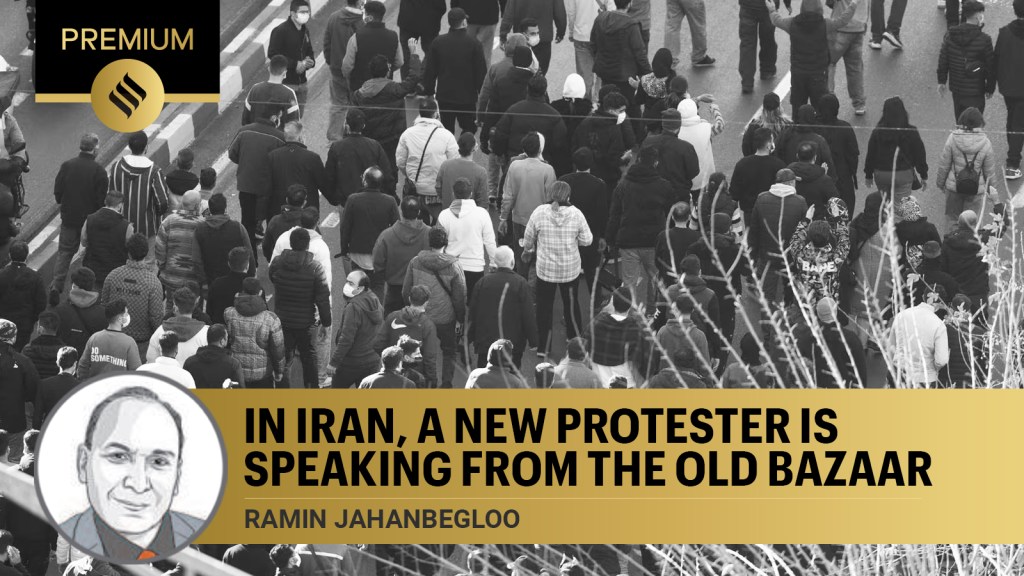 Merchants, shop owners and students across several cities in Iran have been demonstrating for days. (Fars News Agency via AP)


 Share


