US President Donald Trump’s telephone conversations with Kurdish leaders in the last few days have highlighted the role of minorities in shaping Iran’s political future. Media reports say Trump spoke with two influential Kurdish figures — Masoud Barzani and Bafel Talabani — operating in the borderlands between Iran and Iraq.
Kurds are the only large nationality in the Middle East without a state of their own. Kurdish geography — straddling Turkey, Syria, Iraq and Iran — has always cast a large shadow on the Middle East’s politics. Several Iranian Kurdish groups, operating from the adjoining autonomous Kurdistan Region of Iraq, have waged intermittent insurgencies against Tehran for decades. As the US-Iran conflict escalates, the Kurds insist on having a voice in any political rearrangement of Iran after the fall of the Islamic Republic.

This brings us to a question often debated in Israel and the US: Can Iran’s ethnic and sectarian divides be leveraged to produce regime change? Probing the internal contradictions of an adversary — its domestic cleavages as well as the fragility of its alliances — has been integral to strategy since antiquity. It remains central today in the contest between the US-Israel coalition and Iran.
Washington’s hope is that internal opposition can destroy the clerical regime from within as it comes under external military pressure. Tehran’s calculus is no different. It is betting that a regional escalation and rising costs for Arab allies will strain the US coalition and provoke political backlash at home.
By firing missiles and drones at Gulf cities and targeting American assets across Arab lands, Iran has sharpened domestic questions in the US about the wisdom of Trump’s war. It has also exposed the contradiction between Trump’s promise to end America’s wars and his decision to initiate a major conflict with Iran with no clear strategy for victory.
Can Washington do the same with Iran? That Iran is divided at home is not in doubt. Revolutions have rarely reconciled universalist rhetoric with internal diversity. The communist regimes in Russia and China — despite promises of equality and autonomy — struggled to accommodate their many nationalities, a tension still visible in Russia’s war in Ukraine and China’s policies in Xinjiang and Tibet.
A revolution grounded in religion might appear better placed to manage co-religionists who differ from the majority. Yet Iran’s 1979 Islamic Revolution, despite its claims to speak for all Muslims, has never fully secured the affections of its religious and ethnic minorities. Iran’s internal diversity is striking: Persians form about 60 per cent of the population; minorities include roughly 16 million Azeris, 8-10 million Kurds, around 3-4 million Arabs (many in oil-rich Khuzestan), 1.5-2 million Baluch, and several other smaller communities. Although Iran is predominantly Shia, it has, alongside Sunni Muslims, Christians, Zoroastrians and Bahá’ís.
These internal fissures — both ethnic and religious — have long been viewed by Iran’s adversaries as structural vulnerabilities. The strategic logic is straightforward: Empowering internal divisions is far less costly than invasion or occupation. Great powers — imperial and regional — have all been tempted by this logic. But its historical record is mixed; the persistence of the idea does not guarantee predictable outcomes.
Since 1979, the Islamic Republic has managed minorities through a combination of coercion and co-option. Economic neglect, cultural restrictions and securitisation have produced deep resentment — especially in Kurdish, Baluch and Arab-majority regions. Of all minority communities, the Kurds — comprising nearly 10 per cent of Iran’s population — remain the most politically active. Unsurprisingly, they figure prominently in the US and Israeli calculus on weakening Tehran. But the degree of resentment varies across Iran’s minorities. The Azeris, nearly 19 million strong and the largest non-Persian group, remain relatively well integrated in the Islamic Republic.
Iran’s minorities do not form a unified bloc. The regime’s internal repression has intensified radicalisation, but it has not generated mass separatism. Still, some in Washington and Tel Aviv sense opportunity. A strand of Israeli strategic thinking has long argued that Iran’s challenge is not only ideological. Its size, energy resources and national power potential make a unified Iran a formidable neighbour. A fragmented Iran, this view holds, would be easier to manage over the long term.
Critics counter that such schemes underestimate the strength of Iranian national identity. Iran is diverse, but its sense of nationhood runs deep. Talk of partitioning the country is profoundly offensive to Iranian nationalists who oppose the Islamic Republic. Minority leaders, meanwhile, remain wary of exiled figures like Reza Pahlavi, whom they see as centralising nationalists reluctant to accommodate genuine autonomy.
Washington confronts a similar dilemma. It has long viewed minorities as leverage, yet these communities lack a shared political vision. Kurdish aspirations differ sharply from those of the Baluch or Arabs; the Azeris are strongly invested in the Iranian state. This lack of coherence limits the utility of any minority-based strategy.
At the same time, there is no escaping an important regional reality — the growing fragmentation of the Greater Middle East. The writ of central authority has collapsed in Yemen, Libya, Syria and Sudan. Iraq and Lebanon remain deeply divided along sectarian and ethnic lines. Even the once-solid state structures of the Sahel — from Mali to Niger — are fraying. The region-wide pattern is one of competing pressures: Central governments struggling to preserve territorial integrity while religious, ethnic and tribal identities push for autonomy or dominance.
Nation-building across the post-colonial world has always wrestled with these twin imperatives: Centralisation for state-building, and accommodation of minorities for the widest possible political legitimacy. Only a few have managed the balance successfully. As the Islamic Republic now confronts an existential threat from the US-Israel attacks, Iran’s minorities will inevitably shape both the internal contest and the broader evolution of political modernisation in the Middle East.
The writer is contributing editor on international affairs for The Indian Express and is associated with the Institute of American Studies, Jindal Global University, and the Council on Strategic and Defence Studies, Delhi

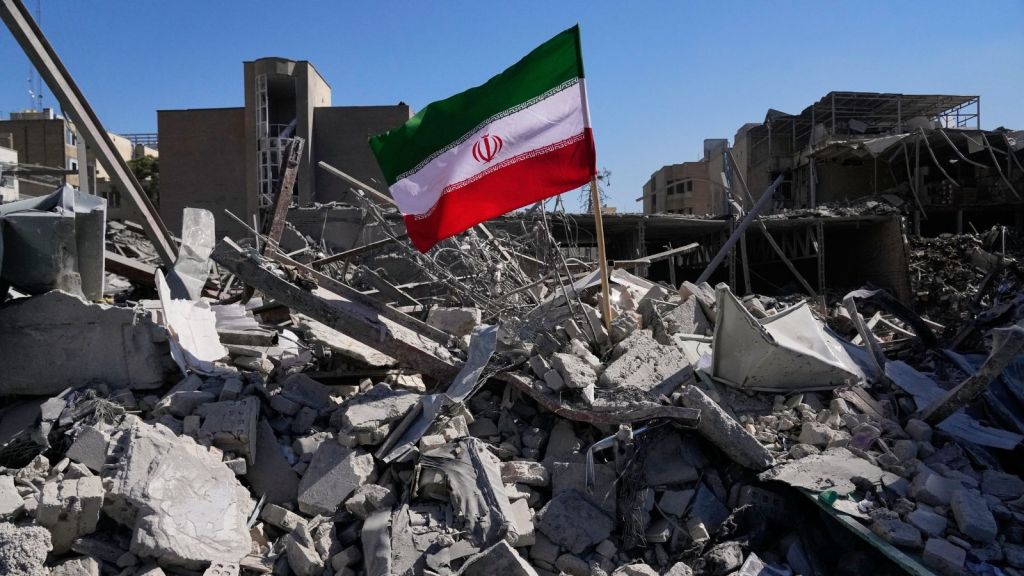 A strand of Israeli strategic thinking has long argued that Iran’s challenge is not only ideological. Its size and national power potential make a unified Iran a formidable neighbour. A fragmented Iran would be easier to manage. (AP/PTI)


 Share


