5 min readMay 30, 2021 07:32 PM IST
First published on: May 30, 2021 at 07:32 PM IST
Written by Sambridh Ghimire
The current situation in Nepal proves the adage, “power tends to corrupt, and absolute power corrupts absolutely”. President Bidya Bhandari has yet again dissolved the House of Representatives (HoR) on the recommendation of PM K P Sharma Oli and announced mid-term polls in two phases on November 12 and 19. This comes at a time when the nation is recording an average of 8,000 covid infections daily. This is the result of a year-old intra-party struggle within the Nepal Communist Party (NCP) which the Supreme Court disintegrated to its constituent parties — Unified Marxist Leninist (UML) and Maoist Centre (MC). Consequently, Oli could not win a vote of confidence and a faction of the UML — the Madhav Nepal faction — went on to support Deuba for the post of premier. There were overlaps in the claims presented by both the leaders, following which the President refused to allow the formation of a new government.

The nation, which had seen over 20 governments in the past 30 years, had pulled up its socks after the Constitution was promulgated. But it seems that the honeymoon period is over. This systemic failure is a result of years of dereliction, led by the country’s institutions.
The President and the prime minister bear the most significant responsibility for the current political stalemate. The provision dealing with dissolution in the Constitution of Nepal 2015 categorically states that it can only occur after all other constitutional government formation alternatives are frustrated. This was further strengthened by the recent verdict of parliament reinstatement and the Rajbiraj Bhandari case. The current case presents prima facie evidence to prove the circumvention of other alternatives and questions the President’s intention. First, the President granted 21 hours to the legislators to submit their claim to form the government. The intent and motive can be inferred as mala fide as there has been a practice of granting at least a week in the past. Second, without a thorough investigation, the President concluded that both the claims to form the government were unjustified.
The executive led by the prime minister has repeatedly acted beyond the constitution’s scope and undermined the legislature’s authority by recommending ordinances to circumvent it. Moreover, PM Oli should have vacated his position when he lost the vote of confidence on May 10. The reappointment of Oli as the prime minister under Art. 76(3) has no ethical, moral or political relevance. Ideally, the prime minister should have resigned. If not, the President ought to use her prudence and not reappoint the person who has lost the confidence of the HoR.
The country’s supreme court has time and time again dismissed the prime minister’s decisions — the unification of the UML and MC, dissolution of parliament and appointment of non-MPs as ministers. Ordinarily, this should evoke a realisation of a mistake but his actions do not appear to show repentance.
Experts have predicted that the third wave of Covid-19 is impending in South Asia. If this happens, Nepal too will be affected. At the time of ramping up health facilities and managing inoculation drives, should the prime minister announce snap polls?
But it would be unfair to pin the systemic failure of the nation on just the catalyst, as it requires a long and gradual decay of the institutions. In the case of Nepal, these include but are not limited to the legislature and judiciary. State organs which are created to safeguard democracy and ensure good governance have been responsible for anarchy and despair.
The legislature of Nepal has been infamous for its ineptitude since the 1990s. This ineptitude crept into the Constituent Assembly and the framers, due to their parochial attitude, impulsively drafted ambiguous provisions. Having experienced the perils of vague provisions in the 1990s, it ought to have been their obligation to envisage complex situations while drafting the constitution.
The perversion of the ’90s is still reverberating in parliament as the political parties have degraded to the point that they are forming alliances with the opposition parties in contravention of the democratic party system in Nepal. The culture of floor-crossing and horse-trading is flourishing.
Finally, the judiciary has witnessed all these events and has been a silent abettor to the current political turmoil. In the recent verdict on the reinstatement, the Supreme Court conveniently dismissed the role of the President in the matter of dissolution. This came when the President’s actions created a series of controversies in the nation by subduing the legislature and overpowering the executive. It is unpardonable that the judiciary turned a blind eye to such a critical perennial matter.
The future of a democracy depends on the vibrance and vigilance of its institutions. It is a tragedy that in Nepal, the institutions could not evolve themselves and were responsible for weakening the system rather than strengthening it.
The writer is a political analyst

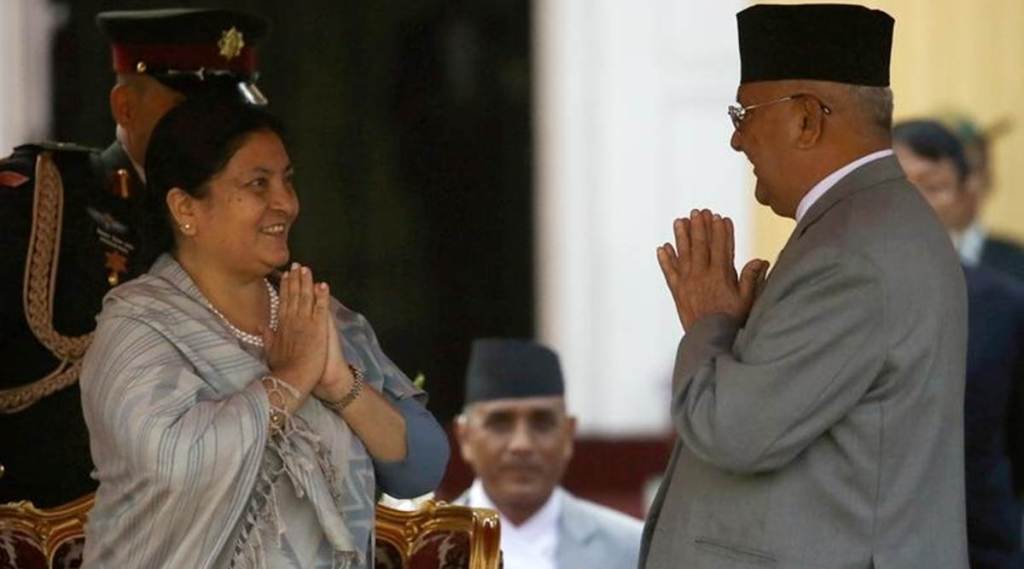 Nepal President Bidhya Devi Bhandari and Prime Minister K P Sharma Oli. (Reuters file)

 Share


