The release of new GDP data, always contentious, has again sparked a lively debate. Most prominently, former Finance Secretary Subhash Garg has asserted that the Ministry of Statistics and Programme Implementation (MoSPI), headed by Saurabh Garg, has vastly overstated growth by the simple expedient of reducing the previous year’s output. In response, MoSPI has argued that Subash Garg is comparing apples to oranges. Who is right? Consider our five-fold assessment.
1. MOSPI’s response is plausible on some technicalities. On the face of it, the MoSPI is certainly correct on the technicalities. Subhash Garg is comparing 2026-27 GDP numbers, calculated using the new base and the latest methodology, to 2025-26 numbers produced using the old base and previous methodology. This is indeed like comparing apples to oranges. If one applies the new methodology to both years, the real growth rate is indeed 7.8 percent. The MoSPI is also right that it is perfectly possible to have a small implied price increase: Value added deflators can indeed rise less than the CPI or WPI; in fact, they can even be negative (but, of course, only rarely, when input prices rise sharply relative to output prices).

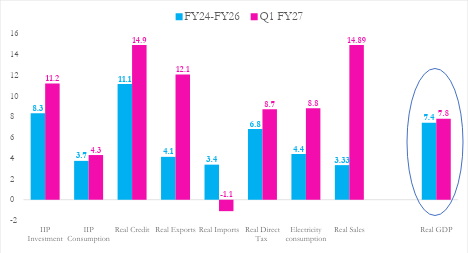
Perhaps more important than these technicalities, there are reasons to think that growth might actually have been good in the first quarter, even if the precise magnitude is open to question. As government spokesmen have pointed out, some of the macroeconomic indicators rose strongly during the period: Real sales growth of listed firms and real non-food credit growth both amounted to 14.9 percent, while real export growth reached 12.1 percent.
So, why all the controversy?
2. The government’s handling of data has created a fundamental trust deficit. The GDP numbers have been met with skepticism for quite some time now, ever since 2016-17, when the official data showed that growth accelerated to a dizzying 8.2 percent in a year when 86 per cent of cash was withdrawn. And the problems go well beyond GDP: The Census has been delayed, the 2017 consumption survey was withdrawn, the deaths from Covid were seriously understated, and exaggerated claims were made about open defecation. With this track record, the public seems to have replaced its traditional “trust-but-verify” attitude with a “doubt-but-remain-open” approach to the data. In other words, the burden of proof has passed to the government to demonstrate the integrity of its data.
It is precisely this trust deficit that explains why Garg’s criticism has touched a nerve. In particular, public doubts have been fuelled because the government has done little to dispel his allegation that backward revisions are aimed at boosting current growth rates. It has still not explained why the first quarter 2025-26 GDP was revised down by 7 per cent when the methodology was changed. Nor has it released a long back series that would explain when the loss of growth actually occurred; unusually, the government has not even announced the usual committee to calculate this series.
Moreover, although the MoSPI has addressed many of the problems with the previous GDP series, there are still known issues with the quarterly GDP numbers. The fundamental problem is that the MoSPI does not have good, timely information on unlisted firms or the informal economy, which together account for nearly 45 per cent of the overall economy. In the past, the MoSPI assumed that these two sectors performed about as well as the large listed companies. But as we documented in our Peterson Institute for International Economics working paper, this assumption has not been valid over the past decade. And the problem may have been acute in the first quarter because the energy shock disproportionately affected smaller enterprises.
3. The numbers seem decoupled from reality and economic reasoning. After all, April and May 2026 were months of shortages, when fuel was being rationed, thereby crimping travel and forcing businesses such as restaurants to purchase LPG cylinders on the black market or shut down entirely. And this was against a background of tepid wage growth, poor job creation, a sagging stock market, and a currency under intense pressure, all of which generated considerable unrest and anxiety amongst the young, reflected in the recent student protests.
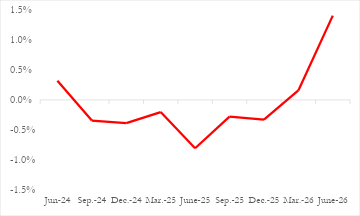
More broadly, it is difficult to understand how the economy could have done so well in the face of the energy shock. After all, when oil prices were falling a decade ago, commentators pointed out that this provided a huge windfall for the Indian economy, supercharging the economy’s growth. By the same token, the rise in energy costs effectively amounted to a tax increase of around 1.5 per cent of GDP, as Figure 1 shows. Without doubt, there were some offsetting factors, such as a fiscal stimulus and an increase in exports, but their impact would have been much smaller than the damage from the 32 per cent import price increase. That at least was the view of the RBI, which recently estimated that the economy had slowed in the first quarter.
Figure 1. Energy Shock, June 2024-June 2026
(Year-on-year percentage change in the price of Indian oil imports multiplied by the share of energy imports in GDP)
Sources: Ministry of Petroleum & Natural Gas and Ministry of Commerce.
Note: Energy imports comprise oil, natural gas and fertilisers.
In the circumstances, it would have been impressive if India had merely managed to sustain its growth rate. Yet the MoSPI goes well beyond this, stating that growth actually accelerated by almost 1 percentage point, comparing this quarter’s GDP growth with growth in the same quarter last year. By way of explanation, some commentators have pointed out that other Asian countries have done reasonably well. But Korea and Singapore are benefitting from the AI boom, while other countries are commodity exporters benefitting from higher prices, none of which applies to India. So, a convincing explanation is still elusive.
4. Rebuilding credibility. How can the government achieve this? The most urgent need is to provide a credible story, backed by economic research, to explain what caused the economy to accelerate amidst the energy troubles. This story should also address certain puzzles. If the economy was booming, why did nominal net GST revenue grow just 5 per cent, even allowing for the GST rate cuts? And why did import volumes fall? And how could the manufacturing deflator have been negative when RBI data show that business margins actually improved?
Beyond the urgent step of providing a credible story, the government should release the complete “Sources and Methods” document, which explains exactly how the GDP is calculated and, importantly, revised. This document certainly exists, as it serves as the internal handbook for compiling the national accounts, and it has always been released in the past. By making the MoSPI’s new methodology public, independent economists can discover how the numbers were derived and reassure the public that the data indeed make sense.
5. Acknowledging the past. As a final step, the government should be consistent in its claims. Right now, the government and its supporters argue in favour of the current numbers by pointing to the performance of a few co-incident macro-indicators, as mentioned above. By the same logic, the government could then acknowledge doubts about the 7-8 per cent growth in the previous 14 years.
Figure 2. Growth in GDP and Macro-Economic Indicators (percent)
(annual average for FY24-26)
Sources: MoSPI; RBI; and Ministry of Power.
Note: Real exports and imports refer to exports and imports of goods and services, respectively. Real sales are based on the performance of listed non-government non-financial companies. Real credit, real sales and real direct tax are nominal values deflated by core CPI.
For example, Figure 2 above compares these indicators for two periods: The current quarter and the previous three years, all based on the new methodology. If these indicators are cited to support the claim of GDP growth of 7.8 per cent for the latest quarter, how can a broadly similar GDP growth in the previous years be plausible when many of these indicators (notably sales, trade, electricity, investment) were so much weaker?
After all, what is sauce for the goose today is sauce for the gander over the past.
Anand is affiliated with the Madras Institute for Development Studies, Felman is with JH Consulting, and Subramanian is former chief economic advisor to the Government of India

 The GDP numbers have been met with skepticism for quite some time now, ever since 2016-17, when the official data showed that growth accelerated to a dizzying 8.2 percent in a year when 86 per cent of cash was withdrawn


 Share


