6 min readFeb 26, 2021 09:02 AM IST
First published on: Feb 26, 2021 at 04:40 AM IST
A great deal has already been written by Indian experts on the decision by the Indian Army and the People’s Liberation Army to “disengage” in Ladakh, starting from the vicinity of the Pangong Tso. Defence Minister Rajnath Singh stated in Parliament: “As a result of our well thought out approach and sustained talks with the Chinese side, we have now been able to reach an agreement on disengagement in the North and South Bank of the Pangong Lake.”
Many have doubted the sincerity of the Chinese and suggested that even if the PLA withdraws, Beijing will somehow manage to return through a “backdoor”. To trust China is undeniably difficult, which is why the minister spoke of withdrawing “in a phased, coordinated and verified manner.” After the Galwan incident on June 16 last year (on President Xi Jinping’s birthday) during which 20 Indian jawans and officers lost their lives, trust has been absent. With the prospect of new clashes looming large, both sides decided to “disengage”.

A few months ago, most analysts were convinced that the Chinese would never vacate the occupied areas. But several reasons compelled Beijing to change its stance as a continuation of the confrontation could have made the Communist “core” leader lose face further. Before we go into the change of mind of Chinese leadership, it is important to understand the political background in the Middle Kingdom.
The new emperor wants to project himself on the world stage as a man of peace. Addressing the World Economic Forum in Davos, Xi recently affirmed that “the misguided approach of antagonism and confrontation… will eventually hurt all countries’ interests and undermine everyone’s well-being”. He proclaimed that “the strong should not bully the weak… we should stay committed to international law and international rules, instead of seeking one’s own supremacy.” Was he speaking seriously? The Wall Street Journal sarcastically commented, “that admonition doesn’t seem to apply to his own government”. It was difficult for the Chinese president to sustain a war for a few hundred metres of territory in Ladakh by mobilising some 50,000 of his troops at an altitude above 4,500 m with glacial temperatures while promoting peace in the world.
In another recent speech, Xi mentioned his objectives — “time and momentum are on China’s side.” The new Great Helmsman believes in the “Great rejuvenation of the Chinese nation” led by the soon-to-be 100 years old Communist Party of China (CPC). He did, however, cite challenges such as the COVID-19 pandemic, supply chain disruptions, deteriorating relations with the West and a slowing economy. Xi’s objectives point to the Two Centenaries — the founding of the CPC in July 2021, before which a fully “moderately well-off” society will be achieved and the centenary of the founding of the People’s Republic of China in 2049, which will see a “strong, democratic, civilised, harmonious, and modern socialist country”. A war with India does not fit into Xi’s plans at this point.
Uncertainty is bound to continue in 2021 and probably beyond, but during the present crisis, India has found reliable and unwavering support from abroad (particularly from the US and France). This was also a factor that made Xi think twice before continuing the confrontation in Ladakh. He must also have been surprised by the firmness of the Indian government, which stuck to its guns and asked China to return to the pre-May 2020 positions.
The resilience and the innate strength of the Indian jawans who adapted far better than their Chinese counterparts to the climatic hardship must have shocked the Chinese leadership. Perhaps this is a reason for China’s medical casualties being much higher due to weather and high altitude.
Another shock for Beijing has been that the Indian Army has been deputed, through the Commander of the Leh-based 14 Corps, to conduct the negotiations. This is a first in post-Independence India. For most foreign service officers, negotiation is the art of compromise. A soldier knows far better than a diplomat how a few hundred meters in a mountainous area can be vital. The Indian military displayed patience, resolve and determination to return to the situation prevalent in April 2020. It should also be mentioned that in recent years, infrastructure development along the northern borders has got an unprecedented boost.
We also have to see the present disengagement in a historical context. Though it knew about the road being constructed by China in Indian Aksai Chin as early as 1952-53, the then government in Delhi kept quiet — that inaction put the country in an inextricable situation. On October 18, 1958, the Indian Foreign Secretary wrote an “informal” note to the Chinese Ambassador stating that it had come to Delhi’s notice that a road had been constructed by China “across the eastern part of the Ladakh region of the J&K State, which is part of India… the completion of which was announced in September 1957”. If Beijing had not announced the opening of the road, the information would have probably been kept secret for even longer by Delhi! To retrieve the situation from such an abyss requires patience, endurance and determination.
Hopefully, a first step has been taken. But utmost vigilance is the need of the hour.
This article first appeared in the print edition on February 26, 2021 under the title ‘A reason to disengage’. The writer, based in South India for the past 46 years, writes on India, China, Tibet and Indo-French relations.

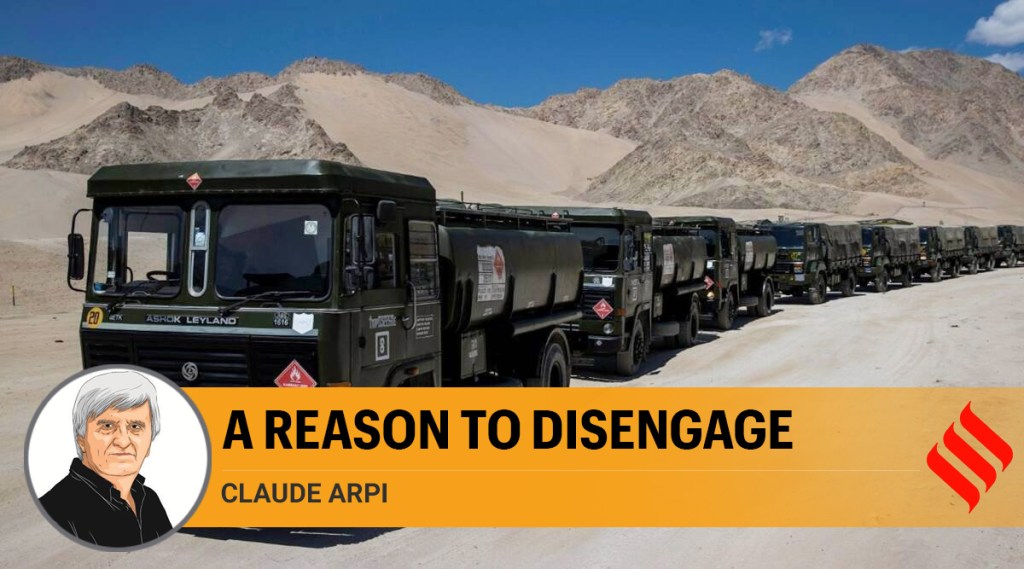 A convoy of Indian Army vehicles move towards Ladakh (File Photo)


 Share


