7 min readJan 1, 2023 06:00 PM IST
First published on: Jan 1, 2023 at 06:00 PM IST
What will India’s collective self look like in the mirror of the near future? Any analysis of the politics of the present moment — of today and tomorrow — needs to be anchored in this difficult question. The answer to it hinges on what India has become today. After eight years of the BJP’s single-party dominance, politics is at a crossroads: It can cling to the remnants of a nearly-demolished democratic spirit or slip into the abyss of more explicit authoritarianism. If the latter happens, we shall have transformed not just in politics but in identity too. Such a transformation represents no less than a hegemonic project that is still unfolding. Election outcomes and the shape of party competition, crucial as they are, should also be located in this larger inquiry. Let us, therefore, attempt to look not only at 2024 but a little beyond that; and not only at elections but much beyond that.
Two interlinked processes are shaping today. One is taking place in the arena of competitive politics and is marked by the rise of the “second dominant party system”. The other is in the realm of politics of normative contestations. The single-party dominance that the BJP has achieved is vulnerable at the state level. There are states where this dominance has so far failed to make its mark. The BJP is also vulnerable in its exclusive dependence on a single leader who needs to toil for local body elections as hard as the parliamentary elections. Similarly, the hegemony that marks the public domain is earned and retained through a complex and frail process. It is ideologically weak and thrives on distortions, manipulations and intellectually inadequate cribbing over victimhood and whataboutery.

Not surprisingly, the current hegemony and single-party dominance are coupled with crass repression by the state and by state-approved vigilantism of private actors. In coming years, the BJP might retain its hold on formal power and competitive politics. It may also successfully stabilise the current distortion of public culture. But its reliance on repression and celebration of masculine militarism against the citizenry will continue.
During its second term, the current regime has made concerted efforts to undermine constitutional democracy but even before that, the process of hollowing the various institutions had begun. While constitutional bodies like the judiciary or the Election Commission have been tamed or threatened, the most abject surrender facilitating an authoritarian turn of governance has been by the bureaucracy and investigating agencies. So much so that these two have become partners of the political establishment in the crime against democracy.
In this overall context, irrespective of electoral outcomes, we are bound to witness a further weakening of the liberal norm. It is true that all parties, when they acquire power, adopt a statist approach bordering on disguised authoritarianism either in the legal instruments they create or in the application of existing ones. Yet, the present moment must be distinguished from this more general tendency. The current regime is inherently antagonistic to the liberal norm. The liberal norm and majoritarianism are at odds and the latter is at the heart of the current regime’s ideological project. This dichotomy pitches today’s regime against all dimensions of the liberal ethic.
Today, the acceptability of majoritarianism is linked to the nature of religious identity. Instead of a move from ritual practices to joyful festivities, each religious event is pulled back into the vortex of public performance of rituals and their linkage to religiosity and national pride. These developments have implications for how the project of evolving a political community necessary for democracy is undermined. This is happening through four processes.
One, ever since the Ayodhya controversy was stoked in the late Eighties, Muslims are reminded of being Muslims rather than Indians. In a sense, a conservative Muslim-ness is forced upon the community through its isolation and now its conversion into second-class citizenry. To a lesser extent, this happens in the case of Christians as well. Two, through the onslaught of public display of religiosity, Hindus are persuaded to become more Hindu in a superficial sense. That is where the discourse of Hindutva has been very successful. Three, as a corollary, the plural nature of Hinduism is pushed aside in favour of a more pan-Indian, homogenised idea of Hinduism.
As a result, the fourth process: The space for cultural intermixing in the social realm shrinks just as the space for cultural contestations and politics of culture in the party arena almost disappears. This is where we come back to the idea of a dominant party system. It is not so much about electoral expansion as it is about the ability of the dominant party to determine what will be the ideological contours of political competition. The idea of the middle ground of politics has been changing. Today, the BJP is poised to force not just the style and language of politics but also the substance of politics onto its opponents and once that exercise is complete, the transformation of India from an imagined constitutional democracy to a majoritarian regime will be complete.
How long will this transformation take? In 2019, by allowing the BJP to win big, the non-BJP parties facilitated a major step in this direction. In 2024, the BJP would expect to take the final step in changing the idea that defines India. In this sense, elections will determine the image of India in the mirror of the future: With each day the present regime enjoys formal and cultural power, the decimation of the constitutional project and distortion of India’s collective self will come closer. This underscores the urgency of confronting the second dominant party system on two fronts. One is a mundane exercise of weakening the electoral prowess of the current regime. The arrogance of the present power machine, from top to bottom, may contribute to this exercise. The other is the rebuilding of the constitutional imagination with something almost unique to India — entwining diversity with the idea of democracy. This will automatically strengthen the liberal spirit. These efforts may prolong the fruition of the hegemonic project that is currently underway. This is where the innate tradition of accommodation and coexistence may prove valuable.
As the BJP’s power saturates in some parts and remains vulnerable in many others, one may expect an open political battlefield but the core issue is: Both during electoral battle and after that, in the course of routine politics, will non-BJP parties have an agenda of protecting the democratic promise we once held? Can we, as Indians, look up straight in the face of our future image?
The writer, based in Pune, taught political science and is chief editor of Studies in Indian Politics

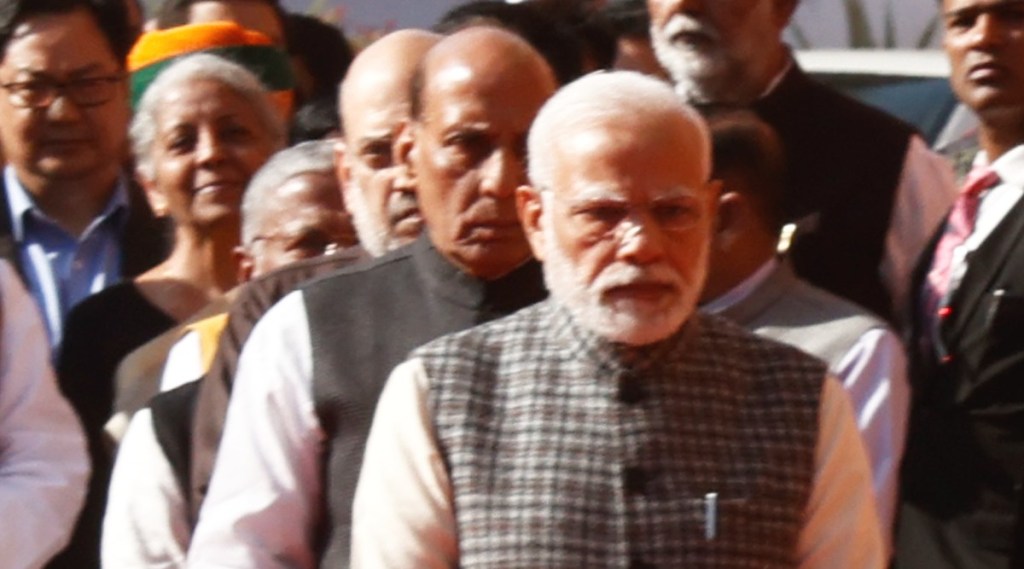 Prime Minister Narendra Modi and others cabinet ministers during pay tribute to Martyers of 2001 parliament attack at the Parliament house during Winter session in New Delhi. (Express photo by Prem Nath Pandey)

 Share


