6 min readOct 12, 2022 08:57 AM IST
First published on: Oct 12, 2022 at 04:00 AM IST
Eighteen years ago, a team of writers prepared a lesson titled “Cast Out Caste” for students aged 13-14 in a series called ‘Living in Harmony’ (OUP ) pegged on translated excerpts from Dalit autobiographies by Omprakash Valmiki’s Jhootan and Bama’s Karukku. It was the first exposure millions of non-Dalit school-goers had to the outrage of casteism. The unit has since been expanded, as has its message. In the same series, a lesson for students aged 8-9 years ran a translated legend about an old woman who served buttermilk at the site of the Brihadeshwara temple. Three years later, a teacher shared an anecdote: One of her students had asked his parents to distribute buttermilk to the workers at their apartment. This is language, translation and values at work. I would plead for space in our educational plans for both Values Education and Translation.
Social justice and gender equality are not just nice terms. They have to be taught, imbibed and lived as early as possible. Translation holds hands with science, philosophy, medicine, sociology, religion, and gender and caste studies and militates against homogenisation and promotion of any single ideology, value system or agenda. Translated texts also silently open doors to different experiences and sensitise readers to experiences, feelings and situations completely different from their own.

Languages are intimately linked with the culture and history of the region of their origin and are the most private and yet most public of things. Luminous thoughts that inspire people to a better life are expressed through this medium as are malign campaigns that can bring whole civilisations to the brink. Convoluted rules that can remote-control and shackle for life, or words that can empower and sustain a movement for generations — both are facilitated by language. How can we harness this force and build a better India over the next quarter century?
Increased globalisation and immigration have made people aware of cultural differences, which, a century ago did not matter much because we did not have to engage with them as much as we need to today. Since we all live in translational cultures, when words like “global citizen” are used in almost every context, isn’t the understanding of what it really means to be equipped for global dialogue missing? Everywhere in the world moral monism is working against cultural pluralism with a steep rise in intolerance and an addiction to indignation pervading the metaspace.
While education for international understanding (EIU) has its place, we urgently need a programme of education for national understanding because local ignorance about ourselves and our country is astounding. Even most educated people have no idea of the most urgent social issues facing the nation because they have never been trained to look beyond their personal needs or comfort zones. Worse, they have been raised to feel that this is the way things are meant to be. So, we have a dangerous combination of indifference to people different from ourselves, and a conviction that in order to win someone else has to lose. This can and should be altered by training teachers committed to the promotion of peace and equality to hold value education classes through translated works.
Nearly every day a student harms a friend over a mobile, and recently a teenager murdered his mother because she refused to fund his gaming. Yet, amazingly, Values Education is not recognised as integral to Indian schooling. There is next to nothing in our educational system that emphasises looking inward to look beyond the self. The pattern of schooling focuses fiercely on the material world and neglects the intangible aspects of our socio-culture, something which has to change if we don’t want to unwittingly sell our souls to the supermarket or fall into amnesia about our past. Translation and values link us to our historical DNA. There are heated discussions about what our culture was or should be but no plans to introduce either school or university students to the finest accounts of Indian life that lie in thousands of autobiographies, plays, novels and poetry. Even as we struggle to move our writers into English, the silences between adjacent linguistic regions in India are remarkable and many an Indian cannot read his or her mother tongue. At one time, we might have blamed our colonial rulers who silenced Indian voices and in their place synthesised something for their needs, but now there is only us: We both create and receive the products of our civilisation.
In our age of the unthinkable about to happen and with new world disorders enveloping us, we need another renaissance to save the world from ourselves. Although literature may not bring about sudden social change it can illuminate aspects of our lives that are not addressed by politics and economics. “India” as she is captured in books either directly in English or indirectly in English-language translations is one of the strongest expressions of our emotionally complex lives. It is this ideal that despite our diversity has held us together as a democratic nation for 75 years.
For those who are concerned about India’s stability 25 years from today, I suggest we invest in two things for which we have rich resources: Translation into and out of Indian languages and ethics education in schools and colleges. India at 100 can be a reality if we focus on soft powers: The language of peace, and our multilinguality.
The writer was Editor, Translations, at Oxford University Press and Macmillan India and currently co-ordinates a project of translations for the Tamil Nadu Textbook & Educational Services Corporation. This article is part of an ongoing series, which began on August 15, by women who have made a mark, across sectors

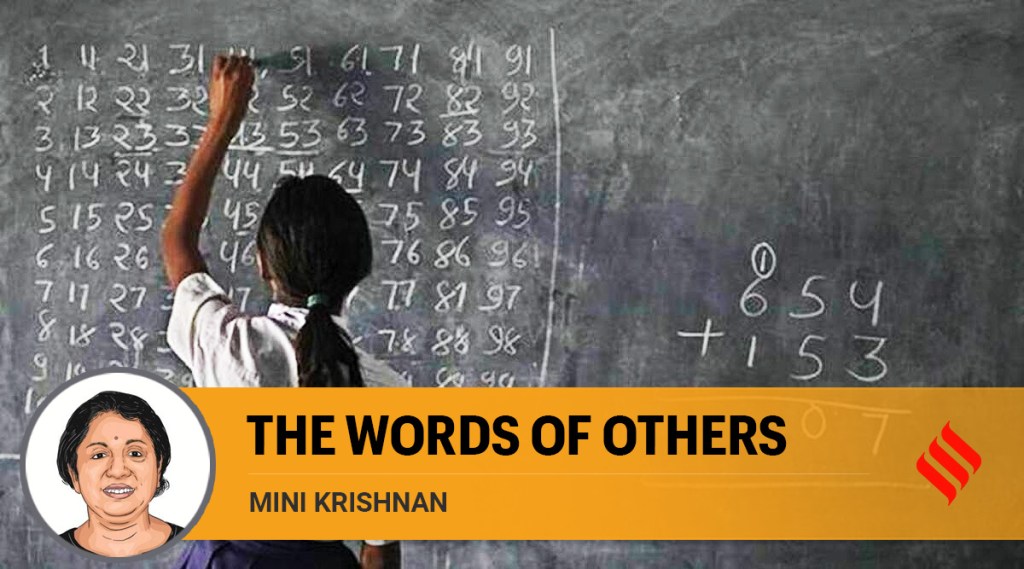 While education for international understanding (EIU) has its place, we urgently need a programme of education for national understanding because local ignorance about ourselves and our country is astounding.


 Share


