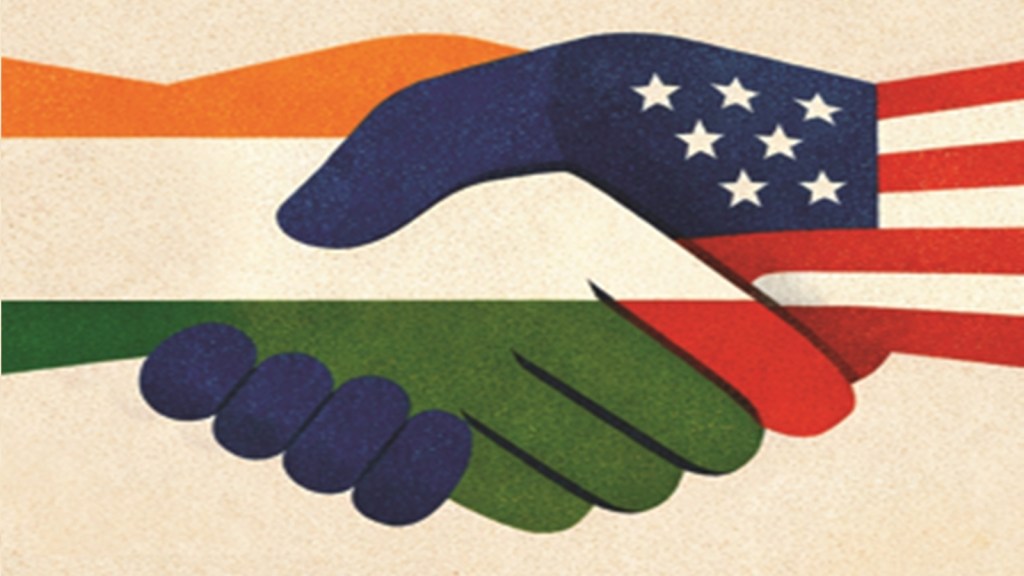
The United States has taken one more step in its ongoing campaign to punish India for asserting her national interest in the pursuit of economic development. The United States Congress has voted overwhelmingly in favour of the Lindsey O Graham Sanctioning Russia and Iran Act 2026. This authorises the US President to impose tariffs of up to 100 per cent on goods from the five largest purchasers of Russian oil and gas, namely, China, India, Slovakia, Hungary and Azerbaijan. America’s European allies have been exempted on the pretext that they are trying to reduce their consumption of Russian energy. President Donald Trump now has the power to act. He will probably use this weapon to strike a range of deals with the five countries before, in fact, utilising his power in full.
President Trump began taking economic actions against India in 2017 when he ended the Generalised System of Preferences (GSP) and began increasing tariffs on a range of commodities and products. That process went through its ups and downs but there has been no retreat. Actions taken against India have remained in place. Some threatened actions have not yet been taken but not called off either. Pressure on India to stop oil imports from Venezuela was ended after the US staged a coup and changed the regime in that country. Now India is being asked to buy Venezuelan oil.

While some of Trump’s geopolitical initiatives have unsettled New Delhi, with his hosting of the Pakistani Field Marshal for lunch at the White House constituting the nadir, it is the geoeconomic sanctions that will really have a long-term impact on the relationship.
In this context, some analysts have suggested a “de-Americanisation” of Indian foreign policy. To an extent this has already happened. India’s impressive hosting of the BRICS Summit, with both China’s Xi Jinping and Russia’s Vladimir Putin in attendance, was certainly a message to Western critics of the group. However, there are objective limits to “de-Americanisation” set by economic and business links.
The fact is that the US remains an important market for Indian exports of goods and services. The people-to-people and business-to-business connection is strong and enduring, though it is entirely possible for state-to-state relations to deteriorate despite robust people and business links. The US, in this regard, is in a league of its own, with large sections of the Indian power elite emigrating to the US.
The defence relationship, too, has become important, but India has options. The growing defence partnership with countries like France, Japan, Britain, Sweden and other European countries, as well as India’s atmanirbharata in defence policy, can help reduce India’s dependence not just on the US but also Russia and Israel. What is entirely possible is the ending of any “strategic” dependence on the US that may have been thought of after the signing of the US-India Civil Nuclear Agreement. That dependence was built on a new sense of trust that we owe to the leadership of President George Bush. With President Trump, trust is gone.
Consider, as an aside, the relationship between the US and China. It is a relationship bereft of trust but economic links keep it going, even after it has become more adversarial. In 2017, Trump entered office declaring that he would “decouple” the US economy from China. On Labour Day in September 2020, Trump declared from the White House: “So when you mention the word ‘decouple’, it’s an interesting word. So we lose billions of dollars, and if we didn’t do business with them, we wouldn’t lose billions of dollars. It’s called ‘decoupling’. So you’ll start thinking about it. You’ll start thinking.”
The idea was quickly picked up by President Joe Biden and a bipartisan consensus seemed to be building in favour of “decoupling”. The Washington DC think-tank and policy circuit went into high gear theorising and estimating the costs of “decoupling”, till Biden’s own administration officials realised that decoupling was a fantasy. “The US will assert ourselves when our vital interests are at stake. But we do not seek to ‘decouple’ our economy from China’s,” cautioned Janet Yellen, then US treasury secretary, adding, “A full separation of our economies would be disastrous for both countries. It would be destabilising for the rest of the world.”
Yellen’s caution was followed up by a clearer statement by the US national security advisor, Jake Sullivan. In a lecture delivered a week later, on April 27, 2023, at the influential Washington DC think tank, Brookings Institution, Sullivan ended a long and substantial address on US economic strategy aimed at reviving and revitalising the US economy, reasserting US global economic leadership, and so on, with the categorical statement: “We are for de-risking and diversifying, not decoupling” from China.
Indeed, that is precisely what India has been trying to do with respect to all her external dependencies — defence, energy, trade and manpower. Over the past year, the Indian strategy has been one of “de-risking” from the United States. The US seeks to de-risk from China. India has to de-risk from both China and the US.
In the foreseeable future, India will have to deal with the twin challenge of managing one major power in decline and another major power on the rise. Few countries have been in this situation before. When the US was rising and Britain was declining, the rest of the world was still dealing with a “hegemonic West”. A rising US did seek to aggressively displace Britain, creating international institutions in which it ensured its own domination, but the declining power could only flail and retreat.
The 21st-century US is no 20th-century Britain. It will continue to assert its dominance — military, technological and economic. However, the world, too, has changed. Countries like China, Russia, India, Brazil, South Africa, Iran and indeed, even the European Union, Japan and Southeast Asian nations will defend their interests and territories. All of them will certainly seek to de-risk from the US. Some, like India, will also seek to de-risk from China. But none of them can afford to decouple from either.
The writer is chairman of the board of trustees, Forum for National Security Studies, and Centre for Aerospace & Strategic Studies

 The 21st-century US is no 20th-century Britain. It will continue to assert its dominance — military, technological and economic. However, the world, too, has changed.


 Share


