In his recent book titled The Indian Way (HarperCollins, 2020), Foreign Minister S Jaishankar, wrote: “It is time for us to engage America, manage China, cultivate Europe, reassure Russia, bring Japan into play, draw neighbours in, extend the neighbourhood and expand traditional constituencies of support.”
This approach of international and regional relations fitted in his view of “plurilateralism”, which relied, in particular, on the will to partner with countries that were not partners themselves: “If India drove the revived Quad arrangement, it also took membership of the Shanghai Cooperation Organisation. A longstanding trilateral with Russia and China now coexists with one involving the US and Japan”. Jaishankar defined this strategy as “a parallel pursuit of multiple priorities, some of whom could be contradictory” and ridiculed those who did not understand that Indian initiatives that seemed unnatural were the hallmark of the new “Indian way”.

“To the uninitiated or the anachronistic, the pursuit of apparently contradictory approaches may seem baffling. How does one reconcile a Howdy Modi gathering (the Houston rally where Modi campaigned for Trump in 2019) with a Mamallapuram (named after the small town where Modi met with Xi Jinping also in 2019) or a Vladivostok Summit? Or the RIC (Russia-India-China) with JAI (Japan-America-India)? Or the Quad and the SCO (Shanghai Cooperation Organisation)? An Iran with the Saudis, or Israel with Palestine? The answer is in the willingness to look beyond dogma and enter the real world of convergences. Think of it as calculus, not just as arithmetic.”
Regarding India’s region, Jaishankar recalled the priority of South Asia — reflected in the motto “Neighbourhood First” — and presented India as the country that can “rebuild a fractured region” through the “wisdom of treating its prosperity as a lifting tide for the entire region”.
How far is this diplomatic strategy tenable in the context of the present crisis in Afghanistan — a SAARC country — that was a friend of India for 20 years? New Delhi has not been able to play a major role in the transition that was in the pipeline for months in Afghanistan, as evident from the fact that India was kept out of the Doha talks (in which the Americans participated) and the Moscow talks (orchestrated by the Russians). While the Russians probably did not want to invite India because of its growing ties with the US, the fact that the Indians were not invited to Doha is more difficult to explain. Did the other participants in the negotiations — including the Americans — give in to Pakistani pressure? Did they consider India as the second fiddle? After all, the US had asked India to become more involved in Afghanistan — including militarily.
Beyond these regional considerations, it seems that “plurilateralism” is not feasible anymore as two blocks are crystallising on the occasion of the Afghan crisis. Russia is prepared to recognise the Taliban, provided they do not destabilise the countries bordering it in the South.
China, which — in contrast to India — shares a border with Afghanistan, has said it is willing to hold talks with the Taliban too. The latter could let the Middle Kingdom exploit its vast natural resources — including a copper mine that the Chinese already own — and help it develop the Belt and Road Initiative in Central Asia. Iran, where India had invested considerable sums to develop a deep-water port at Chabahar to access Afghanistan while bypassing Pakistan, also said it was ready to deal with the Taliban.
Tehran has already played middle-man between the Taliban and Kabul and has been moving closer to China while distancing itself from India since New Delhi yielded to pressure from Donald Trump and decided to adhere to American sanctions. Pakistan — which is helping the Taliban without necessarily controlling them — is part of this coalition too.
In this context, can India continue to play a regional role on its Western side and remain equidistant vis-à-vis Russia, China and the US? Certainly, Indian observers have criticised the Americans for having exposed them to a new Islamist threat by leaving Afghanistan in such a hurry.
However, these temporary tensions should not call into question India’s growing ties with the West. On the contrary, this process is likely to accelerate as the Taliban are increasingly finding support in Pakistan and China. All the more so, as Pakistan, which for decades offered a point of support to the Americans in their fight against communism and then Islamism, has probably taken a decisive step in distancing itself from the West when Prime Minister Imran Khan rejoiced to see Afghanistan “breaking chains of slavery” after the Taliban’s victory.
Thus, South Asia may become a tinderbox in which two new antagonistic blocs might be salient, and where, as a result, the ingredients of a new Cold War could gather against the backdrop of “Belt and Road Initiative vs. Indo-Pacific”. During the first Cold War, India remained non-aligned.
This time, the country may turn to the West more willingly if it feels directly threatened. Will it become a pivotal state and play vis-a-vis China the role Pakistan played vis-à-vis the Soviet Union for the US? Will Washington use its leverage to put pressure on India in domains like trade and human rights? Will it, on the contrary, consider that it needs India so much vis-à-vis China and Russia that it should abstain from interfering with India’s domestic politics? It will take years for the terms of this debate to be clarified, but 2021 has accelerated geopolitical trends that make “plurilateralism” the Indian way a remote prospect.
This column first appeared in the print edition on August 26, 2021 under the title ‘Plurilateral challenge’. The writer is senior research fellow at CERI-Sciences Po/CNRS, Paris, professor of Indian politics and sociology at King’s India Institute, London

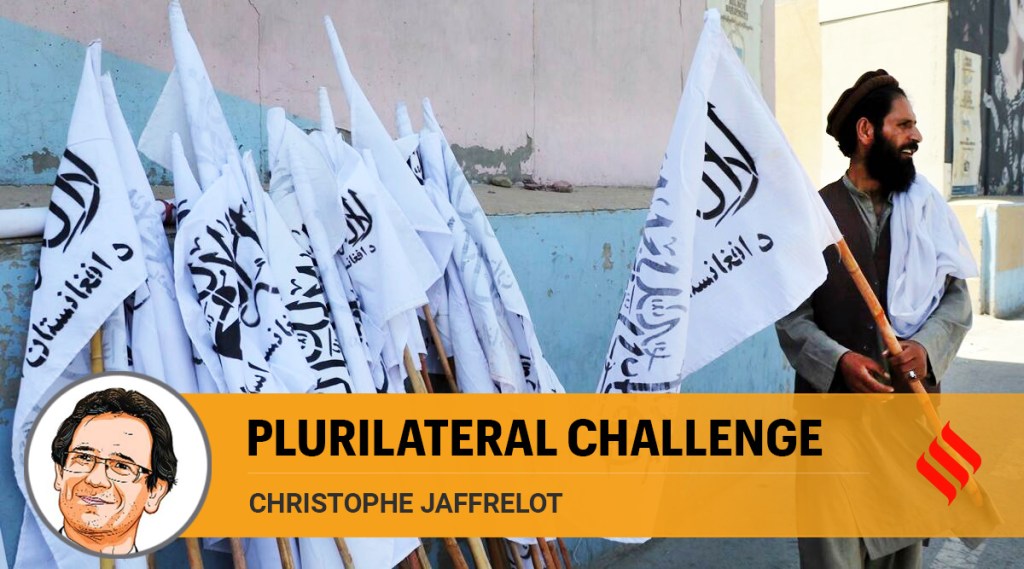 An Afghan holds a Taliban flag in Kabul (AP)



 Share


