The fallout has paralysed the South Asian Association for Regional Cooperation (SAARC) and disrupted economic integration in a region home to 1.8 billion people and 27 per cent of the world’s poor. Compared to the EU or ASEAN, South Asia is one of the world’s least integrated regions, with intra-regional trade accounting for under 5 per cent of these countries’ total trade with the world. Even before the latest conflict, trade ties were fragile, notably between India and Pakistan, whose official bilateral trade plunged from nearly $2.5 billion in 2018 to about $1.2 billion in 2024.

The recent crisis has driven this figure effectively to zero as both cut off all remaining trade (including transit and third-country re-exports). This sudden freeze shrinks overall SAARC trade volumes, given that India-Pakistan exchanges, however limited, are also part of the $23 billion intra-SAARC trade, which remains far below an estimated $67 billion potential, according to the World Bank. Other bilateral trade flows (India-Bangladesh, India-Nepal, etc.) continue, but the conflict has injected caution and disruptions region-wide. In short, a region already trading much below its capacity is seeing a further contraction in internal trade.
The last SAARC summit was held in 2014, and the 2016 summit in Islamabad was cancelled after the Uri attack, as India and some other members pulled out. Since then, no summit has taken place, and the organisation has remained inactive. A major reason for this deadlock is that all decisions must be unanimous. This allows any disagreement, especially between India and Pakistan, to block progress for the whole group. Despite SAFTA launching 19 years ago to boost trade, intra-SAARC trade stayed under 5 per cent. In comparison, ASEAN reached about 25 per cent.
This low trade is due to high tariffs, long sensitive goods lists, and a lack of trust. ASEAN succeeds because it allows flexible cooperation, but SAARC lacks that option. As a result, over one-third of regional trade is excluded from tariff benefits. In response to SAARC’s dysfunctionality, India has been promoting BIMSTEC as an alternative, excluding Pakistan and aligning with its “Act East” policy. Though this move intends to avoid political obstacles, it also weakens regional unity, as not all South Asian nations are its members.
Following the terrorist attack in Kashmir in April, Indo-Pak formal trade has collapsed or, in some cases, remains uncertain and disturbed. For instance, India has imposed a blanket ban on all goods from Pakistan, effectively halting bilateral trade. Similarly, due to the ban on routes, logistics networks are paralysed, and informal trade across Punjab and Kashmir has ceased. Consequently, the once-symbolic Wagah-Atari route is now under military oversight.
Yet besides India and Pakistan, smaller neighbours also risk facing serious fallout due to their dependence on regional stability. In Bangladesh, disrupted supply chains and waning investor confidence threaten the export-led economy, especially in garments and pharmaceuticals. India has already banned RMG garment imports of Bangladesh via land routes.
For landlocked Nepal, disruption of Indian transit routes would choke off essential imports such as fuel, medicine, and building materials. A prolonged crisis would deter foreign investment and derail infrastructure plans. Though Nepal will continue balancing ties with India and China, the unresolved border issues make it prone to Indian pressure. This is especially significant given that many Nepalis work in India. India’s ban on transit through Pakistan also blocks Afghan produce from reaching the Indian market. Overall, roughly $640 million per year worth of Afghanistan’s fruits, nuts, and other agricultural exports can no longer travel via the Wagah border.
While the India-Pakistan conflict may appear localised, in a globalised world, no economy is immune. Similarly, neighbouring countries, often seen as peripheral, are in fact active strategic players that are often impacted by the historically rooted conflict. If this rivalry continues to seep into the region, neighbouring countries will possibly have to abandon SAARC and recalibrate their foreign policies to look beyond South Asia for trade, investment, and economic cooperation.
Regionally, South Asia cannot thrive without collective leadership, cross-border trade, and people-to-people exchanges. Although Article 10 of the SAARC charter prohibits raising bilateral disputes, the Indo-Pak conflict casts a long shadow over the forum. For South Asians, they will continue to be deprived of the economic and other benefits that they so rightfully deserve.
The writer is Senior Director of the international think tank IPAG India, which also has a presence in Dhaka, Melbourne, Dubai and Vienna

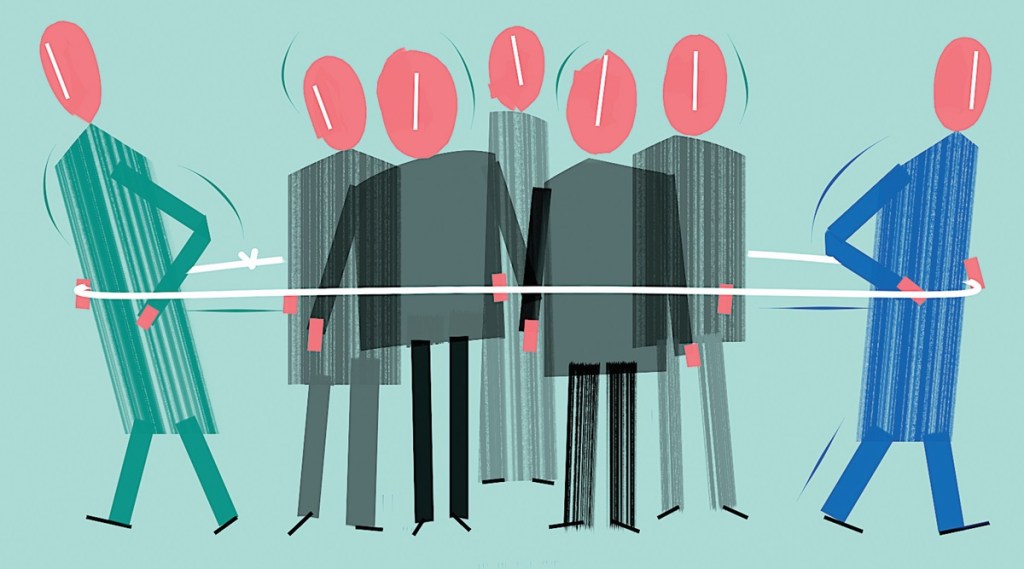 While the India-Pakistan conflict may appear localised, in a globalised world, no economy is immune. (Illustration by C R Sasikumar)


 Share


