5 min readJul 10, 2024 03:49 PM IST
First published on: Jul 8, 2024 at 07:29 AM IST
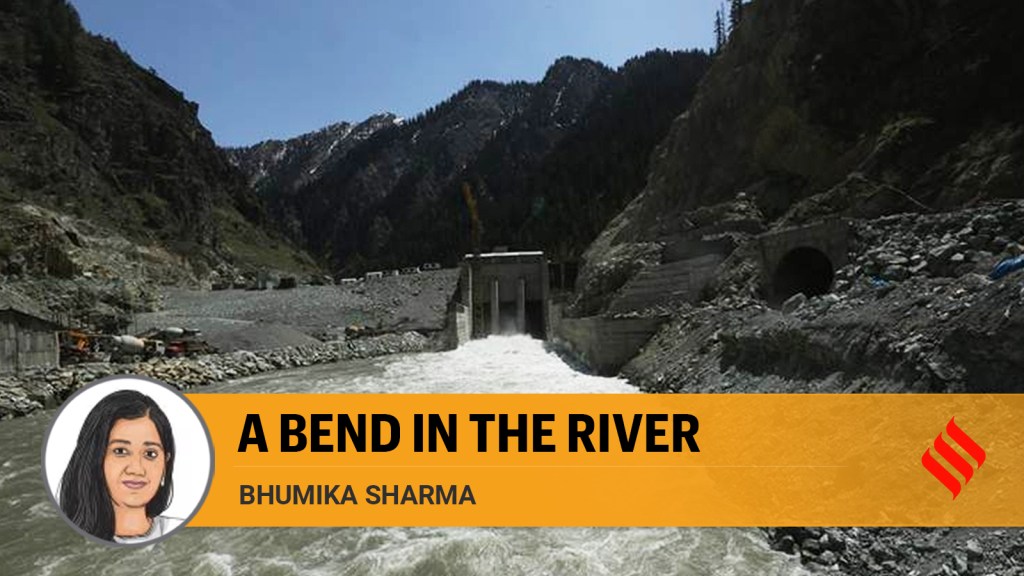
The 1960 Indus Waters Treaty (IWT), facilitated by the World Bank, is a landmark transboundary water-sharing mechanism between India and Pakistan. But disagreements persist. In an unprecedented move, India called for amendments to the agreement last year due to its dissatisfaction with the dispute resolution process. It blamed Pakistan’s continued “intransigence” in implementing the treaty — particularly its material breach. Pakistan sought arbitration at The Hague for resolution of its differences and objections over India’s Kishenganga and Ratle hydroelectric projects, bypassing the treaty-compliant Neutral Expert proceedings.
Changing realities such as climate change also fuel the need for amending the treaty. In 2015, the Indus basin was ranked by NASA as the world’s second most over-stressed aquifer. An estimated 31 per cent of the net basin flow originates from climate-impacted glaciers and snow melts, making mean annual flows more volatile and seasonal. Other factors like unpredictable monsoons also contribute to increased variability of flow volume.

Irrigation and cultivation in the Indus plains are central to both economies. The Indus is responsible for over 90 per cent of Pakistan’s agricultural output and accounts for 25 per cent of the GDP. Given the ballooning population and corresponding consumption, deteriorating water quality poses an additional threat to food and nutritional security, human health and biodiversity.
Contentions within the framework of the IWT mostly revolve around the perceived impacts of infrastructure development on downstream flows, and Pakistan’s concerns as a lower riparian state. Matters are exacerbated by the massive trust deficit between the two neighbours. A recent case in point is Pakistan’s accusation of “water terrorism” against India for the Shahpurkandi barrage project. But Ravi’s water-flow from India into Pakistan is not substantial in the first place, and the dam would streamline the river’s flow — as legally permitted within the IWT — to support power supply and agricultural growth in Punjab and Jammu & Kashmir.
The politics of “upper vs lower riparian” goes beyond transboundary river governance, stirring inter-provincial tensions even within Pakistan, with Punjab and Sind having a longstanding history of conflict.
There is a need to go beyond this insular approach — a simplistic partitioning of the Indus river system — and to look at the basin as a cohesive geographical unit for the benefit of all stakeholders.
Firstly, it is pertinent to integrate an ecological perspective into the governance framework of the treaty. This includes institutionalising the adoption, allocation and implementation of Environmental Flows (EF) within the IWT. According to the Brisbane Declaration and Global Action Agenda on Environmental Flows (2018), EFs refer to the quantity and timing of freshwater flows and levels necessary to sustain aquatic ecosystems which, in turn, support human cultures, economies, sustainable livelihoods, and well-being.
There is a need to harmonise EFs with the principles enshrined in the 1997 UN Watercourses Convention (UNWC), forming the international legal framework on the non-navigational uses of water. These include the two cardinal, and often deemed competing, principles — that of equitable and reasonable use, and the duty to prevent significant transboundary harm.
Concepts of sustainability, minimisation of environmental harm and ecological flows in transboundary rivers find mention in instruments of international customary law — the 2004 Berlin Rules on Water Resources, in particular. Article 24 of the Berlin Rules provides for states to adopt appropriate measures, ensuring adequate flows for protecting the ecological integrity of a drainage basin.
In the dispute over India’s dam construction on the Kishanganga tributary of Jhelum river, the Permanent Court of Arbitration ordered in 2013 that India was under obligation to release environmental flows downstream of its project into Pakistan. This watershed verdict serves as a precedent for maintaining EFs in transboundary river basins.
Secondly, a nuanced understanding of climate-change induced impacts and increased population pressures on the hydrology of the rivers in the Indus basin is needed. This could be done by developing a robust mechanism for real-time data-sharing between the two riparians and evaluation of water quality and changing flow magnitudes in numeric terms. While the IWT does currently provide for data-sharing obligations for both India and Pakistan, there is no defined methodology and this requirement is seldom fulfilled.
A legally binding, World Bank-supervised data-sharing framework within the IWT would ensure accountability. It would also enhance the policy community’s understanding of the water-quality challenges in the Indus basin and prepare mitigation and adaptation strategies accordingly.
Recognising climate change as a common vulnerability, and shifting focus from mere river management to holistic basin management that prioritises sustainability would re-establish the treaty as a bright spot in India-Pakistan relations and serve as a model for global transboundary climate cooperation.
The writer is with Asia Pacific Consulting And Advisory. Views are personal

 A nuanced understanding of climate-change induced impacts and increased population pressures on the hydrology of the rivers is needed.


 Share


