If Prime Minister Narendra Modi’s emphasis in his Independence Day speech on raising the legal age of marriage for women to 21 years is any indicator of the path the task force set up for this purpose is likely to tread, it needs to reconsider the disproportionate impact such legislation would have on marginalised rural communities.
There is enough evidence available with the government that makes a strong case for tackling early marriage by extending the right to free and compulsory education up to the age of 18 years. Before looking at those reports, it is important to understand why raising the minimum age of marriage, a seemingly progressive step, will end up criminalising and exacerbating the existing vulnerabilities of Dalit and Adivasi communities in rural India, instead of empowering its women.

The National Family Health Survey (NFHS-4) data 2015-16 points to certain trends in early marriages: That rural women are likely to marry earlier than their urban counterparts; that the higher up a woman is on the wealth quintile, the later she marries. Most importantly, it establishes a direct causal link between education levels and delayed age of marriage, with the former impacting the latter, not the other way around. Women with 12 years or more of schooling are most likely to marry later.
While these in itself should be sufficient to make a case for education, a look at the disaggregated data speaks to the need to address the gendered and caste-based disparities instead of blanket laws with no considerations of the principles of social justice.
According to the wealth quintile data, the poorest households are concentrated in rural India. The lowest quintile, which is most likely to marry off their girls early out of socio-economic necessities, have 45 per cent of the Scheduled Tribe (ST) and 25.9 per cent Scheduled
Caste (SC) households, as compared to only 9 per cent of the general “Others” category.
Explained: The logic of, and debate around minimum age of marriage for women
The NFHS-4 data on women aged 15-49 by number of years of schooling completed shows that 42 per cent ST women and 33 per cent SC women have received no schooling. Merely 10 per cent ST and 15 per cent SC women have completed 12-plus years of education as compared to 30 per cent women among the Others (general category) and 21 per cent among Other Backward Classes. Only 8 per cent rural girls who drop out in the age group 6 to 17 years cite marriage as the reason, fifth in the order after loss of interest in studies, prohibitive cost of education, burden of household work, and schools located far away.
While a task force for maternal and child mortality/health outcomes is a welcome move, its stated intent to examine raising the legal age of marriage strikes a discordant note with past official reports. In September 2018, the National Human Rights Commission showed how higher education levels lead to a lower likelihood of women being married early and strongly recommended that the Right to Education Act, 2009, be amended to make it applicable up to the age of 18 years. Presently, children in the age group of 14-18 are outside the purview of RTE act and most likely to drop out. This stress on access and quality of education was backed by a report of the apex child right’s body, National Commission for Protection of Child Rights, and the NGO Young Lives, which also showed how between 2005-06 and 2015-16, child marriage in 15-19 age group for girls has decreased from 26.5 per cent to 11.9 per cent.
Marriages in India are governed by various personal laws which set varying minimum ages for girls as also the Prohibition of Child Marriage Act (PCMA), 2006, where it is 18 years for girls and 21 for boys. Under PCMA, any man, above the age of 18 who marries a woman under 18 years, as well as the parents of minors who abet the act can be imprisoned for up to two years. This is compounded by The Protection of Children from Sexual Offences (POCSO) Act, 2012, that increased the age of consent, from 16 years to 18 years.
Several studies have shown how this has criminalised self-arranged adolescent marriages as parents often misuse it to punish couples marrying without their approval, especially in cases of inter-caste marriages. The above-18 boys in such cases are liable to even face a life term. POCSO also requires healthcare providers to mandatorily report to the police any cases of under 18-year-olds who are found to be sexually active with those older.
Express Editorial | There is no reason why minimum age of marriage for women should be lower than that for men
Increasing the legal age of marriage to 21 years will add to these existing hurdles for young women’s access to reproductive and sexual healthcare. All these put SC-ST households, who have the least recourse to legal and other safeguards, at a greater risk.
Noting the law’s patriarchal underpinnings, the 18th Law Commission report (2008) asked for uniformity in the age of marriage at 18 years for both men and women and lowering the age of consent to 16 years, a recommendation also of the Justice Verma Committee.
Instead of moving in this direction, increasing the age of marriage becomes a mere exercise of carceral power by a state which, while outlawing consensual marriages, continues to look the other way when it comes to much-prevalent trafficking of child brides from SC-ST households. Efforts to address child marriage in India should be in consonance with the socio-economic realities that demand investment in education, welfare, and opportunities for women. The median age at first marriage for both men and women in India has registered a significant decadal improvement with more people now marrying later than ever before. Any attempt to leapfrog through quick-fix and ill-conceived punitive measures will only considerably reverse these gains.
This article first appeared in the print edition on August 22 under the title “When helping hurts.” The writer is a Gender Studies PhD scholar at the University of Sussex, UK.
Opinion | Ensuring delayed marriage requires concerted efforts to keep girls in school for longer

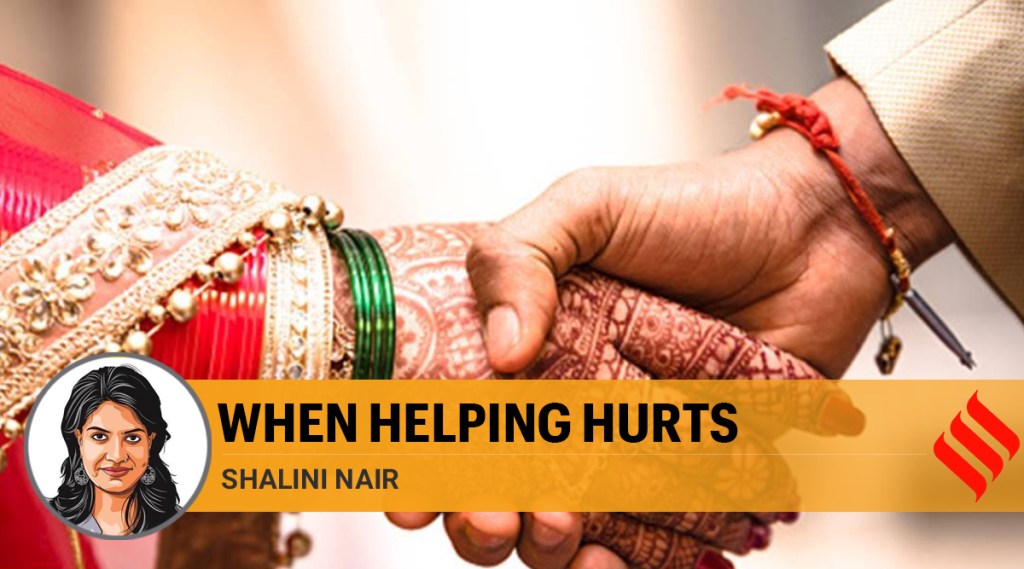 Women with 12 years or more of schooling are most likely to marry later. (Source: Getty Images)


 Share


