
A new phase of the fightback
Though stringent lockdwon was timely. Now it's time to address ballooning opportunity costs across sectors
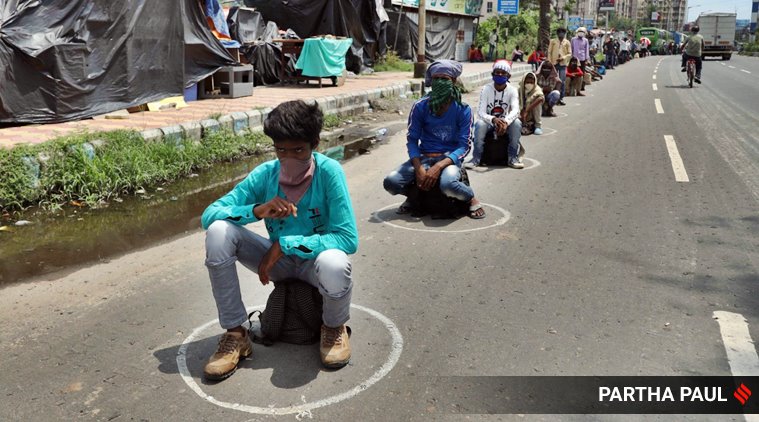 In Kolkata amid the nationwide lockdown to contain the spread of Covid-19. (Express photo by Partha Paul)
While the OECD countries are reeling under the COVID-19 impact, India is clearly ahead of the curve. This is not merely in terms of the confirmed cases in the country but is also strongly reflected in very low mortality numbers (0.085 deaths per lakh population) compared to other nations (40.4 in the UK and 19.30 in the US). While the first cases were reported in most hotspot countries and India around the same time (last week of January), today, the outbreak is far more manageable in India than in most other countries. It was pragmatic for a resource-poor country to be pre-emptive and declare a national lockdown when the total number of cases were still low at 500. The subsequent growth of the pandemic clearly shows a perceptible decline in the number of cases due to the lockdown. Though stringent, this was much-needed and a timely policy intervention by the government. It is important, however, to appreciate the high and growing opportunity costs that are involved during a lockdown. We must brace ourselves for long-term pandemic management (18 to 24 months) with significant economic impact on our lives.
The immediate costs of the lockdown are borne by the most economically vulnerable people in society. This perhaps was the rationale behind the first round of economic policy interventions announced by the finance minister within a few days of the lockdown. They targeted front-loading of cash transfers through PM-Kisan, support to construction workers, self-help groups, food distribution through the public distribution system, among others. Beyond welfare concerns, there are significant growth concerns that are mounting with every day of economic inactivity in the country. Companies are struggling to honour payroll and maintain their workforce against cancelling orders and declining demand for their goods and services. These in turn will lead to greater delays and defaults in loan repayments, thereby further weakening the fragile banking sector and struggling credit markets.

Opinion | In Pakistan, religious leaders, not doctors, are setting Covid policy
The Reserve Bank of India stepped in for some timely monetary interventions, however, the longstanding climate of risk aversion within the banking sector will mean that transmission of these monetary interventions is unlikely to be timely or adequate. All eyes are set expectantly in one direction. Historically, when economies are faced with major calamities, governments step in to stabilise the environment and boost confidence within the business community who are the creators of wealth and employment. We have seen this response from all major economies disrupted by COVID-19 over the last several weeks. India will not be an exception to this as the government fine tunes its strategy to support and kickstart our immobilised economy. The opportunity cost of time, however, is ballooning with each passing day. Just like the spread of the virus, we are up against the full force and power of compounding. Mindful policy interventions, when timed well, can cut growing losses and the misfortune of many.
India is a large country and the current crisis keeps reminding us of that reality every day. While we have succeeded in slowing the growth of the virus at the national level, the true gains and pains are at the state and local level. As the data reveals, currently we have three states that have made remarkable gains and “flattened the curve” of COVID cases. These are Kerala, Haryana and Tamil Nadu where recoveries are growing and active cases are rapidly declining. States like Karnataka and Telangana are improving their recovery rates consistently, despite fluctuations. While every state and local administration has to keep eternal vigil and double down on containment and testing, they have to aggressively improve their contact tracing efforts with the help of their police who are trained in debriefing, call record mapping and have more manpower than public health departments of local administrations.
Opinion | RBI’s job involves trade-offs, not conflicts
What should our strategy be? Given the scale and variation in infection control across the country, our national strategy needs to be informed and calibrated. Currently, there are more than 300 districts in the country which have reported zero COVID-19 cases. This can be confirmed quickly with some random testing (we do have the capabilities to conduct these meaningfully) and the lockdown can be lifted effective immediately. Then there are about 225 districts which have reported less than 10 cases each. With adequate ring fencing at the level of the block where these cases are reported, these districts too can afford to lift their lockdowns. There are, however, approximately 30 districts across the country which have reported large numbers of confirmed cases and are identified as “hotspots”. The lockdown in these places needs to continue with some relaxations for basic trade and essential services. Not surprisingly, these “hotspots” are also important economic centres of the country. The capacity of the local administration to develop and enforce appropriate strategies of containment, contact tracing and testing, should determine their decisions to ring-fence and isolate blocks while allowing other parts of the district/city to resume economic activity.
Over the last month, India has developed significant capacity to test and treat COVID-19 patients across the country by creating a large number of specialised fever clinics and identifying COVID hospitals across every state. Our disaggregated data analysis, however, suggests that there is no hospital rush of patients with symptoms of acute respiratory ailments like in the US, the UK, and Europe. Given the uncertainty of the virus, we seem prepared for large hospitalisation and care if the need arises. The efforts now must be to further contain the growth of the infection. If the current rate persists, we will reach over a lakh cases within three weeks. That is the power of compounding we are against. Beyond knowledge sharing across states and adopting successful containment strategies from each other, there is a role for the central government in providing “NSG-like” public health support teams to states that need them. On the economy front similarly, the central government’s timely economic package should flatten the curve of exponentially rising opportunity costs across the sectors. Given the relative scale and virulence of the COVID-19 virus in India, the odds seem stacked in favour of a calibrated opening of the economy.
The writer is a former member of the Prime Minister’s Economic Advisory Council
Opinion | It should inspire countries to recommit to principle of universal bio-deterrence

 Share


