5 min readSep 14, 2026 06:14 PM IST
First published on: Sep 13, 2026 at 02:05 PM IST
Are we any the wiser about the course of India-China relations after the Eight Points of Outcomes and Consensus statement on the border issued on August 25 and the meeting between Prime Minister Narendra Modi and Chinese President Xi Jinping at the just-concluded BRICS Summit?
What the August statement and the two readouts from India and China after the summit indicate is that, with respect to the border, the two sides are at a Nash equilibrium. For the Economics 101-challenged like me, a Nash equilibrium is an outcome in a non-cooperative game in which “no player’s expected outcome can be improved by changing one’s own strategy” (according to Britannica online). In essence, India and China, at least tacitly, recognise that in any foreseeable future they cannot aspire to and achieve a better position in the border quarrel. They may well spar diplomatically and militarily occasionally, as they have since 2013. But the intermittent war of words and of hardware over control of the high Himalaya can only move the Line of Actual Control slightly.

The border quarrel can only be solved to the maximal satisfaction of India and China by negotiation or by force. India and China have been negotiating a border deal almost without interruption since 1981 — the Secretary/Vice Minister-level talks (1981-88), the Joint Working Group (1989-2005), and the Special Representative Mechanism (2003-present). Over more than 45 years, they have met once a year on average.
After all those years of talking, the only agreement of substance is the 2005 “Political Parameters and Guiding Principles for the Settlement of the India-China Boundary Question”. The most important parameters and guidelines were that a settlement would be reached as a package (nothing is settled until everything on the border is settled). The final agreement would be a “political settlement” that would consider strategic concerns, history, national sentiment, practicality, geography, and the interests of settled populations in the borderlands.
The August 2026 eight-point statement, enjoining the negotiators to seek an early and substantial harvest with respect to the border, does not violate the idea of a package deal. Rather, it suggests that the two sides should focus on success in one area instead of negotiating everything everywhere all at once. Having achieved success in one section, they should then move on to another section of the border. Yet, as per the 2005 agreement, each sectional success would only be finally accepted and ratified when the entire border is settled.
Nothing in the Modi-Xi BRICS readouts alters the basic 2005 agreement or the eight-point early harvest statement. The negotiation process has been somewhat nudged by the eight-point statement, but it is hard to imagine that diplomatic bargaining now or in the future can give India or China their maximal objective. For India, the maximal objective is to get back Aksai Chin up to its original claim and to keep everything it has in the other sectors. For China, it is to get Arunachal Pradesh all the way to the southern slopes (which is most of the state) and to keep everything else it has in the other sectors. It is inconceivable that Indian or Chinese negotiators can achieve their maximal objectives.
Nor can they do so by force. India cannot conquer Aksai Chin up to its original claim line, and China cannot conquer Arunachal Pradesh up to the southern slopes. Terrain, climate, logistics, and military defences make any dramatic — and lasting — military gains almost impossible. Short of extremely bad strategy by their commanders or internal political chaos that distracts from deterrence, the status quo on the border is stable.
Two things can disturb the Nash equilibrium (apart from bad defence or internal political collapse): The transition to a successor Dalai Lama, and an India-Pakistan fight that draws China directly in and leads to a two-front war for India.
Eventually, Beijing will appoint its preferred Dalai Lama. The Tibetans will almost certainly choose their own. New Delhi will be caught in the middle. India-China tensions could consequently spiral, and China could lash out as it did in 1962 when the instabilities in Tibet were a factor leading to war.
Alternatively, another India-Pakistan fight could spiral. In 2025, New Delhi detected a Chinese helping hand to Pakistan during Operation Sindoor. In a future South Asian confrontation, China might be more ostensively involved. New Delhi or Beijing may then find themselves drawn into a fight that would threaten the status quo.
Beyond the border negotiations and all the other good things that the present détente with China promises — trade, visas, supply chain resilience, river water cooperation — New Delhi should be thinking about the strategic challenges that could disturb the current Nash equilibrium. Can India-China relations be insulated from a Tibet transition and a future India-Pakistan fight? Can the fruits of détente help build sufficient insulation? What more needs to be done with China?
The writer is visiting professor, International Relations, Ashoka University, visiting senior fellow, Centre for Social and Economic Progress, and emeritus professor, Lee Kuan Yew School of Public Policy, National University of Singapore

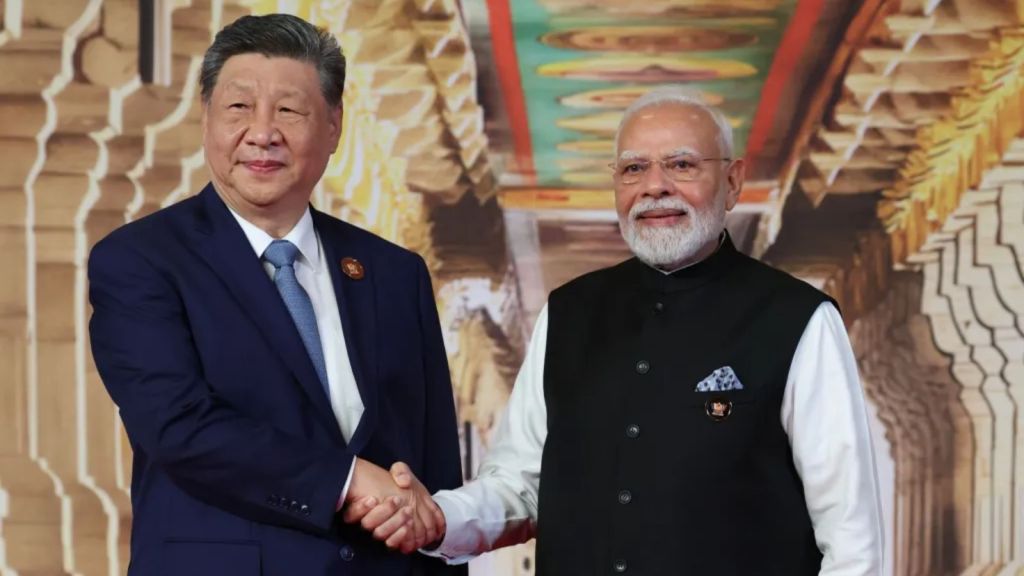 Prime Minister Narendra Modi greets Chinese President Xi Jinping upon his arrival for the BRICS summit in New Delhi, India, on Saturday, September 12, 2026. (Foreign Ministry via AP)


 Share


