On August 26, within minutes and without any large rain, a wall of water and debris tore down the Bhotekoshi and destroyed the border crossing between Nepal and Chinese-controlled Tibet. Hundreds are dead, and many more are missing. The scale of the loss on the Tibetan side may never become public, because Tibet is, in effect, sealed to outside scrutiny.
It is tempting to read this as Nepal’s tragedy alone or that of people in Nepal and Tibet. It is not. India is the largest downstream country of the Tibetan Plateau – the “water tower of Asia” – and the flood warns of a vulnerability New Delhi has been slow to confront. Some of its most important rivers rise in a region India cannot see into, controlled by a state, China, that treats the data about them as an asset to switch on and off. The Brahmaputra rises as the Yarlung Tsangpo in Tibet before entering Arunachal as the Siang; the Sutlej and Indus rise there too. What India knows of them at their source, it knows because Beijing chooses to tell it.

Weak by design
Consider the architecture. India and China have no water treaty — only two flood-season memorandums, on the Brahmaputra (2002) and the Sutlej (2005), for which India pays roughly a crore a year, plus a consultative Expert Level Mechanism (2006) that meets when relations allow. That is the whole edifice, and it is deliberately flimsy. China shares data, but on its own terms and its own reading of what sovereignty permits; it has refused any binding treaty. India has no ‘right’ to demand any information. Both countries, tellingly, stand outside the one instrument that would oblige upstream states to give prior notice and not harm those below — the 1997 UN Watercourses Convention. China voted against it; India abstained; neither has joined since.
The flimsiness is not accidental: a non-binding memorandum can be suspended without breach. For example, in 2017, during the standoff at Doklam, China stopped sharing Brahmaputra data, blaming damaged collection sites, even as that summer’s floods killed scores in Assam. It resumed once relations thawed, then dried up again after the 2020 Galwan clash; the memorandum lapsed in June 2025, unrenewed, and India is still pressing for the data to return. Flood-prediction information is not a neutral public good but a lever released when ties are warm and withdrawn when they are not.
Beijing tells a different story though. It says the data was suspended only for technical reasons, the upgrading of monitoring stations, and points to years of “good cooperation” on flood reporting, including upstream alerts that saved lives downstream. On the dam, its foreign ministry calls the project “fully within China’s sovereignty,” promises it will “prevent and mitigate disasters,” and describes it as run-of-the-river; credible Chinese hydrologists argue such cascades can be managed. Some of this may be true. I still recall a side remark by a Chinese scholar during a state-controlled visit to Tibet for a foreign delegation of which I was a part many years ago; he pointed toward a river and said: “See, that is a river that flows into India, and we can stop it any time we want.”
Notice what the sovereignty formula does: it answers a humanitarian question — will you warn the people downstream? — with a territorial one. And every reassurance shares one flaw: those it is meant to reassure cannot verify it, because the region it concerns is sealed. A state that cannot inspect, audit, or independently monitor is asked simply to trust a state notorious for its closed nature.
The dam changes the stakes
If the flood is the symptom, the dam is the escalation. In July 2025, China broke ground on the Medog project at the Great Bend of the Yarlung Tsangpo, where the river drops some 2,000 metres just before turning towards Arunachal Pradesh. At a planned 60 gigawatts, it will be the world’s largest hydropower project — several times the Three Gorges — and it sits in one of the most seismically violent zones on the planet, the same tectonic seam that produces the outburst floods now hitting the border. Arunachal’s chief minister has called it an “existential threat” to the tribes of the Siang valley; Bangladesh, at the river’s end, sought details in early 2026 and got no substantive reply. A structure of this scale, on India’s largest river, in a region closed to inspection, hands one state extraordinary power over the water and safety of another.
Why is the plateau so opaque? Not because secrecy is a Chinese temperament, but because of how China governs Tibet. I have argued that China rules Tibet less as an ordinary province than as a colonised space — held through near-total political and territorial domination, the reshaping of society and religion to foreclose autonomy, top-down development that binds the population to Beijing, and a dense apparatus of militarisation, surveillance and information control in the service of the state. India, which hosts the Dalai Lama and the largest community of Tibetan exiles — a thorn in China’s side — is regarded with particular suspicion.
River data is one more thing held close in a region held down — and you cannot have the openness without loosening the control the Chinese state will not loosen. Yet this is no morality tale of Chinese secrecy against Indian virtue. India has been complicit in its own exposure: successive governments, the present one included, have been content with the paid-data memorandum and have not pushed for the binding, basin-wide architecture that would make information a right rather than a favour. Nor is India only a victim. It is an upstream withholder too, sharing thinly with Bangladesh and, this year, suspending the Indus Waters Treaty and choking data to Pakistan after the Pahalgam terror attack. The logic it faces on the Brahmaputra is the logic it practises on the Indus.
None of this is inevitable, which is the real indictment. Cooperation, not conflict, is the global norm on shared rivers: of the world’s transboundary basins, far more are governed by treaties and joint bodies than by stand-offs. The Rhine became a model by insulating technical management from politics; the Indus Treaty shared a river between enemies through three wars. Most striking is the Senegal River, where four of the poorest countries on earth — Mali, Mauritania, Senegal and Guinea — jointly own their dams as “common and indivisible property” and kept the arrangement running even through a border war between two members. If states this poor and this mistrustful can pool sovereignty over a river, China’s refusal to do so is plainly a choice, not a constraint. Tellingly, China makes the same choice on its southern flank, sitting outside the Mekong River Commission its neighbours built while running its own controlled mechanism upstream. Shared-river cooperation is not impossible in Asia; its largest upper riparian simply declines the binding kind.
India’s water future is tied to a plateau it can neither see into nor shape, held by a neighbour with whom trust runs thin and the border runs hot. The Nepal flood is a small, terrible preview of living downstream of an information black hole. The water will keep coming — as flood, as sediment, as the managed release of a dam — and the question for India is not whether it can force China to open up, which it cannot, but whether it will build the institutions that make hazard information a shared necessity, not a bargaining chip. On present evidence, that is precisely what the securitised governance of Tibet — and the region’s taste for using rivers as leverage — is built to prevent.
Let us not forget that the Panchsheel Agreement of 1954, that lapsed as the China-India border dispute became entrenched, was formally called the “Agreement on Trade and Intercourse between the Tibet Region of China and India”. As the Indo-Tibetan border has firmly become the India-China border, albeit disputed, the two countries must decide whether a shared river is a common lifeline or a weapon held in reserve.
The writer is Professor of International Relations at the University of Westminster, London. He is the author of Geopolitical Exotica: Tibet in Western Imagination and Hindu Nationalism in India and the Politics of Fear

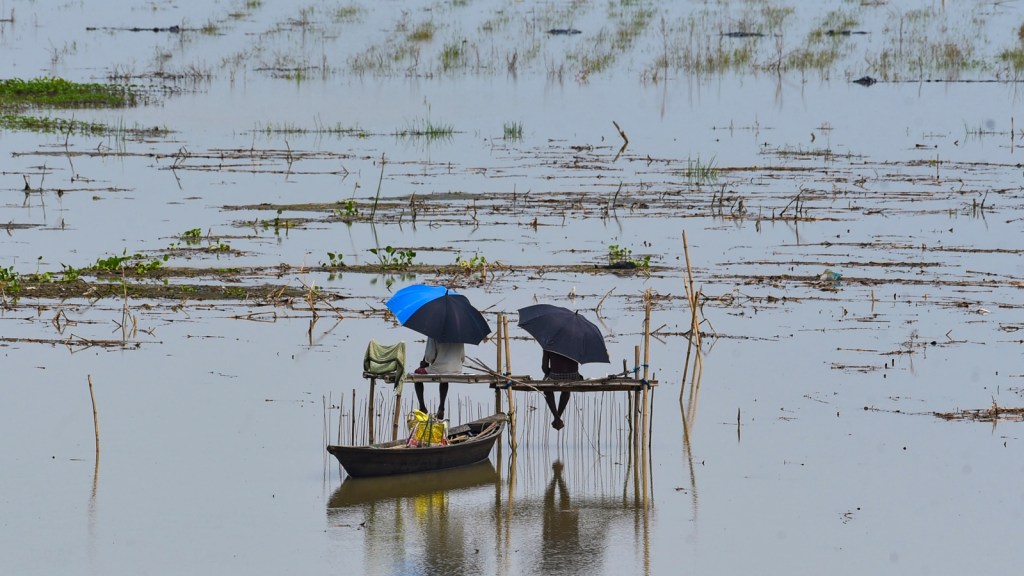 India’s water future is tied to a plateau it can neither see into nor shape, held by a mistrustful neighbour across a hot border. (PTI/File)


 Share


