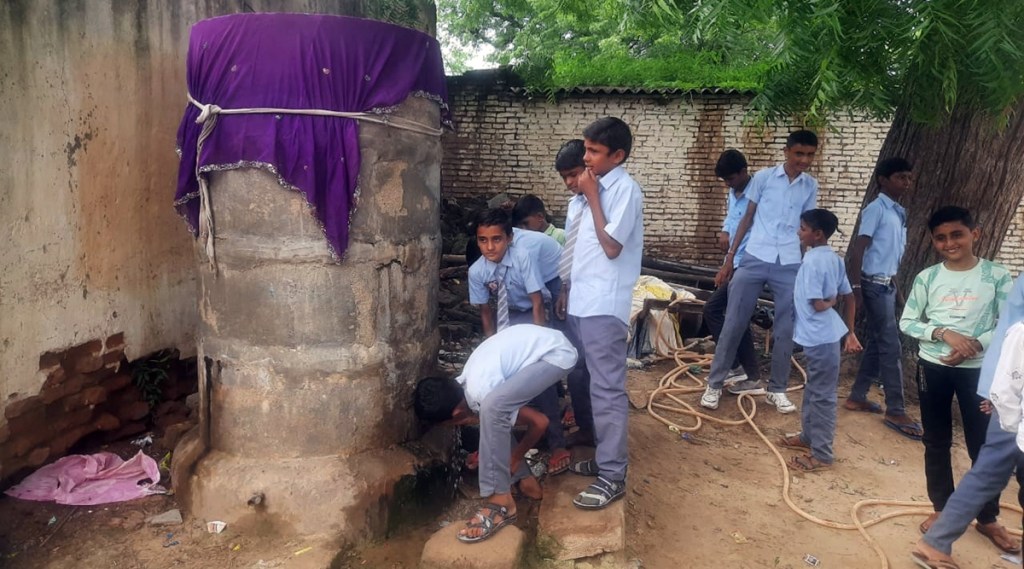
On August 4, 1923, the Bombay Legislative Council recommended that the “untouchable classes” be allowed to use all public watering places, wells and dharamshalas — as well as public schools, courts, offices, and dispensaries — which are built and maintained with public funds or administered by bodies appointed by the government or created by statute. Four years after this recommendation, Bhimrao Ramji Ambedkar, on March 19, 1927, marched along with thousands of satyagrahis to claim water from the publicly-funded and maintained Chavdar lake in Mahad, now in Maharashtra’s Raigad district. The upper castes could not tolerate this act of defiance by the “untouchable” satyagrahis led by Ambedkar. They attacked and beat the satyagrahis black and blue. This is history. But the beating of a Dalit boy, Indra Meghwal, in Jalore, Rajasthan, resulting in his death, is the shocking reality of contemporary India, which is celebrating Azadi Ka Amrit Mahotsav, 75 years of Independence.

After Independence, the founding fathers of India sought freedom from untouchability. The Constitution of India abolished untouchability, its practice in any form was forbidden and enforcement of any disability on account of untouchability was declared a punishable offence. Following the constitutional mandate, Parliament enacted the Untouchability (Offences) Act, 1955, which was subsequently amended in 1976 and renamed the Protection of Civil Rights Act, 1955. This act made the enforcement of untouchability or any disability arising therefrom a cognisable and non-compoundable offence and enhanced the terms of imprisonment. The enforcement of the PCR Act proved ineffectual. Soon the government realised that the Act and the provisions of the IPC were not deterrents enough to prevent untouchability or violent attacks upon the Dalits and Scheduled Tribes when they asserted their constitutional rights. Accordingly, Parliament passed another law called the Scheduled Castes and Scheduled Tribes (Prevention of Atrocities) Act, 1989. This Act defined “atrocity” and covered multiple aspects, ways and mechanisms through which Dalits and Adivasis are subjected to exclusion, discrimination, humiliation, and violence, and constantly denied equal opportunities and the enjoyment of their constitutional rights. This Act has been amended twice, the latest being in August 2018. These efforts of the government heavily relied on the enactment of laws and making them tougher with every new avatar. However, independent India betrayed the vision of freedom from untouchability and atrocities against Dalits continued to mount.
As per data compiled by this writer for the National Confederation of Dalit and Adivasi Organisations, based on figures from the annual reports of the NCRB from 1991 to 2020, more than 7 lakh atrocities on Dalits, including 38,000 rapes of Dalit women, have taken place in the last two decades. More than five atrocities per hour have taken place against Dalits in the last five years. It is, therefore, timely to ask if law enforcement is working as it should.
It has been widely reported that the state governments do not implement the Atrocities Act seriously. The National Human Rights Commission (NHRC) in a report published in 2004 — authored by former Secretary to the Government of India K B Saxena — mentioned that many states such as Assam, Bihar, Uttar Pradesh, Rajasthan, etc. did not constitute special courts as provided in the law. None of the states, except Gujarat, Maharashtra, and Rajasthan, identified the untouchability-prone areas. As happened in the case of Indra Meghwal, denying the registration of first information reports (FIR) on caste-based atrocities is normal across the country, forcing Dalits to mobilise in order to get the atrocities registered. This mobilisation for justice is often seen as a “challenge” to the traditional dominance of upper castes in police, judicial, and institutional structures, including media.
What makes Dalits vulnerable is the lack of sustainable land ownership, with no control over livelihood or common resources and lack of employment opportunities. But their migration to cities — for education and livelihood — has given them exposure to spaces that are free from traditional caste norms. Educational advancement, an awareness of the law, a strong notion of justice and the constitutional system have empowered Dalits. This empowerment, where Dalits claim justice and equal dignity or self-worth, is manifested in acts such as riding horses in marriage processions, growing and maintaining moustaches, and seeking a just space in cultural and political areas.
These “non-traditional” postures or behaviour by Dalits form the silver lining in the dark cloud of inequality and deserve support. But institutions in India, government or non-governmental, political parties or organisations, religious organisations and their heads, are conspicuously silent on violence against Dalits. This silence is deeply entrenched in societal divides. Unless this divide is bridged, the realisation of an open, vibrant, and democratic society will be a mirage and Dalits’ sense of freedom will be a lie.
The writer is the chairman, National Confederation of Dalit and Adivasi Organisations (NACDAOR)


 Share


