4 min readApr 16, 2026 07:12 AM IST
First published on: Apr 16, 2026 at 07:12 AM IST
The renewed interest in Ravi Varma’s paintings after his work Yashoda and Krishna fetched a whopping Rs 167.2 crore at an auction recently brings other artistic facts into the limelight. Varma is considered the earliest Indian painter to make works in oil, to use the Western methodology for Indian forms and facial characteristics, and to situate them in the country’s historical and mythological settings. An artist who painted at the end of the 19th century, he gave his forms a flesh-and-blood reality. Influenced by the Kerala mural tradition as well as the Western method of oil painting, he developed a naturalistic style that was rooted in the country.
Varma was self-taught and learned oil painting by watching the European painter Theodore Jansen at the court of Travancore. He emulated Jansen’s mimetic methods, which the latter closely guarded lest the young painter outdo him. Thus, in “stealing the fire” for his people, he was to create a new national art.

Varma was born in Kilimanoor, a small town in Kerala, in 1848. He began his career making portraits that instantly became popular because of their realistic rendering. He went on to make genre studies of women who were beautiful and alluring, both from his own social milieu as well as from models who posed for him in the studio.
The women in his works, hitherto ignored or sidelined, would anticipate their fulsome presence, both in their splendour as well as strength. One of his best-known works, Portrait of a Lady (1893), has an elegant woman draped in a gold bordered sari, wearing her traditional nath, and with her arms folded in her lap. There is a grandeur as well as a pensive loneliness that holds the viewer in thrall. Yet, is she also someone who is constantly subjected to the male gaze? While the women are rendered with striking realism, she is shown at her alluring best, which certainly subjects her to the male desire for eroticism and acquisition. Yet, in the end she remains her own self, able to conquer her destiny.
Varma’s aim of creating pan-Indian figures reaches its apogee with the painting Galaxy of Musicians (1889), a tableau of 11 women from different parts of India in traditional costumes, holding musical instruments. It was part of a repertoire of 10 paintings shown in 1893 at the international exhibition of the World Columbian Order in Chicago. Varma received two awards.
It was Varma’s mythological and historical works, however, that won him the greatest acclaim. The best-known of these was the Hansa-Damayanti theme, where a lovely woman is shown leaning against a pillar listening wistfully to the swan who bears a message from her beloved.
The artist started a lithographic printing press in Ghatkopar, Mumbai, in 1894 and later shifted it to Malavli near Lonavala, Maharashtra, in 1899. These oleographs were popular and flooded many homes not only in India but also in the homes of expatriates in Africa and South-East Asia. The trivialisation and commercialisation of these works undoubtedly took place but for no fault of the artist. The last painting made by Varma was Kadambari Playing the Veena but it remained incomplete due to his demise. He had become a household name by then.
The artist’s naturalistic portrayal of Hindu gods and goddesses, particularly in oleographic prints, was to become the focus of worship for many belonging to the lower castes, who were not allowed to enter temples. It let them be devotees from the back door, as it were, but also incorporated these viewers into a larger, more egalitarian idea of the nation that resisted caste exclusion. Despite their apparent trivialisation, then, the paintings of Ravi Varma continue to hold sway over the general public, infused as they are with the idea of India.
The writer is an art historian and independent curator based in New Delhi

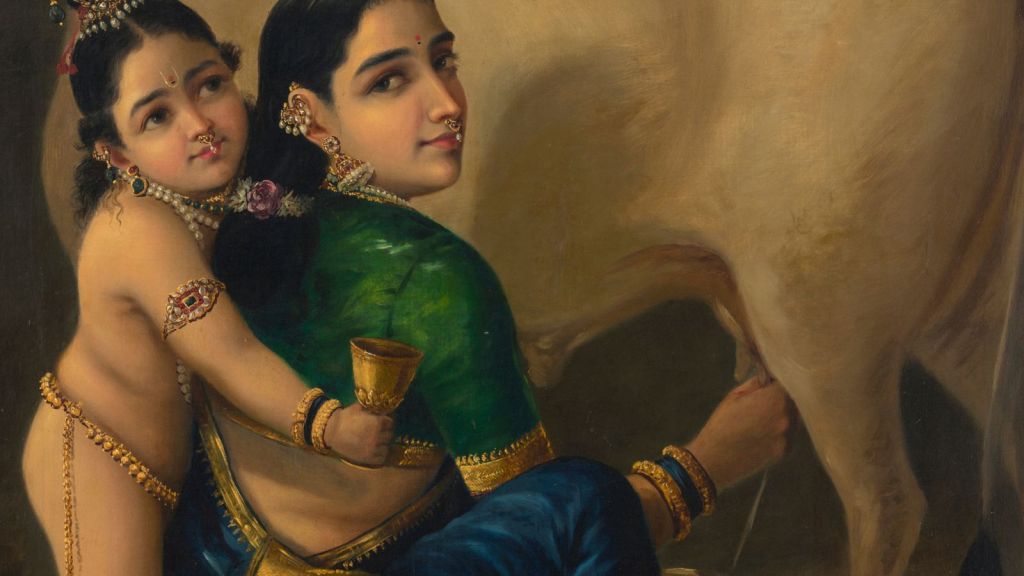 A Raja Ravi Varma painting has set a new auction record in India. (Express Photo)


 Share


