5 min readMar 3, 2026 12:22 PM IST
First published on: Mar 3, 2026 at 12:22 PM IST
As the world order unravels under the pressures of great-power politics — starkly illuminated by the recent escalation in West Asia — a fundamentally structural shift is unfolding in New Delhi. In the first leg of his consequential trip to three Indo-Pacific countries, India, Australia, and Japan, Canadian Prime Minister Mark Carney is walking the talk he delivered in Davos. Calling out polarising global narratives, Carney proposed the formation of variable geometries — flexible, functional partnerships capable of bypassing deep structural fissures. This trip to India has clearly emerged as the central pillar of that effort.
Facing a mercurial neighbour to its south, Canada, whose economy is disproportionately dependent on the US, is seeking diversification. However, the reset that has been formalised and institutionalised with this visit goes beyond these geopolitical and geoeconomic mandates. Taking ties beyond the diplomatic controversies that paralysed the relationship for over two years, the visit marks the beginning of a new-age, future-facing partnership.

A flurry of MoUs — spanning renewable energy to critical minerals, technology, etc — signals a profound shift. The relationship is moving beyond traditional complementarities and into an era defined by interconnected national innovation ecosystems. The India-Canada trade corridor is being redefined. Once largely characterised by the exchange of Canadian pulses and potash for Indian pharmaceuticals, economic relations between Ottawa and New Delhi are now being woven around the nodes of the techno-economy. The presence of senior executives from Canada’s nine major pension funds in Carney’s delegation, representing an investment footprint in India that already surpassed $110 billion in 2024, underscores that this is a structural alignment of long-term capital, not just diplomatic rhetoric.
The newly launched Canada-India Talent and Innovation Strategy is the clearest manifestation of the leap from transactional buyer-seller exchange into an active, integrated co-creation of value and prosperity. In this new avatar of partnership, the Indian diaspora in Canada is not a one-way transfer of human capital, but a vector for brain circulation. Indian scholars, engineers, and researchers are actively co-creating intellectual property, bridging Canada’s highly capitalised innovation markets with India’s unmatched capacity for scale.
This is no longer a one-way street; it is an institutionalised corridor, evidenced by the establishment of a new Dalhousie University innovation campus with the Indian Institute of Technology and Indian Institute of Science Education and Research in Tirupati, the injection of $100 million from the University of Toronto for joint scholarships, and HCL Technologies committing to drastically expand its Canadian workforce.
Furthermore, advanced technological ecosystems require a secure, sustainable foundation. This is where the material techno-economic complementarities between India and Canada are not only mutually beneficial but also align with the global green energy transition goals. As Prime Minister Narendra Modi acutely observed in his remarks, “for Carney, the environment and the economy are inextricably intertwined”. With India’s energy demand growing faster than anywhere else on earth, this philosophy underpins the sweeping new Strategic Energy Partnership.
This green convergence is cemented by Canada’s decision to join the International Solar Alliance (ISA) and upgrade its status in the Global Biofuels Alliance. It is also backed by hard strategic agreements: A landmark $2.6 billion deal with Cameco to supply nearly 22 million pounds of uranium for civilian nuclear energy from 2027 to 2035, alongside vital new dialogues on critical minerals, securing the lithium and cobalt supply chains necessary for the next generation of industrial growth.
To protect and scale these joint ventures, the institutional architecture of the relationship is being rebuilt. The formalisation of the Terms of Reference for a Comprehensive Economic Partnership Agreement (CEPA) — slated for conclusion this year — provides the necessary legal scaffolding to transition bilateral supply chains from a vulnerable just-in-time model to a resilient just-in-case framework. It drives towards an ambitious new goal of doubling bilateral trade to $70 billion by 2030.
Geopolitically, Canada is firmly anchoring itself in the Indo-Pacific region; its new status as a dialogue partner in the Indian Ocean Rim Association (IORA), combined with a trilateral MoU on Technology and Innovation with India and Australia, operationalises the variable geometries Carney envisioned.
Prime Minister Carney’s visit to New Delhi, therefore, marks the formalisation of a profound geopolitical reality. In a world increasingly defined by great-power conflict and economic coercion, middle and rising powers can no longer afford to be mere spectators. Through deep technological co-creation, resource sovereignty, and flexible institutional frameworks, India and Canada are forging a resilient partnership built not just to weather the coming global storms but to actively author the economic and technological landscape of the Indo-Pacific.
The writer is assistant professor, JNU

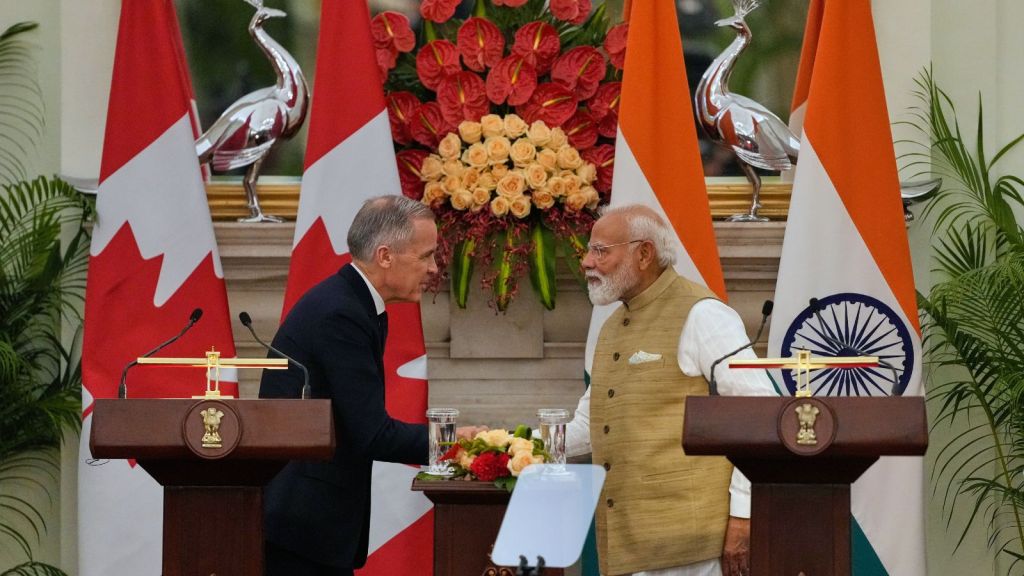 A flurry of MoUs — spanning renewable energy to critical minerals, technology, etc — signals a profound shift. The relationship is moving beyond traditional complementarities and into an era defined by interconnected national innovation ecosystems.


 Share


