5 min readSep 4, 2025 01:57 PM IST
First published on: Sep 4, 2025 at 07:12 AM IST
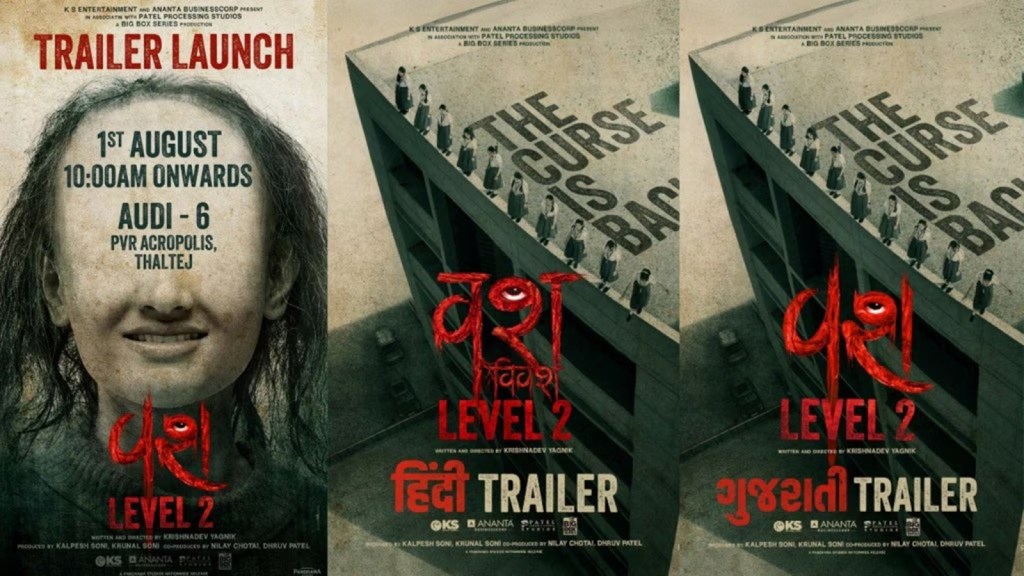
A cohort of bickering, praying, gossiping — in other words, wholly regular — schoolgirls reaches their posh-looking private school, eats at their cafeteria and undergoes a palpable transformation. The laughing, chattering hum of the cafeteria turns to silence. Their breathing changes — shallow, noisy breaths — as the girls’ faces tighten with anxiety. No one talks or looks at each other any longer. The camera zooms in, invoking a sense of claustrophobia. Then, a blurred male figure walks in and orders 10 schoolgirls to jump off the ledge of the school’s terrace. One by one, they all leap to their deaths. Thus begins a reign of terror unleashed by a cohort of schoolgirls under the spell of a demonic hypnotiser in the superb thriller/horror film Vash Level 2, made in Gujarati and dubbed in Hindi for release across major cities.
As the day progresses, the girls wreak havoc: Bludgeoning citizens on the roads with anything they can get their hands on, setting petrol pumps ablaze, bringing traffic to a careening stop. The school authorities and city police have no effect on the possessed. The demonic hypnotiser, hiding in plain sight in the cafeteria, has them under his control. He demands access to another demonic hypnotiser, his guru, now locked in a citizen’s dungeon, his tongue sliced out so he can no longer communicate.

A mass hypnosis on ordinary human beings that makes them turn on their fellow human beings to unleash violence and extreme anarchy in society. An apparently normal society that turns tense and fearful abruptly. An outwardly poised man with an aura so powerful that people do his bidding with the fervour of the possessed. At one crucial point in the film, the current hypnotiser calls out to one of the schoolgirls he has sent out to kill a man sleeping on the street with a rock. Bloodied and blank-faced, she stares back at him but doesn’t come his way. So potent is the spell that even the hypnotist can no longer fully control the possessed. They are out there, addicted to the blood on their hands and faces.
The horror and fantasy genres are never not political. When the classic German Expressionist film Nosferatu, widely recognised as the first major Dracula adaptation on screen released in 1922, the spectre of Nazism was rising across Europe. In his essay for The Tablet, film critic J Hoberman notes that “…Mein Kampf, published in 1925, makes multiple references to Jews as vampires, bloodsuckers and parasites…” Critiques of the film point to Count Orlok’s rat-like characteristics; the analogy between pestilential rodents and Jews is common to a number of anti-Semitic propaganda films. And what of the original novel? Bram Stoker’s Dracula is read variously as the threat of the Turkish or East European other to the Liberal West, the vestiges of maladjusted feudalism in a capitalist liberal order, the rise of Irish and other nationalisms, often led by old landed elites with interests to protect their influence, against the Empire. Equally, you could read into Count Dracula the spectre of the Empire sickening and out of time, infecting victims against the modern, liberal ideas of the 20th century.
Indeed, one of the pleasures of the fantasy genre is the amorphousness of its form. Overthinking, some might say. Dracula is just a solid creepy story featuring an unforgettable supernatural character. Hard to argue with that, given Dracula’s undying appeal. Ditto for Frankenstein. I could read into it a warning against modernity’s scientific and technological arrogance, creating artificial life with little regard for its consequences. (This is a premise beautifully revisited in Kazuo Ishiguro’s English-language novel Never Let Me Go.) Goopy Gyne Bagha Byne (GGBB), Upendra Kishore Ray Chaudhuri’s children’s story filmed unforgettably by his grandson Satyajit Ray, could be read as a terrific ride about the travels of two minstrels into a happy kingdom and a sad kingdom. Or, I could read it as a comment about enlightened and despotic pre-modern rulers.
In fact, it was GGBB that put Vash Level 2’s political narrative in my mind. In GGBB, an evil magician burns a concoction whose fumes cause the kingdom’s populace to lose their speech. Later, on the instructions of the minstrel heroes, he burns another concoction whose fumes return speech to the populace. The spell is broken. In Vash Level 2, it is something in the meal served to the schoolgirls that brings them under the control of the hypnotist. But it is not something edible that breaks the spell. In an inventive ploy, it happens only once the means of communication are snapped.
Isn’t this what contemporary critics say about the media? Turn away from these peddlers of propaganda, and sense will prevail. It’s impossible to disagree with when you think about the genocide unfolding in Gaza — every prestige news outlet in the West has capitulated to Israel’s propaganda. A technologically-advanced nation that has itself suffered the trauma of a monster’s hypnotism has revived his memory. This, of course, is the subtext I read into Vash Level 2. What else could it be?
The writer is a National Award-winning film critic and the author of The Day I Became a Runner: A Women’s History of India Through the Lens of Sport

 Isn’t this what contemporary critics say about the media? Turn away from these peddlers of propaganda, and sense will prevail.


 Share


