Every time I set foot in the Northeast, I feel reenergised and refueled. Many call it the periphery of India, however it is the very heart, beating in many colours, sounds, and textures. A garland of pearls, strung together by countless communities, cultures, and ways of life, woven seamlessly into the eternal rhythm of nature. No wonder our Prime Minister calls it the Ashtalakshmi-a region of diversity and opportunity.
On my recent three-day visit to Arunachal Pradesh, I experienced this moving mural, each frame brimming with heritage and progress. My journey began at the Donyi Polo Airport in Hollongi, a shining example of the success of UDAN (Ude Desh ka Aam Nagrik), which has made air travel affordable and accessible to India’s remotest skies. In just a few years, the number of airports in the Northeast has grown from nine to seventeen, with four in Arunachal Pradesh itself, a transformation driven by the Prime Minister’s push for connectivity. When I was in Civil Aviation, under the leadership of Prime Minister Narendra Modi, who directed us to make these airports more than mere transit points, each was envisioned as a window into its land, where bamboo-inspired structures, tribal motifs, and regional architectural designs remind every traveller that modern India takes flight without leaving its roots behind. After a smooth three hour drive, I found myself in the embrace of Ziro Valley for the world-renowned Ziro Music Festival. It is ranked among the world’s top music festivals, yet unlike any global spectacle. In its authenticity, lies its rootedness. Every element is designed in an all-natural, eco-friendly setup, ensuring the valley returns to its pristine state once the music fades. Bamboo and cane structures, bound with jute ropes, stood like gentle sentinels. Pathways paved with riverbed stones led into courtyards alive with music and stories. Stalls brimmed with rice steamed in bamboo shoots, river fish roasted on skewers and fresh juices served in bamboo mugs. Local artisans showcased their crafts, and thanks to Digital India and the Jan Dhan–Aadhaar–Mobile trinity, cashless payments were effortless. Every chime of “payment complete” was more than a transaction it was the sound of empowerment. Today, even in the heart of Arunachal’s valleys, digital inclusion and connectivity ensures that no citizen is left behind. Ziro transformed itself into a cultural melting pot as bikers roared from Nagaland, Punjab, and even from France and Scotland. On stage, a Khasi folk singer followed an indie band from Mumbai; a French guitarist jammed with a local drummer; a Swiss wood sculptor exhibited her work, while a folk artist from Rajasthan laughed alongside Apatani farmers. It was Ek Bharat Shreshtha Bharat in its truest form, where music became a language of togetherness and a celebration of India itself.

Women, Willpower, and the Wisdom of Soil
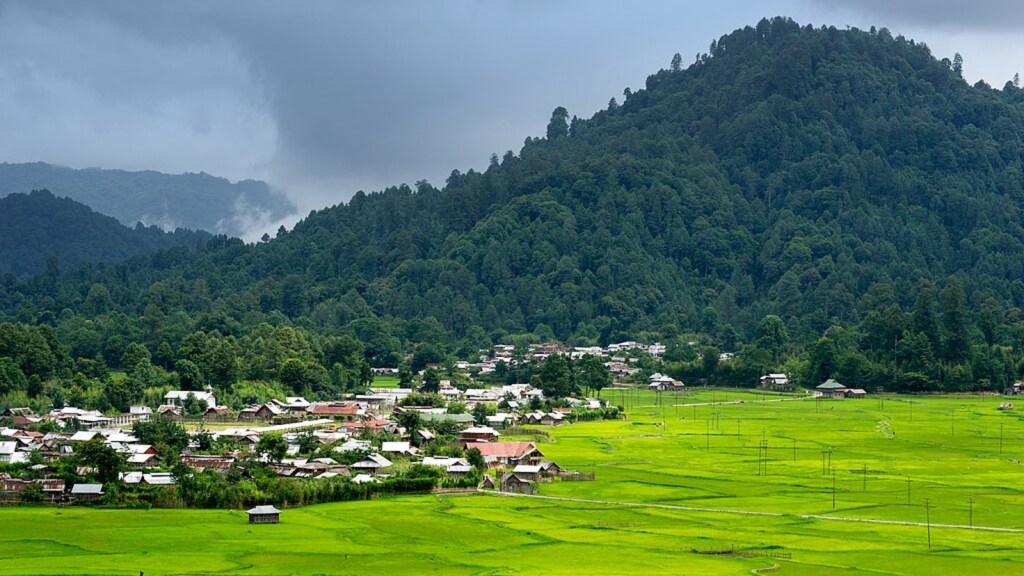
The next morning, the valley breathed in a gentler rhythm-the Apatani way of life. An 8-kilometre brisk walk through the countryside with the young and energetic Chief Minister Pema Khandu unfolded like a living painting: Mist trailing over golden paddy fields, colorful flowers blooming, canals glimmering with darting fish, bamboo houses standing proud against the mountain winds. At its heart lay the UNESCO-recognised paddy–fish cultivation system, a timeless practice where ingenuity and nature move in harmony. And then came a moment that etched itself in memory: the Apatani people, breaking into song with the playful refrain “Delhi se aya mera dost,” their voices wrapping around me in such warmth that I felt less a visitor and more as if I had returned home. That emotion continued as we savoured a traditional Apatani meal with steaming millet porridge, bamboo shoot curry, wild greens, and river fish fillets. Preparation of each dish carried with it a legacy handed down through generations. The essence of every dish spoke of lifestyle aligned with nature. Sacred groves nurtured in the backyard, while bamboo-piped water systems channelled the freshest water directly into homes.
But it was the women of Ziro who left the most lasting impression. Across villages, Self-Help Groups (SHGs) empowered under Pradhan Mantri Mudra Yojana, and Deen Dayal Upadhyaya Grameen Kaushalya Yojana are embracing an inclusive livelihood. From weaving textiles dyed in natural hues, to fermenting fruits into pickles and wines, to carving ornaments from bamboo and stone, their enterprises are vessels of culture, dignity, and hope. At the Goodwill Enclosure, I was also humbled to meet the 1811 Medium Regiment, the guardians of our country’s valour, before pausing to pay homage to our Army martyrs.
Naara Aaba: From Ziro to the World
In Hong Village, I met Tage Rita Takhe, who left her engineering career to start Naara Aaba, India’s first woman-led kiwi winery. With the support of her family, she transformed her orchard into a thriving enterprise producing wines from kiwi, apple and guava each infused with the crisp freshness of mountain air. Her success embodies the Prime Minister’s call for ‘Vocal for Local, Local to Global.’ Rita was invited to share her journey at the United Nations headquarters in New York-a remarkable achievement that demonstrates how empowered grassroots entrepreneurs are now, touching global horizons.
Hun: A Laboratory of Hope
If Ziro was music and soil, Hun Village was discipline and vision. Its spotless streets, bordered by stone walls and bamboo fences, were adorned with murals and flowering pathways. Waste had been turned into compost, solar lamps lit homes, and eco-tourism flourished through homestays built with bamboo and polished stones. Here, fruit plantations of oranges and kiwis thrived alongside weaving cooperatives marketing shawls online through e-Marketplace (GeM). Young entrepreneurs spoke proudly of taking their crafts digital, while elders shared wisdom in shaded courtyards. This was the Digital Northeast Vision unfolding in real time where connectivity and community walk hand in hand. Hun demonstrated how Atmanirbhar Bharat lives as everyday practices where tradition is not lost to modernity, but strengthened by it. On the final leg of my journey, I visited the Shree Sidheshwar Temple, home to one of the tallest naturally formed Shivalingas in the world. Standing before that sacred stone, I felt the timeless essence of Arunachal, a place where faith, sustainability, and heritage coexist in serene harmony.
A Lesson for the World
As I left Arunachal Pradesh, I realised this land is not “catching up.” It is, in many ways, ahead offering lessons the world desperately needs: sustainability rooted in tradition, women-led entrepreneurship, digital empowerment, and community-driven growth.In every corner, I saw the reflection of our Prime Minister’s vision of Digital India, Atmanirbhar Bharat, Ek Bharat Shreshtha Bharat, Startup India and Jan Dhan Yojana unfolding into powering aspirations. Arunachal Pradesh is not just the land of dawn. It is the land of sunshine, spirit, and sustainability. As I carry a pocket full of its sunshine back with me, I also carry a conviction that the story of Arunachal is not just Arunachal’s story. It is India’s story, the story of a nation that is rooted in tradition, yet surging forward with confidence into the future.
The writer is Union Minister of Communications and the 10th Minister of Development of North Eastern Region



 Share


