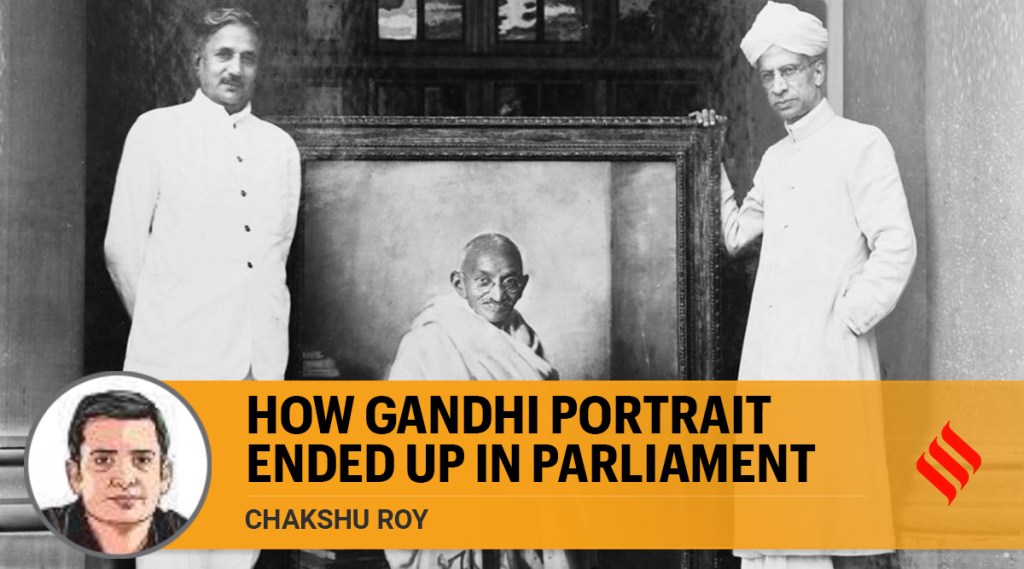
The Royal Academy of Arts has held a summer exhibition in London for the last 250 years. Art enthusiasts eagerly await the exhibition’s opening every year to see works by established and aspiring artists. Such is its draw that the Academy displayed Lutyen’s and Baker’s design of the buildings of the New Capital City of Delhi at the 1914 event. The exhibition also has had its share of controversy. In 1932, despite the selection committee’s acceptance, the Royal Academy rejected a portrait of Mahatma Gandhi from the summer exhibition. This painting now occupies a prominent place in the Indian Parliament.
It was the first portrait to adorn the Central Hall of Parliament, where Constituent Assembly members debated the Constitution. Every President of India has stood underneath this painting and addressed MPs of both Lok Sabha and Rajya Sabha. The artist who painted it was Captain (later Sir) Oswald Birley, an Englishman born in New Zealand. Birley had studied at Harrow and Cambridge, was a veteran of both World Wars and one of England’s most sought after portrait painters. Before painting Gandhi, he had an illustrious list of personalities like King George V, the King and Queen of Siam (Thailand), and British Prime Minister Stanley Baldwin, who sat for his portraits. Birley was also no stranger to India. By then, he had visited India twice and travelled extensively in the country.

Birley had painted the who’s who of British society, and the Academy had regularly exhibited his works. The rejection of his Gandhi painting led to speculation that the Academy acted under government pressure. Adding to the controversy was the acceptance of two of his other portraits, one of which was of Lord Irwin, the former Viceroy of India. The President of the Royal Academy denied any political motive behind the rejection. He said that the Gandhi picture was the least important of the three works submitted by Birley. A newspaper commented that the Gandhi portrait was not “good enough”. The rejection made the portrait more famous. Sarvapalli Radhakrishnan would use its image in the volume he edited for Mahatma Gandhi’s seventieth birthday in 1939.
The portrait ending up in Parliament required the intervention of Sir Prabhashankar Pattani, the Dewan of the princely state of Bhavnagar. The Dewan and the ruler of Bhavnagar are known for championing students to study engineering at the Massachusetts Institute of Technology (MIT). Business historian Ross Bassett states, “During the 1930s, a small princely state in Kathiawar, Bhavnagar, was the leading source of Indian students at MIT. In fact, Bhavnagar, representing less than 2 per cent of the population of India, produced almost half the Indians who earned degrees from MIT in the 1930s.”
Bassett found that some students from Bhavnagar received scholarships from the princely state to pursue their degrees. Sir Pattani engaged with these students on his visit to Boston. Material from the recently set up Pattani archives indicates that the Dewan was a hands-on administrator. He implemented a scheme to release farmers from the burden of private debt and passed a law to limit interest rates that money lenders could charge in the state. Sir Pattani was also an associate of Gandhi. He travelled with Gandhi to London in September of 1931. Both of them participated in the Second Round Table Conference — Gandhi representing Congress and Sir Pattani, the princely state of Bhavnagar.
During this London visit, Gandhi had a busy schedule. He did not pose for sculptors trying to make a bust of him, and it is unlikely that he would have sat for long hours for a portrait. What is more likely is that Birley made a sketch of him and then completed the painting in his studio.
Two weeks after India’s Independence and five months before Mahatma Gandhi’s assassination, the portrait arrived in Parliament House. Sir Prabhashankar Pattani had died in 1938, and his son A P Pattani presented the portrait to the Constituent Assembly. He informed his colleagues that Birley had made the portrait for himself and agreed to part with it when his father told him that the portrait was for India.
Birley would paint portraits of other famous personalities like Winston Churchill and General Dwight D. Eisenhower (later US President). He died in 1952 at the age of 72. A year before his death, he held a retrospective of his portraits and paintings in London. He was proud of his portrait of Mahatma Gandhi and considered it “good enough” to persuade the Indian government to loan it for the exhibition. It was the only time that the portrait left the country.
The writer is head of outreach, PRS Legislative Research




 Share


