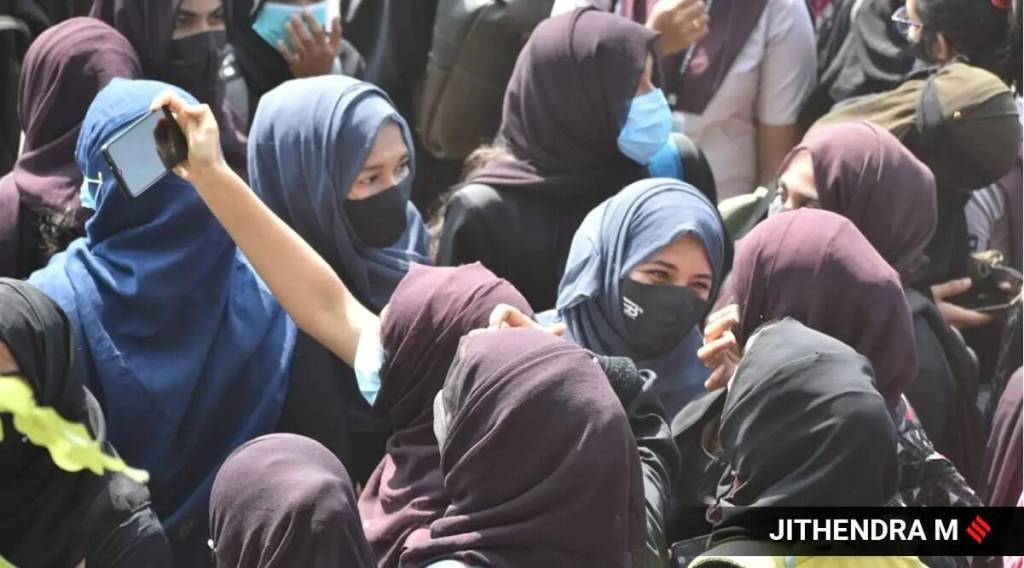
A recent report published in The Indian Express revealed that there has been a significant shift of Muslim students from government colleges to private pre-university colleges (PUCs) in Udupi district, which was the hotbed of the hijab protests in 2022. In 2022-23, the enrolment of Muslim students in government PUCs has dropped by half, including that of Muslim boys (from 210 to 95), while Muslim girls’ enrollment has dropped from 178 to 91 in PUCs in 2022-23. There has been a simultaneous offsetting of this drop by the increase in enrolment in private PUCs. These are worrying numbers but perhaps unsurprising. They also reveal a great deal about the educational choices that marginalised Muslim students and their parents were forced to make in the light of a binary they never wanted to deal with – education or faith — and the binary the state should never have put before them: The right to education or the right to religious freedom.
A brief look at the history of Karnataka’s education sector will tell you that it was one of the first states to embrace privatisation, right from the 1970s. This extended to all sectors, not just education, as the state gradually withdrew from investing in public-sector enterprises. This has been a fragment of the larger story of the Indian education system, which witnessed unprecedented massification in the last few decades, especially from the 1990s, post-liberalisation. Unfortunately, this speedy massification has had two major flaws: It was led more or less by private players, and the massification did not necessarily mean an expansion of equity or access. In short, it has left behind many marginalised communities who suffer the cumulative deprivation of poverty, social identity and location. Seen in this context, it is unsurprising that one of the (perhaps, unintended) side effects of the hijab ban has been to push students out of government institutions, towards private institutions they can often barely afford.

About 44.81 million — 16.6 per cent male and 9.5 per cent female — Indian undergraduate students aged between 18 and 24 cannot afford to pursue higher education, according to the National Sample Survey (NSS), 2014. According to the AISHE (2019-20), 78.6 per cent of colleges are run by the private sector, aided and unaided, but cater to only 66.3 per cent of the total enrolment. Poverty is one of the major deciding factors in educational choice, with even eager and willing parents finding it impossible to send their children to the schools of their choice. India also has high out-of-pocket expenditure (OOPE) in both healthcare and education, with parents often making uncomfortable choices between what is perceived as lower-quality government services or unaffordable private services.
Education is a public good, a human right and has positive public benefits, not just for the individual or the community but the nation as a whole. But who did the hijab ban benefit, really? The claims that were made intermittently – in favour of discipline, ensuring public order, maintaining the decorum of the schools, etc – now seem ludicrous in the face of the reality that the students were effectively pushed out of the school altogether.
Saniya Kawazi, a student from Gokak, Karnataka pleaded with her teachers, saying that it had taken her 15 years to get “here” and to not deny her taking the exam in the aftermath of the hijab ban. The “here” is a precarious, often impossible dream that is cobbled together by marginalised Muslim parents, through crippling debts, loans, and requests and by powering through the fears and anxieties of perceived discrimination that is a very real part of educational choice-making. For a long time, it was mistakenly assumed that Muslim families are not interested in secular education — the stereotypes still persist. But various studies, including the Sachar Committee Report, have busted this myth, and show that Muslim students and their parents express an earnest desire to send their children to the best of institutions, but are hindered by the many social, economic and political compulsions. Many of the students were in limbo all across 2022, finding it too late to transfer to a private PUC in the middle of the year, even if they could somehow afford it.
A great deal of ink has been spent on the religious connotations of hijab, secularism debates, its “essentiality”, the constitutional positions on religion in the public sphere, and so on. But less has been investigated in terms of who the hijab ban really benefited. Eventually, by design or by fluke, the ban has fit exceedingly well into the broader collapse of public education and the idea of education as a public good. The rampant commercialisation that haunts Indian education is an oft-told story. But its intricate relationship with the politics of hate and exclusion is less understood. The premise of the constitutional vision of education as well as of the welfare state that came into existence over 75 years ago was deliberately focused on the most marginalised, the idea that no one ought to be excluded, actively or implicitly from the path of progress and self-realization. Instead of communalising spaces of exchange and democratisation — what public education is meant to be — the government should be concerned that students are being actively forced to drop out to pursue education they cannot afford.
The writer is a PhD researcher at the Centre for the Study of Law and Governance, JNU



 Share


