5 min readSep 30, 2023 09:43 PM IST
First published on: Sep 30, 2023 at 02:00 PM IST
Indian-American comedian Hasan Minhaj is best known for his political satire. But as a voice of the South Asian diaspora in America, should his stand-up material be viewed purely as comedy or does he deserve criticism for playing fast and loose with the truth?
Minhaj, previously the host of the satirical news show Patriot Act on Netflix and a contender to replace Trevor Noah as the host of The Daily Show, was the subject of a recent The New Yorker piece on his “lenient” approach to factual accuracy in his stand-up comedy sets. In the piece, journalist Clare Malone investigates the veracity of several personal anecdotes centred on race and religion — for instance, an FBI informant infiltrating his local mosque and attempting to bait him and other Muslim boys into talking about jihad.

It turns out, despite Minhaj’s seemingly honest presentation, many of his more emotionally charged stories — having to hospitalise his daughter over an anthrax scare after airing controversial Patriot Act episodes or a white girl rejecting his prom invitation over his race or the FBI informant at his mosque — are partially true at best and entirely fabricated at worst. But Minhaj says there’s an “emotional truth” at the core of his stories, which justifies the parts that are untrue and helps drive home his message on societal issues.
These stories, however, were a part of Minhaj’s stand-up shows, not his news-satire show Patriot Act, for which the bar for factual accuracy is understandably higher, even if the hosts of such late-night shows often claim they’re not journalists.
Don’t get me wrong, as a journalist, fabricating a story about an anthrax scare doesn’t sit right with me. Knowing the truth now, it feels manipulative, even if it is based on a real experience. But what are the standards for fact-checking in stand-up comedy? And how often do comedians face this kind of scrutiny over their material?
It’s not entirely surprising that comedians will exaggerate or invent stories and characters for comedic effect. That creative licence isn’t questioned for most comedians — many have even admitted to fabricating the stories behind some of their best punchlines.
It seems to me that the content of Minhaj’s comedy — discussions on race, religion and identity — sets him apart from many of his peers and is partly the reason behind the kind of scrutiny he faces in Malone’s The New Yorker piece.
Having spent several years in the US as a student during the Donald Trump presidency, I know it’s not easy to have a discussion on identity, especially as a minority, without it becoming “political”. When so many aspects of your identity are subjects of political discourse and government policy (the travel ban on some Muslim countries under the Trump administration, for instance), a personal opinion can become a political stance.
As a prominent brown, Muslim man in America, Minhaj has become somewhat of a voice for the South Asian diaspora. Both the Patriot Act and his stand-up material address issues that are central to the immigrant and minority experience.
Scrutinising the Patriot Act, primarily a news show, is a different matter. The criticisms Minhaj has faced from his own staff over lax fact-checking are fair and warranted. I don’t think the same can be said for his stand-up act. The objective of his stand-up comedy is not only to get a laugh and sell Netflix specials but also to highlight social issues around identity. I think this muddies the water, blurring the line between pure comedy and honest discussion on sensitive and frequently politicised subjects like race and religion. This, however, isn’t an issue many comedians have to grapple with, if their material doesn’t straddle that line.
America has become an increasingly polarised country — conservatives and liberals have likely never been further apart in thought, especially on matters and politics around identity. Social and economic injustice are common enough; perhaps Minhaj doesn’t have to resort to exaggerating his experiences if he can instead shine a light on real stories, many gut-wrenching enough without embellishment, to supplement the “emotional truth” of his own stories.
anjishnu.das@expressindia.com

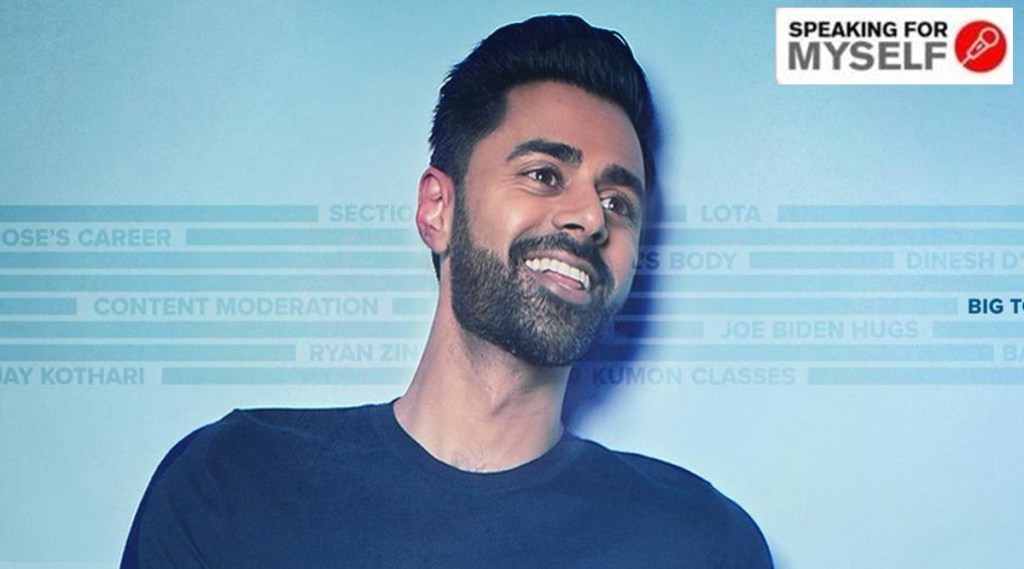 Hasan Minhaj was the subject of a recent The New Yorker piece on his “lenient” approach to factual accuracy in his stand-up comedy sets. (Photo: X/@patriotact)


 Share


