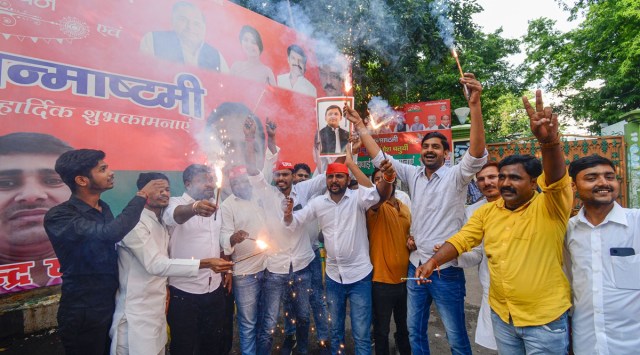

The Ghosi by-election can be seen as the first battleground between the INDIA alliance and the BJP-led NDA alliance in Uttar Pradesh. But more importantly, it was a test for the less-talked-about Akhilesh Yadav’s PDA strategy. The Ghosi assembly constituency of the eastern Uttar Pradesh’s Mau district became vacant for re-election after the resignation of the Samajwadi Party (SP) MLA Dara Singh Chauhan who joined the BJP. The byelection results announced the SP candidate Sudhakar Singh as the winner with a huge vote margin of 42,759. BJP’s Dara Singh got 81,668 votes against Sudhakar Singh who bagged 1,24,427 votes. It is a major victory for the SP in the national context as it consolidates Akhilesh Yadav’s position as a key leader in the national level INDIA alliance of opposition parties.
PDA, which stands for pichde (backwards), Dalits, and alpsankhyak (minorities), is a renewed game ball thrown by the SP chief to win back the support of the MBCs (most backward communities) and non-Yadav OBCs who seem to have been drifting towards the BJP in the last decade. Although the PDA strategy has not figured in national media in a big way, and in relation to discussions around the INDIA alliance, it has the capacity to revolutionise the politics of social justice, which many scholars have announced as “dead politics”.

The rise of regional parties such as SP, BSP, and RJD in the wake of the Mandal Commission Report and the resulting agitation for reservation was unprecedented. That moment seemed to have passed in the political history of India. However, the caste census demand has put the focus back on the question of social justice. For SP, the PDA marks a new beginning and a renewed focus on the welfare politics of the marginalised communities that many INDIA alliance parties are seeking to affirm through various other ways. Rahul Gandhi’s call for Jitni Abadi, Utna Haq (distribution of public resources proportionate to the population) coupled with various opposition parties’ (SP, RJD, and Congress) demand for a caste census has brought the question of social justice to the forefront of Indian politics again. SP’s ability to carve out an election strategy out of this fluid demand has put it as a forerunner, like the RJD in Bihar which has made caste census a reality, in this political race.
The Ghosi election victory also consolidates the position of SP in the INDIA alliance as a party capable of delivering PDA votes — who form the largest block of voters. It also consolidates the existence of the alliance as INDIA members (Congress, Apna Dal Kamerawadi) and Suheldev Swabhiman Party supported the SP candidate Sudhakar Singh by issuing a statement of solidarity and asking their prime voter base and local support teams to vote for the SP candidate. Though formed outside of the context of the Ghosi by-election, the INDIA alliance added to the strength of the SP and its eventual victory as the fight was mainly between BJP and SP.
The Ghosi by-election marks several strategic departures in the mobilisation approach of the SP as it illuminates how the politics of PDA was translated onto the field. With about 4.3 lakh voters, the Ghosi seat has a significant PDA population: About 90,000 Muslims, 60,000 Dalits, 50,000 Chauhans, 40,000 Yadavs, and 60,000 Rajbhars. First, the party entered street and neighbourhood activism. They mobilised with Akhilesh Yadav at the front, along with key leaders such as Shivpal Singh Yadav, Naresh Uttam Patel, and Ram Gopal Yadav. Heads of state and national level committees — Rajpal Kashyap, head of the OBC wing and Juhie Singh, the National President of the SP’s Women Wing — led everyday campaigns raising issues of marginalised and excluded communities and were successful in appealing to voters. Such a campaign allowed a diverse set of voters to connect with the SP’s PDA ideology. The victory also brings the SP closer to Dalit voters as BSP supremo Mayawati asked her party cadre and voters to stay away from the Ghosi by-election and vote NOTA. The local media suggests that Dalits voted for the SP candidate in large numbers.
What is even more interesting is that the PDA strategy has come out as a socio-economic issue-based strategy rather than a mere reassembling of caste leaders. Sudhakar Singh, from the dominant Rajput community in the region, was pitched as an insider against Dara Singh who hails from Azamgarh and is considered to be the leader of the OBCs. It was believed that the BJP had an upper hand as it had not only Dara Singh Chauhan, the ex-SP MLA, as a candidate who has a huge following among Chauhans in its fold, but also Om Prakash Rajbhar, the founder leader of the Suheldev Bhartiya Samaj Party, an ex-ally of SP and now part of the NDA alliance. Rajbhar campaigned aggressively for Chauhan along with the top leaders of the BJP. Ghosi voters have alternated parties in the last 30 years giving SP a double chance this time, which itself is a statement of the SP’s entrenched political mobilisation. Retaining the seat for the SP, after its winning candidate, Chauhan, migrated to the BJP, was key to its image as a party — one that can win with any candidate. Overall, the Ghosi victory has provided a glue to the PDA strategy and social justice politics in the region. It has the potential to bring new OBC and MBC voters into the SP’s fold as issues of caste census and reservation have returned to the political centre stage. Such a strategy, combined with the ongoing Lok Jagaran Yatra and the Cycle Yatra, poses a formidable challenge to the BJP and NDA alliance for the 2024 general election.
The writer is a historian based at the University of Nottingham, UK


