Over the past week, the media has been faithfully reporting proceedings before a Bench of five judges of the Supreme Court as to whether the Constitution 103rd Amendment Act, 2019 violates the “basic structure of the Constitution”. After the hearing is over, the judges will render their decision. But in the meanwhile, here are some ideas about the origin of the Constitution’s “basic structure”.
Courts are empowered under our Constitution to invalidate not only executive orders, but also legislative enactments that violate any part of the Fundamental Rights guaranteed in Part III of the Constitution (Bill of Rights). But as to whether they are also empowered to adjudicate on the validity of constitutional amendments — passed with the requisite special majority and following the procedure prescribed in Article 368 — the Constitution is silent.

Up to the year 1989, with one single political party almost consistently returned to power at every election, the judges had plumbed the depths of silence in the world’s longest Constitution searching for some limitations on the amending power. They found none; and they said so, emphatically, in 1951 in a Bench decision of five judges (Sankari Prasad vs. Union of India). Fourteen years later — a different Bench of five judges — said no again (Sajjan Singh vs. State of Rajasthan), but this time with some hesitancy.
Ultimately, in 1973 in Kesavananda Bharati, a larger Bench of 13 judges sat for the longest time (several months) listening to arguments on what was described as “an issue of grave moment, not only to the future of this country but to the future of democracy itself!” In a fractured verdict, by a 7:6 majority, it held that though under Article 368 Parliament’s power to amend the Constitution was plenary, extending to each and every article of the Constitution including the articles enumerated in the Fundamental Rights Chapter, no amendment was permissible if it altered “the basic structure or framework of the Constitution”.
By reading implied limitations in the amending power, the Supreme Court established a new precedent (overriding two prior judicial precedents). But the majority view was roundly criticised. It was said that by propounding the basic structure theory, the guardians of the Constitution had at one bound become guardians over the Constitution — constitutional adjudicators had assumed the role of constitutional governors! With the Congress party having secured an overwhelming majority in Parliament (after the general elections of 1971), the country might have moved into a period of grave constitutional crisis. But then, fortuitously, fate intervened: On June 12, 1975, in the High Court of Allahabad, Indira Gandhi lost the election petition filed against her by Raj Narain (he had contested against her in the 1971 elections from Rae Bareilly). The unthinkable had happened — a prime minister in office had been unseated in Parliament.
And whilst her appeal to the Supreme Court was pending, an Internal Emergency was first imposed from June 25, 1975. Then, in August 1975, Parliament hurriedly passed the Constitution 39th Amendment Bill. It provided (amongst other things) that no law made by Parliament (that is, existing election laws) would apply to the election of a person appointed as Prime Minister; the election of such person shall not be deemed to be void or ever to have become void; it would continue to be valid in all respects.
In effect, the judgment of Justice Jagmohan Lal Sinha of the Allahabad High Court — holding Mrs Gandhi guilty of “corrupt practice” under then existing election laws — was attempted to be reversed by a constitutional amendment. This crude attempt was resisted by a Constitution Bench of five judges, relying for the first time after Kesavananda Bharati, on the basic structure theory of the Constitution. In Indira Gandhi vs. Raj Narain (1975), a Constitution Bench of the highest court held — under compulsion of a monstrous law — that free and fair elections were a fundamental part of the Constitution, so fundamental as to be beyond the reach of the amending power, all the five judges on the Bench having been a part of the Bench of 13 judges in Kesavananda Bharati. It was this decision (in Indira Gandhi vs. Raj Narain, 1975) that helped to cement the “basic structure theory”.
The decision constitutes a high watermark in the assertion of the Court’s judicial power in the teeth of a determined majoritarian regime. Much later, in 2007, a different Bench of nine judges in I.R. Coelho vs. State of Tamil Nadu, in a unanimous decision, authoritatively upheld the narrow majority view (of 7:6) in Kesavananda Bharati, and gave it permanent constitutional validity.
The basic structure theory was the response of an anxious and activist court to the experience of the working of India’s Constitution during its first 25 years. It has come to stay more because of political compulsions than acquiescence because initially for a long period, no single political party in India had secured a two-thirds representation in Parliament. (A two-thirds majority is required for the passing of a constitutional amendment).
After the return — since 2019 — to one-party super-majoritarian rule, it remains in force today only because it has not been successfully invoked on too many occasions.
The writer is a constitutional jurist and senior advocate to the Supreme Court

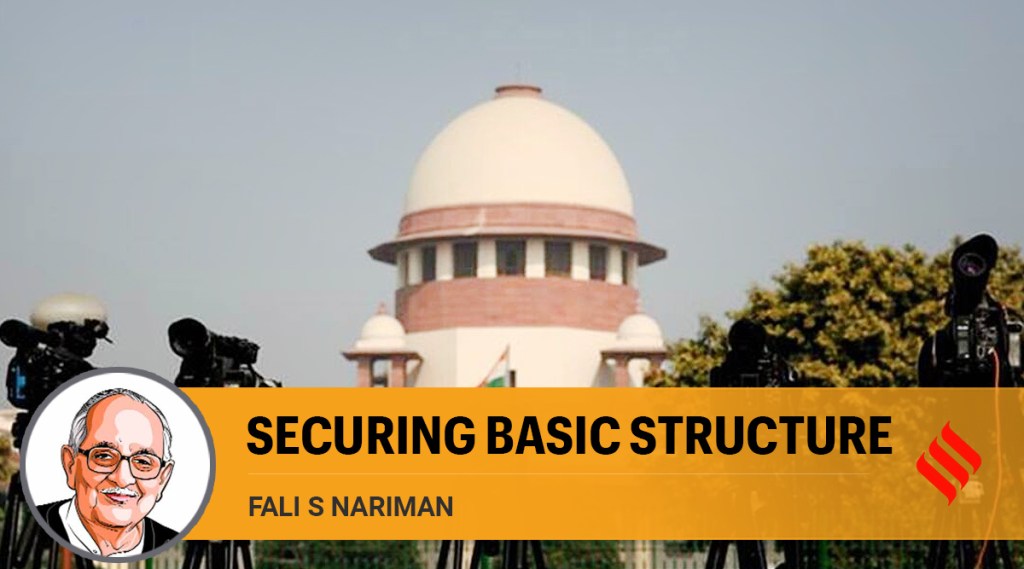 The basic structure theory was the response of an anxious and activist court to the experience of the working of India’s Constitution during its first 25 years. (File)

 Share


