6 min readMar 5, 2025 12:13 PM IST
First published on: Mar 5, 2025 at 12:12 PM IST
A growing sentiment among international relations analysts and major sections of the global media is that President Donald Trump’s statements, policies and actions will lead to changes in the world order. Trump’s plan for the Gaza Strip, his desire to acquire Greenland but, above all, his direct outreach to Russia and pressure on Ukraine, brutally manifested in his Oval Office meeting with Ukrainian President Volodymyr Zelenskyy on February 28, are being interpreted as his disdain for the basics of the world order established, essentially by the United States, after World War II.
A central component of the world order was the Transatlantic Alliance (TA) whose military arm was NATO. The TA consisted of the US and western European countries. With the end of the Cold War, it has embraced members of the expanded European Union (EU) and NATO states within its fold. It was clear, right from the beginning, that the US was the principal country of the TA, and if and when it cracked the whip, other countries had no alternative but to comply. This was witnessed in 1956 when President Dwight Eisenhower compelled Britain and France to abandon the attack on Egypt after President Gamal Abdul Nasser nationalised the Suez Canal. Notwithstanding this show of power, the US sought to maintain a veneer of collective collaboration in the TA as among sovereign equals. But the veneer was always thin and the world knew it. Significantly, during the Cold War, the USSR which was the main country of the Warsaw Pact and the main power and ideological rival of the TA, kept other Pact members on a tight leash.

Unlike his predecessor, President Joe Biden, Trump has, till now, ignored European members of the TA on Ukraine-Russia peacemaking efforts. More than that, he has indicated that realism demands that compromises will have to be made on Ukraine on one of the formal tenets of world order — the sanctity of a country’s sovereignty and territorial integrity. The fact is that for the TA countries, these principles really mattered only in respect of Europe for this was considered an essential pillar of the European security system; hence, the strong response to Russia’s invasion of Ukraine. Their violation in other parts of the world was of little consequence to the TA countries unless their interests were threatened, such as in Afghanistan when the Soviet forces entered that country in 1979. Trump is indicating that Europe cannot consider itself unique and must be ready for compromises, or, in his idiom, deals.
There are two more points regarding his Ukraine-Russia approaches that analysts have to take into account. The first relates to the realism he showed in ending the US involvement in Afghanistan when he signed an agreement with the Taliban in February 2020. That agreement was tantamount to US’s strategic defeat in the “forever war”; but he swallowed that bitter pill. Other members of the TA did not demur because it did not directly impact European security though it did lead to illegal migration flows out of Afghanistan. The second relates to Trump making it plain to European members of the TA that they must bear the principal costs of ensuring European security even if it means a change in their lifestyles. EU members are irked by this because they have got used to the advantages which come with less funds being deployed for defence.
There are major differences between Trump and European TA members on whether Russia can be “trusted” even if Ukrainian interests and the tenets of European security are compromised in a deal with Russia. But these differences and Trump ignoring Europe in holding talks with the Russians in Riyadh and his conversations with President Vladimir Putin cannot be seen as him abandoning the TA. As a businessperson, he knows the continuing comprehensive significance of the TA for all its members. The European Council notes that the US and EU “together… represent almost 30 per cent of global trade in goods and services and 43 per cent of global GDP. In 2023, transatlantic trade in goods and services reached €1.6 trillion”. Trump is putting pressure to get better terms and move manufacturing to the US in greater measure. However, he and his strategic advisors would know that the TA is required to combat the Chinese. Indeed, he cannot allow China, the US’s principal challenger in replacing it as the world’s pre-eminent country, to make inroads into the EU. China may be a greater threat in the Indo-Pacific but it is getting an international reach and is getting deep strength in science and technology. The TA along with Japan will have to act together in these areas if they wish to retain their leadership in these critical knowledge areas.
There is no need to confuse Trump’s abrasive style and articulation and his setting aside of diplomatic courtesies with the substance of his strategic approaches and his realism. In his first term, too, he displayed a disregard for the conventions of inter-state interaction. That has increased manifold now. Europe will have to learn to live with Trump’s ways just as other parts of the world had to perforce adjust — or simply had no alternative — to its disdain for “lesser breeds without the law” during the colonial period. However, the European component of the TA should know that Trump has little alternative but to not allow any deal reached between Russia and Ukraine to be broken by the former. That would shatter the US’s position globally.
Trump seems convinced, and not without justification, that the TA reneged on the informal understandings reached with the USSR on NATO expansion and a deal on Ukraine may create some space between China and Russia to the TA’s advantage. In any event, the main poles of the world order are not going to change with the dust that Trump is raising these days.
The writer is a former diplomat

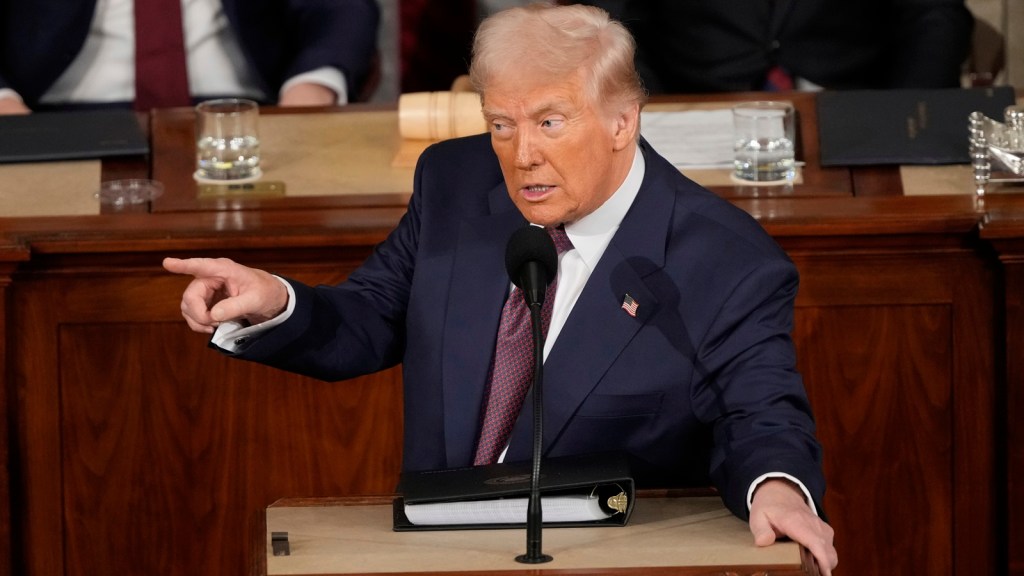 President Donald Trump addresses a joint session of Congress at the Capitol in Washington on Tuesday. (Photo: AP)


 Share


