
On December 4, 1985, fuming sulphuric acid (oleum) gas leaked from a fertiliser plant in the Karampura area of West Delhi, enveloping the surrounding neighbourhoods. Scores of residents fell ill, and one person died because of inhaling the gas. As things are in India, this would hardly constitute a major industrial disaster, and yet the aftermath of the event continues to inform environmental law, policy, and public perception. This is because the event transpired exactly a year after the Bhopal disaster, which had alerted the entire world to the latent risks of industrialisation and corporate greed. Following the oleum leak, lawyer MC Mehta took the Union of India to court via a public interest litigation seeking the relocation of hazardous industries from Delhi.
Over the years, the case would come to include many other concerns related to air pollution in the Delhi region and beyond, leading to actions like industrial relocation and the transition of the city’s public and paratransit fleet to natural gas. Once a thriving industrial area, Karampura is today a patchwork of commercial establishments like car showrooms, factory outlets, and banquet halls, while the compound that housed the fertiliser plant has transformed into an upscale multi-storied apartment complex. The present economic and social character of the place, in short, is a direct consequence of the changes the oleum case set in motion.

Urban planners and designers consider citymaking an intentional process through which urban spaces are produced using technical, creative, and participatory means. Citymaking, however, is also an outcome of a multitude of unintentional and unanticipated processes. Forty years after the oleum case, now is a good time to take stock of how air has shaped the fabric of the capital city.
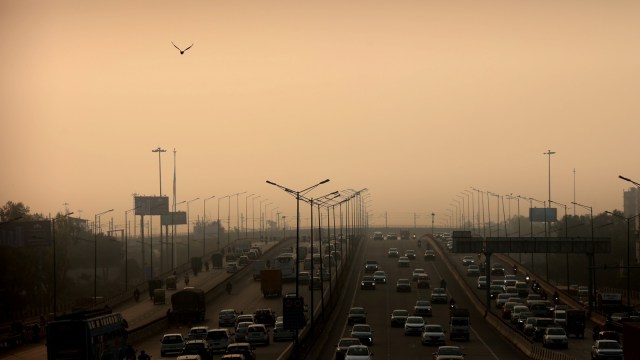
The first aspect concerns the infrastructures we take for granted, but which have been created primarily to clean the air. The CNG transition was made possible by the chain of gas stations built across the city. A similar process with EVs is currently underway, and the PMO’s directive to accelerate the transition by creating the required infrastructural ecosystem underscores the point. Alongside fuel, the 270-km-long peripheral expressway built to act as a bypass for traffic passing through Delhi is another major air-related intervention. This massive project is aimed at vehicular emissions, but has come to transform Delhi’s vast periphery, leading to the consequent growth of industries, warehouses and land speculation. An even bigger infrastructure is the Delhi Metro. The promise of the Metro, as part of what was then known as a mass rapid transport system (MRTS), to curb air pollution was a major rationale at its inception.
Secondly, urban governance has been fundamentally affected by air. In particular, the judiciary has been a critical agent of policymaking and implementation of extant policy. From the MC Mehta case noted above to the Arjun Gopal case related to the banning of traditional firecrackers, courts have been extremely proactive in taking up air pollution in the Delhi region. The frameworks of absolute liability and precautionary principle, and the inclusion of technical expertise to assist the regular work of the court in environmental matters via the Environment Pollution (Prevention and Control) Authority (EPCA) are some innovations that Delhi’s air has engendered in the arena of environmental jurisprudence. Even today, there is a sort of wintertime reconfiguration of governance as the courts issue directions that ministries and departments must track and be seen to enforce. The odd-even experiment, subsidies on the happy seeder to reduce stubble burning, and changes to school and office calendars to account for the autumn smog are some other air-related policy interventions.
Finally, bad air has produced new identities and solidarity amongst the city’s population. A leading pulmonologist recently noted that new patients are being created by Delhi’s toxic air, as a growing number of residents begin to pay attention to the otherwise mundane act of breathing, and to the condition of breathlessness they encounter. Several citizens have made air their life’s work, whether as scientists, activists, journalists, doctors, entrepreneurs, or very often, a combination of these. Many of them collaborate to know the issue better, to design technical fixes, and to push the state to act.
As we hurtle deeper into an uncertain world where environmental crises loom large, it is important to recognise how things like toxic air contribute to new built forms, policy, and social norms. The question before us is how accessible and democratic these changes are in the collective pursuit of a more humane city.
The writer is associate professor of Public Policy and Management, Indian Institute of Management Calcutta


