5 min readDec 24, 2020 08:53 AM IST
First published on: Dec 24, 2020 at 04:00 AM IST
In a landmark verdict in Karan v. State N.C.T. of Delhi, the Delhi High Court has secured the right to restitution for victims of crime. The progressive impact of the judgment on victim jurisprudence will certainly be unparalleled.
Even though Section 357 of the CrPC empowered courts to order the accused to pay “compensation” to the victim, this was rarely followed. This led the apex court to observe on multiple occasions that Section 357 must be used liberally. Ultimately, in Ankush Shivaji Gaikwad v. State of Maharashtra (2013), the SC held that lower courts must apply judicial mind and record reasons for passing, or not passing, orders pertaining to the use of Section 357 — effectively making its application mandatory.

However, the lower courts found practical constraints while applying Section 357. First, these courts were limited by the language of Section 357, which allowed them to issue orders for only such compensation as may otherwise be recoverable in a civil court. Second, the courts were restricted by the absence of a uniform head under which compensation could be granted. Third, the absence of a uniform mechanism to calculate the paying capacity of the accused as well as ascertaining the impact of the crime on the victim prevented courts from granting compensation under the section without risking arbitrariness. Fourth, the absence of sentencing guidelines impeded the application of the section. Neither Section 357 nor the SC judgment in Ankush Shivaji Gaikwad came to the aid of the courts with respect to these limitations.
The significance of the Karan verdict lies in the Delhi High Court’s use of the Victim Impact Report (VIR) to determine the quantum of compensation. The Court’s version of VIR is loosely based on the concept of Victim Impact Statements (VIS), but with some significant differences. VIS is an instrument of victim participation, which effectively allows victims to inform the court in their own words as to how the crime impacted them. Barring minor variations, the VIS’s format comprises the description of physical injury, emotional harm, or the damage or loss to property as a result of the offence.
VIS provides victims with the opportunity to directly address the court and, therefore, works towards providing them assurance about their concerns being heard and addressed by the court. It allows the victim to come to terms with the offence and makes the offender perceive and realise the impact of the crime on the victim. It also works to aid the court in determining the quantum of the sentence and fine.
It is in this sense that the Delhi HCs conception of VIR differs from a traditional VIS. The primary purpose of the VIR in the Court’s conception is to act as an aid to determine the quantum of compensation to the victim in conjunction with the paying capacity of the accused. The VIR will not be directly made by the victim before the court but will be filed by the Delhi State Legal Services Authority (DLSA), which shall conduct a summary inquiry to ascertain the impact of the crime upon the victim.
The DLSA shall submit a report that reckons the paying capacity of the accused as well as the impact on the victim, after a conviction. The courts will have to pass an order of compensation based on this report, and in the manner laid down by the judgment. The scheme is binding on all lower courts in Delhi that deal with criminal cases.
While the verdict generates hope for victims, there are certain concerns. For instance, the language of Section 357 does not differentiate between restitution and compensation. Restitution includes reparation made by the offender while compensation is paid by the state. Unless this difference is statutorily recognised, ambiguity is bound to persist. Moreover, VIR/VIS should not remain merely limited to calculating restitution; it must be effectively used in the sentencing process — especially because the victim is not a party when the court hears the offender on the question of the sentence. The need of the hour is that the courts come forward to adopt VIR/VIS as one of the best practices in the interest of justice to victims of crime.
This article first appeared in the print edition on December 24, 2020 under the title “Justice as relief”. Bajpai is professor and chairperson at the Centre for Criminology and Victimology at National Law University Delhi who also acted as Amicus Curiae in this case. The inputs by Ankit Kaushik are acknowledged

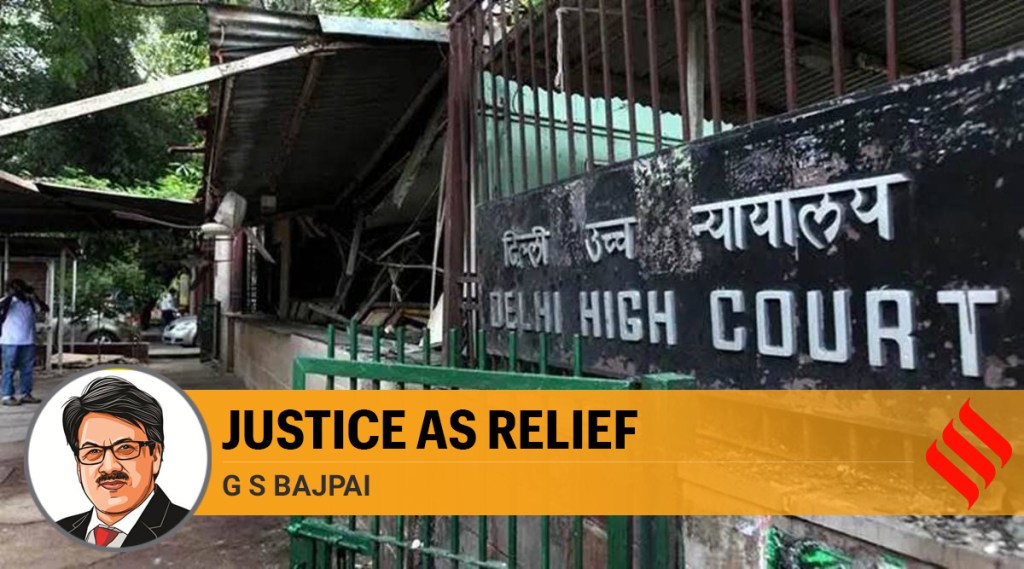 Delhi High Court

 Share


