Notwithstanding his great eminence and the difference in our ages, Dr Manmohan Singh and I shared at least two things: A love for policy-relevant economics and a university, Cambridge. I was at New Hall in the 1970s, he at St John’s College in the 1950s.
Today, if you enter the dining room of St John’s, not from the High Table side where the professors enter, but from the far end, where the students enter, and look above the entrance door, you will see Dr. Singh’s portrait hanging — he looks out with a contemplative smile. The portrait personifies him in many ways: A quiet gaze that took in everything, and a man who, even with a few words, expressed a great deal.

I first met Dr. Singh in late 1981, across a table when he was chairing the selection committee for an Associate Professorship in Economics, as Chairman of the Board of Directors at the Institute of Economic Growth (IEG). I was a candidate.
From 1981 (when I joined IEG) to 2019, I met him many times on different occasions in different locations, before, during, and after his prime ministership. Each meeting – official or personal – left its imprint.
Dr Singh was both an economist and a politician, but the contrast between his speeches on economic issues and those on political matters was striking. In the latter, he spoke each word slowly and carefully, often reading from a written text. On economic subjects, however, he was extremely lucid, often making a point with passion and wit. For example, as PM, when releasing M S Swaminathan’s book, From Green to Evergreen Revolution in 2010, after some formal comments, Dr Singh set his notes aside to talk extempore about Indian agriculture and the economy, drawing on his deep knowledge of both classical economists, such as Smith and Ricardo, and current thinkers, while outlining Swaminathan’s pioneering contributions.
Again, in 2019, when five volumes of his writings and speeches, Changing India, were released at the India International Centre (Delhi), Dr Singh spoke at length about his intellectual journey, without notes, with self-deprecating humour, famously saying that he was not only “an accidental prime minister” (the title of Sanjay Baru’s book) but also “an accidental finance minister”, as the audience burst into laughter.
During UPA 1, soon after he became prime minister, I interacted with him to request legal reform in women’s rights in property. The earliest of these meetings was in February 2005, when I went to his office with two colleagues to submit a detailed note and petition, signed by several hundred individuals and organisations, asking for gender equality in Hindu inheritance law, by comprehensively amending the Hindu Succession Act (HSA) of 1956. He congratulated us for our efforts and asked a few questions. But when I enquired if he would take this forward, he simply smiled and folded his hands. I took this as a ‘yes’. The UPA government did indeed act on the suggestions. On 29 August 2005, Parliament passed the Hindu Succession Amendment Bill, 2005, now an Act. It was one of several pieces of progressive legislation that UPA enacted in just one year (others being the domestic violence act, RTI and MGNREGA), all benefitting women and the poor – a landmark for any Prime Minister.
Socially, however, he was a reticent man, even at the dinners he hosted for dignitaries as PM. I especially recall one that he gave for the Cambridge University Vice Chancellor, Leszek Borysiewicz. I was seated almost facing the VC and Dr. Singh, and I decided to break the silence by asking Sir Borysiewicz about his research on viral immunology. Perhaps not the best topic for a dinner conversation, but it did the trick!
Over 2009-2012, I met Dr Singh in another capacity – he was chairman of IEG’s Board of Trustees when I was Director of IEG, one of India’s oldest and renowned policy-oriented research institutions, founded by Prof. VKRV Rao. Dr Singh always took a keen interest in IEG matters and was generous with his time, despite his many prime ministerial engagements. His decisions remained cautious, however. Once when I was asked to suggest potential names for filling two vacancies on the Board of Trustees, he preferred someone he knew well, saying “Bina, baki logon ko main khud nahi jaanta” (I do not know the others personally), adding that the trustees must work as a team.
Although Dr Singh had degrees from both Cambridge and Oxford, Cambridge was closer to his heart. In the 1950s, when he was studying Economics there, so were five other South Asians: Jagdish Bhagwati, Mahbub ul Haq, Lal Jayawardena, Amartya Sen, and Rehman Sobhan. In his forthcoming book, economic historian, David Engerman, calls them Apostles of Development, and depicts the history of international development through the lives and works of these Cambridge six.
Great men are also known through their families. At times, when I visited his residence privately, Dr. Singh would speak with pride about his three daughters, one of whom – Amrit – a prominent human rights lawyer, was based in the USA and thus less known in India than her sisters, Upinder and Daman. I met Amrit in New York in 2008, when I was teaching at the New York University School of Law, and was struck by her drive and passionate commitment to human rights.
My last memorable meeting with Dr Singh was in 2019. I had just returned from a visiting professorship at Cambridge, during which I had discovered his portrait at St. John’s College. He was pleased to get a print of this portrait (although taken from my cell phone) and eager to hear about the changing face of economics at Cambridge. As always, under Mrs. Kaur’s hospitality, I was served tea and cookies in fine China. And when it was time to leave, Dr. Singh accompanied me to the entrance of his home on Motilal Nehru Road and bid farewell.
I will miss his sage presence in my life – a man of few words whose modesty cloaked an encyclopaedic knowledge of economic theory and practice, an incisive intellect, and a deep capacity for human understanding.
The writer is former Director and Professor, IEG and Professor of Development Economics and Environment, GDI, University of Manchester

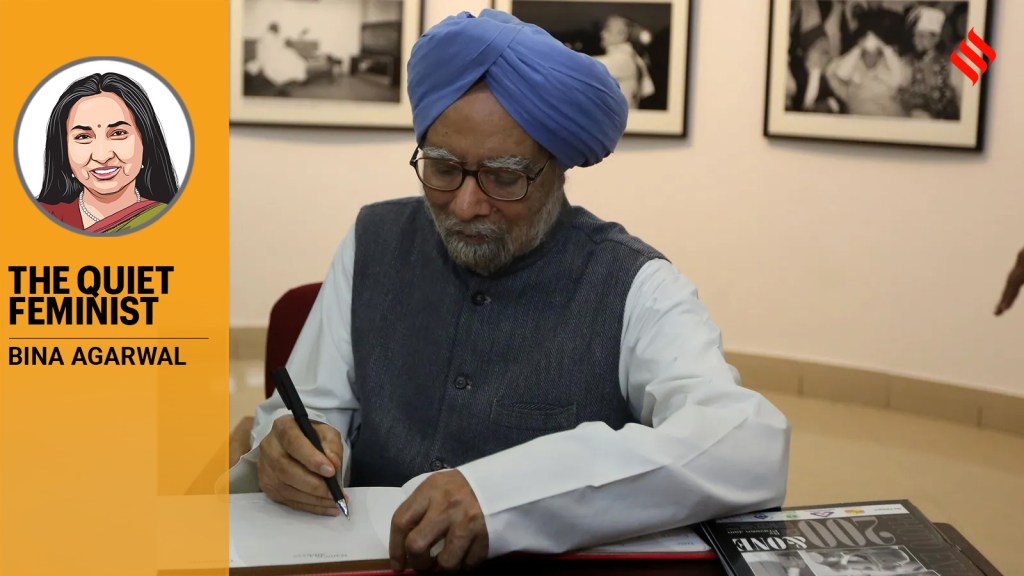 Dr Singh was both an economist and a politician, but the contrast between his speeches on economic issues and those on political matters was striking. (Express Archive Photo)


 Share


