The internet was flooded with stories of Goldin’s contributions on the pay gap, gender-blind recruitment, the role of the contraceptive pill in women’s career trajectories, the work-life trade-offs facing American, college-educated women and the inequity within couples triggered by unequal care-giving and “greedy jobs” that require high intensity and complete focus at an age when women must contend with their desire to nurture children.

In a world where women are often penalised for being brilliant, where economics is often collapsed into tired macroeconomic models, cute econometric techniques or breathless discussions on growth rates, a woman who studied the economics of womanhood won. So much has been said and written; but I wish to highlight three critical strands in her work that may be helpful to those of us outside the academy.
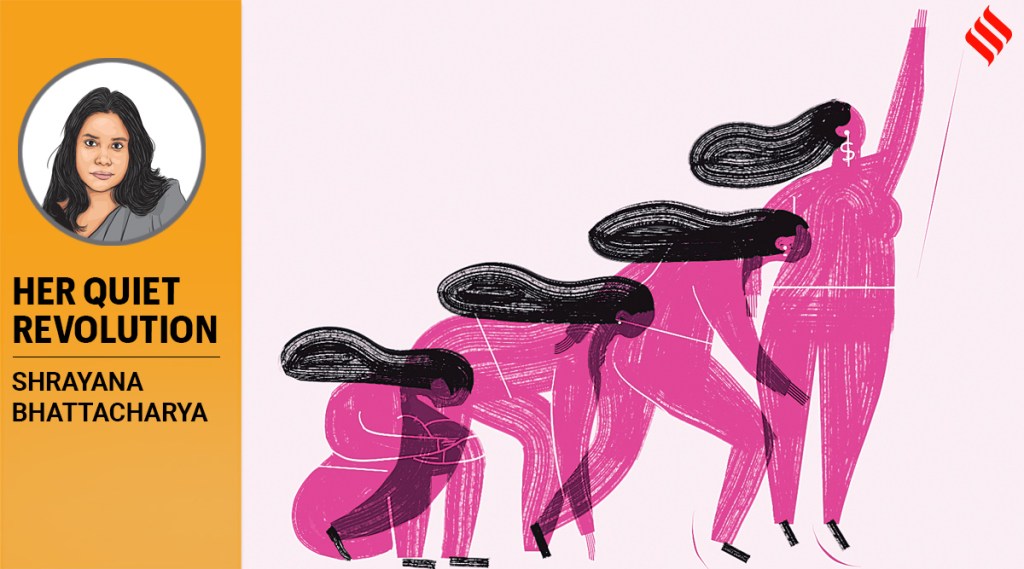
First, Goldin’s important framing of “quiet revolutions” in the labour market can help us be more clear-eyed when we talk about women’s economic empowerment. In her 2006 paper, “The Quiet Revolution that Transformed Women’s Employment, Education and Family”, Goldin reflected on the inter-generational changes in women’s quotidian attitudes towards their own education and employment. She described how the modern role of women in the US economy can be charted in four distinct phases.
While she classifies the period from the late-19th century till the late-1970s as “evolutionary”, where married women’s employment rates zoomed up, she argues that this rise in employment led to a “revolutionary” phase in the subsequent decades for highly educated women in the US, despite smaller increases in female labour force participation, compared to the previous phases of history. Her astonishing account, weaving myriad data sources and indicators, suggests that the revolutionary phase began when women who were teenagers in the mid-1960s realised that their lives could be different from their mothers and planned their marriages and education accordingly. She says, “The revolution was a ‘quiet’ one, not the ‘big-bang’ type. I am not using the terms ‘evolution’ and ‘revolution’ lightly.”
For Goldin, the distinction between the two does not lie in the rate of increase in women’s employment, rather in three aspects of women’s choices. The first is what she calls “horizon”, that is, whether at the time of planning her education, a woman perceives that her lifetime labour force participation will be “long and continuous or intermittent and brief”. The second is “identity” — whether a woman derives a sense of personhood from her professional identity.
The third concerns “decision making”, where women are fully autonomous in making their labour market choices. She contends that revolution occurred when American women started working because they found a sense of worth and meaning from their careers, as opposed to working when their families needed the additional money. It involved a cognitive shift from “jobs” to “careers,” which implied shifts in the age of marriage and prolonged investments in acquiring market relevant skills.
Such a framework with its emphasis on measuring generational shifts in ideas of a woman’s sense of self and aspirations remains potent in thinking about how jobs foster more economic autonomy for women, especially those with higher levels of education. Naturally, the stories of change will be vastly different in the Global South or countries like India with high informality rates and multiple axes of inequity of caste and region.
Second, a key lesson from Goldin’s research is the vital importance of deep, rich and interdisciplinary descriptive data in understanding economic well-being and transformation. Her investigations rely not only on seeking “a highly descriptive truth” but also an “analytical one”. In her books and papers, the reader can see a wonderful integration of theory, popular references, painstakingly collected and corrected quantitative data and a deep understanding of all that was transpiring in America beyond the data set. In discussing her methods while investigating any subject, she writes, “At my desk will be several books on the subject, often history books, sometimes sociology, occasionally fiction, rarely economics.”
Unable to use standard surveys as they did not pick up women’s work, she constructed data sets that she described as a “nightmare of matrices” from the national archives and dusty old business directories following suggestions for sources from colleagues across disciplines. The data was collected, as she detailed, the “old-fashioned way — by hand and by me”.
Third, yes, Goldin’s body of work is largely about women in the US labour market. But it is more than that. Her work is an innovative and rigorous historical account of long-term social change within a particular milieu. In a recent interview, she said, with humour, “For economists, change is important — change is interesting. Therefore, men are boring and women are interesting.” Understanding the Gender Gap, her landmark 1990 book, was after all subtitled An Economic History of American Women. Her pathbreaking analysis of 200 years of data debunked the prevalent view that economic growth directly propelled women’s labour force participation. Instead, she showed how the evolution of structures of American society and economy — families, technologies, a shift away from agriculture, growth of specific types of white-collar salaried jobs and labour arrangements — influenced the evolution of women’s economic outcomes. She is a storyteller-economist who traces the past into our present.
If feminism is the conviction that gender and other forms of power relations remain salient in understanding any phenomena, her recognition is a significant moment for the movement. Sure, there will be critiques of the work being anchored in neo-classical frameworks and the West, of being more representative of highly educated women within the US. Some feminists would argue that Goldin’s work does not adequately comment on the power of patriarchy in restricting the choices and agency available to women. However, by centering and privileging women’s bodies, personal lives and social relationships in the study of economic behaviour, Goldin has championed feminising the lens of economic enquiry. Let us hope the policy world follows.
Bhattacharya is the author of Desperately Seeking Shah Rukh. Views are personal



 Share


