7 min readDec 26, 2020 09:47 AM IST
First published on: Dec 26, 2020 at 12:59 AM IST
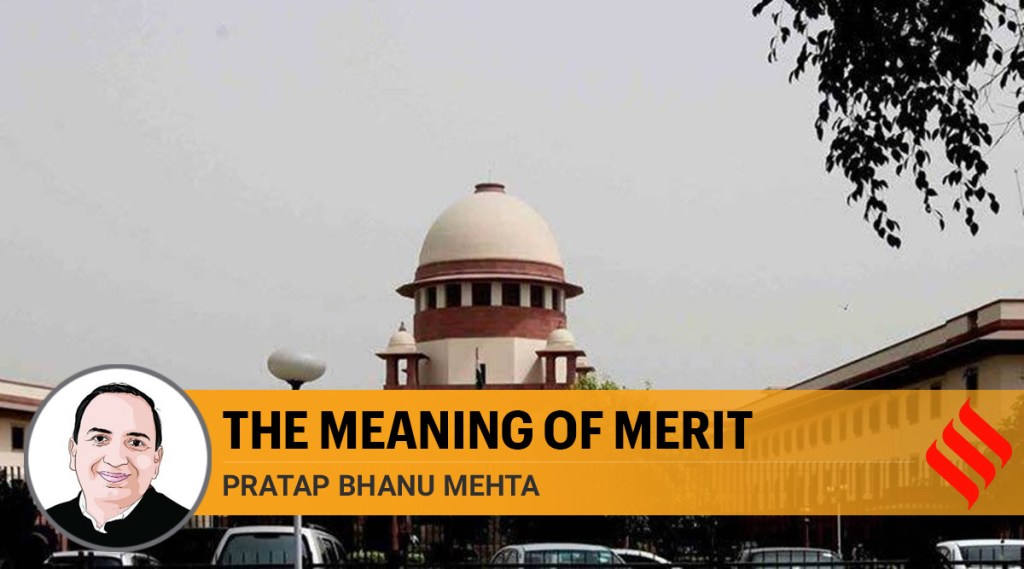
The Supreme Court has, in a significant recent judgment, Saurav Yadav versus State of Uttar Pradesh, once again artfully negotiated the thicket of issues arising out of reservation. There is no question that India needs a credible and effective affirmative action, though it can be debated over whether the current system is the best way of going about it. The matter before the Court arose in the context of complications that arise from trying to specify the relationship between vertical and horizontal reservations. Articles 15(4) and 16(4) enable vertical reservation based on slotting the population in terms of SC, ST, OBC and General Category. But there is also a class of reservations which cuts across all these categories and are referred to as horizontal reservation. These can include reservation for women (in this case, a 20 per cent reservation for women in posts for police constables), differently-abled persons, freedom fighters, army veterans and other categories to whom we may choose to provide reservation.
The problem arises in specifying the relationship between the two categories of reservation. In cases like Anil Kumar Gupta v/s State of Uttar Pradesh, the Court had made it clear that horizontal reservation ought to be generally understood in compartmentalised terms, as a nod to recognition of inequalities within each vertical category. In this particular case the problem was different, but it is illustrative of some of the interpretive absurdities of our system. There were 3,295 constable posts in the General Category of which 188 went to women. In filling up these vacancies, OBC women were not considered. But here is the absurdity. The last female candidate selected in General Category secured 274.8298 marks. But 21 applicants in the OBC female category scored more than these marks, including the plaintiff who scored 276.5949 marks! But these candidates were not considered against the available General Category seats because they were OBC. In short they were excluded from competing from the General Category positions even though they has scored more, simply because they were OBC. The Court rightly thought this was absurd.

This case is an interesting miniature sociology. One cannot help remark on the fact that marks have to be computed to four decimal places or higher to determine ones fate. It also shows how, in effect, some state governments are trying to use the open category seats as a quota for general category candidates.
Other jurisdictions have involved similar cases. The High Courts had been giving contrary directions: Uttar Pradesh and Madhya Pradesh excluded reserved category women for consideration in the general category. Rajasthan and Gujarat, amongst others, included them. The Supreme Court, in a three judge bench, ruled against the UP government and clarified the relationship between horizontal and vertical reservations. This was the correct decision.
The judgments authored by Justice Uday U Lalit and a concurring judgment by Ravindra Bhat are clear and concise. They reiterate the principle that groups eligible for horizontal reservation cannot be excluded from the open category seats because they are from other vertically reserved category communities, like SC or OBC. Women from all categories are eligible to be considered for the open category. As Justice Bhat put it, the open category seats are not meant to be a quota for the non-reserved categories. The consequence of the UP government’s policy was in effect to declare the open category a quota for upper castes. The Court has ended this nonsense. Second, in terms of framing, it has also got one issue right. The Court has often, very unhelpfully, contrasted merit with reservation. And in popular parlance merit is construed to be a deviation from reservation. But this has always been a mistaken view of the relationship between merit and reservation. In principle, reservation is an instrument for identifying merit in individuals from historically marginalised communities. The Court is saying that by excluding the adjustment of OBC women who had scored higher against general category seats, the UP government was ironically using the General Category to exclude meritorious candidates.
Some scholars, like the brilliant Gautam Bhatia in “Horizontal Reservations and the Persistence of the Myth of Merit”, (https://indconlawphil.wordpress.com/) worry that the Court’s judgment does not go far enough. It is still concerned with merit. In B K Pavitra versus Union of India for example, the Court had tried to be more radical and deconstruct the entire logic of merit. It had argued rightly that inclusion must not be seen as the antithesis of efficiency and merit; in fact inclusion and substantive equality are the aims of government. There is a good deal to be said in favour of this argument. There is also a larger critique to be made of the ideology of meritocracy, a critique to which I fully subscribe. But, as Saurav Yadav reminds us: Inclusion also takes place in the context of a criteria of selection. In the current framework, a recourse to a limited language of merit is inescapable for one simple reason. When the Court is using the term merit, it is not doing so in any exalted philosophical sense. It is simply pointing out that certain selection criteria are being used. Such selection criteria are also within particular reserved categories: Why some OBC candidates are picked over others is also a function of selection criteria, in this case marks. From this point of view, even those who advocate reservation do not fully give up on the meritocratic criteria of selection — they just apply it differentially. What the Court was concerned with is fairness in the application of the selection criteria within the overall framework of reservation.
Saurav Yadav is conceptually interesting for this reason. Defenders of radical inclusion think that social justice can be achieved by displacing merit with inclusion. But this has the unintended consequence of leaving intact the idea that those included come through by casting aside merit. In some ways, it actually shares common ground with critics of reservation who share exactly this premise. What the Court is trying to do, in an interesting way, is to argue that for its purposes, the opposition between merit and reservation needs to be deconstructed — not because there is no such thing as merit (as defenders of reservation claim), or because there should not be reservation (as critics of reservation claim). It is trying to say something more interesting: Members of the reserved category must be fully considered as falling under the rubric of being potentially meritorious.
This article first appeared in the print edition on December 26, 2020, under the title “The meaning of merit”. The writer is contributing editor, The Indian Express.

 There is no question that India needs a credible and effective affirmative action, though it can be debated over whether the current system is the best way of going about it.


 Share


