
Opinion C Raja Mohan writes: A diplomat’s memoir of how close India-Pak peace was — and why it failed
C Raja Mohan writes: If the Kashmir talks that almost came to fruition were Satinder Lambah’s last hurrah in a diplomatic life devoted to negotiating peace with Islamabad, the political failure to conclude them marked the end of an era in India-Pakistan relations
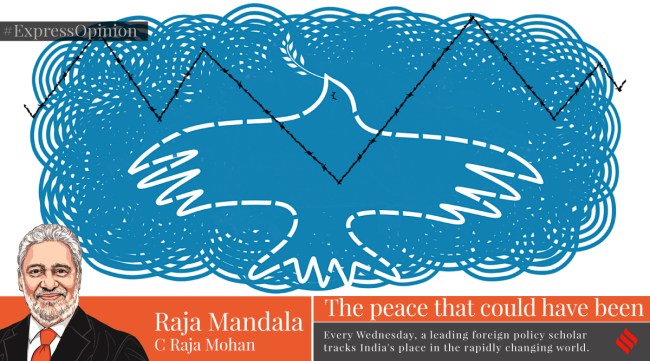 C Raja Mohan writes: Between 2004 and 2007, Lambah completed the substantive part of the negotiation. (Illustration by CR Sasikumar)



As Pakistan’s multi-faceted crisis deepens by the day, India seems utterly detached. There has been little visible engagement between the governments of India and Pakistan for some years now. The only exception was the ceasefire agreement of February 2021. Delhi insists on a terror-free environment to resume the dialogue. It is not that Pakistan is eager to resume talks.
Imran Khan, who was ousted from power a year ago and is riding high with strong popular support and the judiciary’s tilt towards him, ruled out talks with India the other day. He wants Delhi to reverse the constitutional changes in Kashmir that were introduced in August 2019 before Pakistan comes to the table.

What about the ruling coalition in Islamabad? The major elements of the current government including Nawaz Sharif’s Muslim League and Asif Ali Zardari’s Pakistan People’s Party have at various times in the last three decades made a sincere effort at negotiating peace with India. But they were overruled by the then-Army leadership. Today, they are fighting for their political survival against Imran Khan; engaging India is not at the top of their minds. The new Army chief, General Asim Munir, has said little about India. He has far too many domestic problems on his plate.
Must we then just give up on Pakistan? The story of one Indian diplomat, the late Satinder Lambah who spent most of his long diplomatic career in Pakistan, says India should not. In his book published posthumously, In Pursuit of Peace: India-Pakistan Relations Under Six Prime Ministers, Lambah insists that it is unwise for India not to engage a large and significant neighbour like Pakistan. This certainly is not a view widely shared today within the Indian strategic community.
Few understood the deep despair within the Indian establishment on engaging Pakistan better than Lambah. He was very centre of the repeated Indian efforts over the recent decades to negotiate peace with Pakistan and had the bitter experience of seeing them come to nought.
He had served as India’s deputy high commissioner and later as high commissioner in Pakistan. He oversaw the Pakistan desk as the joint secretary in the Ministry of External Affairs. Lambah was the special envoy of Prime Minister Manmohan Singh, who negotiated an ambitious peace agreement with Pakistan’s General Pervez Musharraf on Kashmir.
That extensive experience gave him more than enough insight into the difficulties of negotiating with Pakistan. Among the many challenges was Pakistan’s internal volatility in terms of engagement with India. There was no guarantee that the results from the negotiations with one leader would be honoured by his successor.
Lambah was also acutely conscious of the bureaucratic and public pressures on the Indian prime ministers not to sign sensible agreements, because they might be seen by the public as making undue concessions to Pakistan. There have been many instances when Indian leaders pulled back from agreements that they said yes to but changed their minds soon after.
The reluctance to turn even successful negotiations into formal compacts is rooted in the massive public emotion attached to the relationship in both countries. The multitude of grievances on both sides, accumulated in the run-up to the Partition and since, hangs heavily over the bilateral engagement.
On the other hand, there is extraordinary mutual goodwill at the level of individuals and large sections of civil society. Satinder Lambah, whose family migrated from Peshawar at the time of Partition, had great sensitivity to both the negative and positive dynamics of bilateral diplomacy. This sensitivity combined with the mastery over the negotiating record made Lambah the natural candidate to take charge of the most consequential negotiations with Pakistan since 1972. The mandate was to settle the Kashmir question with Pakistan.
Between 2004 and 2007, Lambah completed the substantive part of the negotiation. In his last press conference as PM in January 2014, Manmohan Singh regretted that the settlement could not be clinched because of the political turbulence in Pakistan.
Several factors intervened to nip the possibilities. On the Pakistan side, General Ashfaq Pervez Kayani who succeeded General Musharraf was unwilling to pursue the peace process. The downfall of Musharraf also saw the return of cross-border terrorism, as witnessed in the Mumbai terror attacks of November 2008. That in turn steadily diminished the public support in India for the engagement with Pakistan. Lambah believes the negotiations were the closest India and Pakistan came to resolving the Kashmir question. If the talks had succeeded, Lambah notes, the “course of history” between India and Pakistan and the subcontinent could have turned towards a “permanent peace”. The period from 2004 to 2007 was a moment of extraordinary effort to transform bilateral relations with Pakistan. Manmohan Singh built on the foundation built by Vajpayee’s visit to Pakistan in January 2004. The good news from the Manmohan era is that the two sides made noteworthy progress on a range of disputes.
Besides Kashmir, Delhi and Islamabad came close to agreements on Siachen and Sir Creek disputes, liberalising trade ties, cross-border energy and power trading, expanding tourism and people-to-people contact. The bad news, however, is that the two sides failed to convert them into concrete outcomes. The situation since then has turned bleaker.
Lambah’s Pursuit of Peace is a treasure trove for anyone interested in the evolution of India-Pakistan relations. He provides deep insights into key issues and the many significant episodes in the tragic diplomatic history of the two nations.
In the last years of his life, Lambah was often pressed to reveal the nature of his Kashmir talks with Pakistan. The reticent Lambah did give a bare-bones outline in a lecture in Jammu some years ago. “Pursuit of Peace” gives valuable historical background, the political context and interesting diplomatic detail on the origin and evolution of his Kashmir negotiation.
Lambah tells us about the definitive guidelines under which he negotiated on Kashmir and the scrupulous effort in Delhi to avoid changing the territorial disposition in Kashmir or violating the Indian Constitution. That an agreement was so close to signature in the most contested domain of India-Pakistan relations should leave us with some hope for the future – when leaders across the Radcliffe Line someday can retrace the path treaded by Lambah.
Yet, when India and Pakistan do return to the negotiating table, there might be no going back to the old formulae. Delhi now wants to decisively change the terms of engagement with Islamabad. This is unsurprising since the balance of power between India and Pakistan continues to shift in favour of Delhi. The Indian economy today is 10 times larger than Pakistan’s.
The inability of Pakistan’s elite to get its economic act together, restore a measure of internal political cohesion, and reorient its foreign policy towards regional cooperation will only deepen the imbalance. For Pakistan’s elite obsessed with “strategic parity”, the much-needed compromises with India are likely to become even harder.
If the Kashmir talks that almost came to fruition were Lambah’s last hurrah in a diplomatic life devoted to negotiating peace with Islamabad, the political failure to conclude them marked the end of an era in India-Pakistan relations. The current Indian disinterest in Pakistan’s internal troubles reflects, in part, that transition.
The writer is a senior fellow Asia Society Policy Institute, Delhi and contributing editor on international affairs for The Indian Express

 Share
Share


