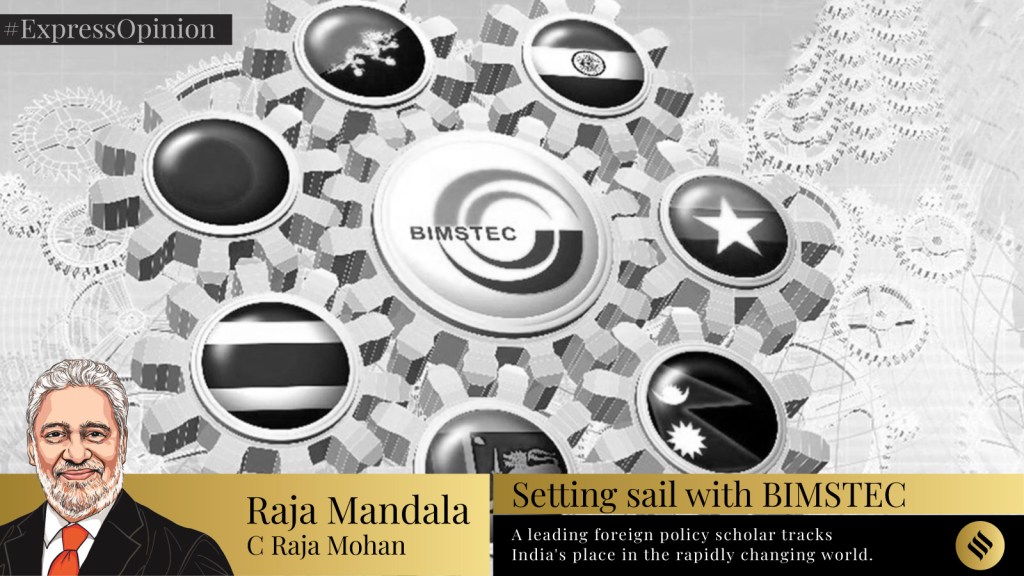
As Prime Minister Narendra Modi heads to the Bay of Bengal Initiative for Multi-Sectoral Technical and Economic Cooperation (BIMSTEC) forum’s summit this week, a sizeable portion of Indian diplomatic energy is focused on addressing the earthquake tragedy in Myanmar, one of its key members, which has also affected Thailand, another member. The remaining members — Bhutan, Bangladesh, India, and Sri Lanka — are from South Asia.
While the PM directs India’s active contribution to international relief and rehabilitation efforts in Myanmar, he must also address the longer-term challenge of revitalising the BIMSTEC forum. A quarter-century after its establishment in 1997, BIMSTEC finally received a charter at the 2022 Colombo summit, which came into effect last year after all members ratified it. The leaders gathering in Bangkok will issue a vision document outlining the forum’s ambitions. Several new initiatives, including one on maritime connectivity, are expected to be announced. With its full international persona now established, BIMSTEC can collaborate with other regional actors and global institutions.

Any reference to BIMSTEC inevitably raises its unfortunate image as an alternative to SAARC, the stalled forum for regional cooperation in the Subcontinent. This perception arose partly because the Modi government’s push to enhance BIMSTEC activity followed immediately after the SAARC summit’s failure in 2014. Though senior SAARC officials had negotiated two broad connectivity agreements and ministers had approved them, Pakistan’s leadership withdrew at the last minute, reportedly because its army opposed regional cooperation with India. Amid lamentations about SAARC’s failure or India’s supposed neglect, it’s crucial to recognise that Pakistan remains unwilling to participate in any regional integration that includes India.
Second, while the Bay of Bengal constitutes a natural region with historical interconnections, the post-War evolution of the littoral has complicated efforts to restore these natural bonds. The British Raj had unified the littoral in a modern, albeit colonial, framework. It projected power into the Bay of Bengal’s hinterlands and across its waters, colonising Burma and controlling Singapore and the settlements along the Malacca Strait connecting the Bay of Bengal to the South China Sea.
Third, the Raj’s geopolitical dominance over the Bay of Bengal diminished with Britain’s decline and Japan’s rise as a great power in the east at the turn of the 20th century. Imperial Japan’s expansion into Asia included occupying the Korean Peninsula and parts of China while ousting European colonial powers from the region — the French from Indo-China, the Dutch from the East Indies (now Indonesia), and the British from the Malay Peninsula, Burma, and the Andaman Islands — before threatening India during World War II. Britain barely managed to reverse Japanese expansion in India’s eastern neighbourhood, succeeding only through the combined efforts of the large Indian Army and American support. Following Japan’s defeat and decolonisation, the Bay of Bengal became peripheral to Indian Ocean affairs as great power competition between America and the Russo-Chinese bloc shifted to the Pacific. Another partition of Bengal during the Subcontinent’s division intensified regional conflicts within eastern South Asia. These developments marginalised the Bay of Bengal in great power politics. Now, China’s rise, its expanding maritime capabilities, its growing naval presence in the Indian Ocean, India’s eastward maritime push, and the Washington-Beijing rivalry are making the Bay of Bengal a contested zone once again.
Fourth, the inward-looking economic policies of post-colonial India and Myanmar distanced the Bay of Bengal from new commercial flows. India’s economic reforms in the 1990s and the end of Myanmar’s economic isolation sparked fresh hopes for integration in the Bay of Bengal, which remain unfulfilled.
Several factors have impeded Bay of Bengal regionalism. Unlike Pakistan in SAARC, no member wields a veto in BIMSTEC. Yet, structural constraints persist. BIMSTEC has yet to achieve the level of mutual trust present in the Association of Southeast Asian Nations, where member states set aside bilateral disputes to pursue shared goals of growth and connectivity. The ongoing disputes between Bangladesh and Myanmar, and tensions between Delhi and Dhaka following Sheikh Hasina’s ouster, illustrate these challenges. More concerning is Naypyidaw’s weakened territorial control, which hampers a core BIMSTEC objective: Realising Myanmar’s potential as a land bridge between South and Southeast Asia. These factors suggest India should moderate its expectations of rapid progress. Yet, unlike SAARC, which never truly sailed, BIMSTEC is a slow boat advancing toward greater engagement. Revitalising it requires India to act on multiple fronts.
First, at the regional level, Delhi must persist in building BIMSTEC institutions and developing arrangements for deeper economic integration. As the global economic order faces disruption, India must maintain regional trade relations, including within BIMSTEC.
Second, this regional effort must be complemented by pursuing opportunities for enhanced bilateral trade and connectivity with BIMSTEC members. Modi’s bilateral engagements with Thailand and Sri Lanka, where he will stop en route home, are equally crucial. Delhi must also find ways to minimise the damage the Muhammad Yunus regime is inflicting on India-Bangladesh relations.
Third, Delhi cannot rely solely on multilateral and bilateral approaches to promote Bay of Bengal regionalism. It must identify areas for unilateral action. Thailand’s decision to offer visa-free entry to Indian travellers demonstrates unilateralism’s potential — this single policy has dramatically enhanced India-Thailand engagement, despite years of BIMSTEC discussions about connectivity. India must leverage its economic might — now reaching $4 trillion — and its asymmetric relationship with BIMSTEC neighbours. Thailand, BIMSTEC’s second-largest economy, has an aggregate GDP of about $500 billion. As Delhi reconsiders its tariffs in response to US President Donald Trump’s trade war threats, it might want to develop similar independent initiatives with its neighbours.
More crucial for the long term is accelerating national maritime development. Transforming the Andaman and Nicobar Islands into a major regional economic and maritime security hub, developing ports and related infrastructure along the eastern seaboard, modernising seafaring regulations, and improving the ease of doing maritime business will strengthen the imperatives for Bay of Bengal regionalism. India’s positive unilateralism will be a powerful force multiplier for transforming the Bay of Bengal littoral.
The writer is contributing editor on international affairs for The Indian Express

 Delhi cannot rely solely on multilateral and bilateral approaches to promote Bay of Bengal regionalism. It must identify areas for unilateral action.


 Share


