5 min readJan 29, 2021 09:11 AM IST
First published on: Jan 29, 2021 at 12:13 AM IST
Recently, the Nagpur Bench of the Bombay High Court in the case of Satish Bandu Ragde v. The State of Maharashtra held that “skin-to-skin” contact is essential to constitute the offence defined under Section 7 of the Protection of Children from Sexual Offences Act, 2012 (POCSO Act) which deals with sexual offences against minors. The honourable court held that the act of pressing the breast of the child aged 12 years, in the absence of any specific detail as to whether the top was removed or whether he inserted his hand inside it, would not fall in the definition of “sexual assault” under Section 7 of the Act. Section 354 of the Indian Penal Code, 1860, which deals with outraging modesty of women and which provides for a lesser sentence, was held to be applicable in such cases. This ruling raises several concerns.
While holding that the stringent nature of punishment provided for the offence requires stricter proof and serious allegations, the court said the punishment should be proportionate to the seriousness of the crime. The principle of proportionality is an important principle in criminal jurisprudence. Nevertheless, while adjudging the seriousness of the offence the court has not given consideration to the fact that the victim, a minor, is entitled to greater protection.

The POCSO Act was enacted with the specific intention of protecting children from sexual assault and sexual harassment. It took into consideration the standards prescribed by the Convention on the Rights of the Child adopted by the General Assembly of the United Nations to which the Indian government acceded to on December 11, 1992. The Act acknowledges the special vulnerability of children and that special protection, above and beyond that provided in the IPC, is required when the victim is a child. The severe punishment provided under the Act is not due to the severity of the condemned illegal sexual act in itself but because the act is committed in relation to a minor who is more vulnerable. The major concern is that the interpretation of the court seems to defeat the purpose of the POCSO Act. In making the Act inapplicable to cases of sexual harassment of a minor and applying the IPC in its stead, the honourable court seems not to have given due consideration to this legislative history and object.
The honourable court also held that to fall within the definition of sexual assault, the condemned act must be of the same nature as the acts prescribed under Section 7 of POCSO, which defines sexual assault as “Whoever, with sexual intent touches the vagina, penis, anus or breast of the child or makes the child touch the vagina, penis, anus or breast of such person or any other person, or does any other act with sexual intent which involves physical contact without penetration is said to commit sexual assault.” The court has concluded that the touching of the breast without skin-to-skin contact is not similar to the abovementioned acts and, therefore, does not fall within this definition. The court seems to have followed a rather pedantic approach to reach this conclusion. The fact that the trauma of the child whose breasts were groped through a cloth could be of the same nature and severity as direct touching of the breast is not discussed. And if the trauma is the same, the mere existence of cloth should not affect the applicability of the POCSO Act.
This interpretation also lays down a dangerous precedent. Other actions, which would thus escape punishment under this Act, could include intrusive touching of vagina through an underwear or forcing a child to touch a penis through a cloth or even a condom which are all extremely violative acts. Therefore, if such an interpretation is followed, there is a threat that the POCSO Act in itself might become redundant as a wide range of sexually violative activities would be excluded from its ambit due to lack of “skin-to-skin” contact.
The National Commission for Protection of Child Rights had asked the Maharashtra government to appeal this decision in the Supreme Court. The Supreme Court has currently stayed the acquittal of the accused under this judgement. Whether the Supreme Court accepts the interpretation given by the high court remains to be seen.
This article first appeared in the print edition on January 29, 2021 under the title ‘Letting down the vulnerable’. The writer is a lawyer and novelist.

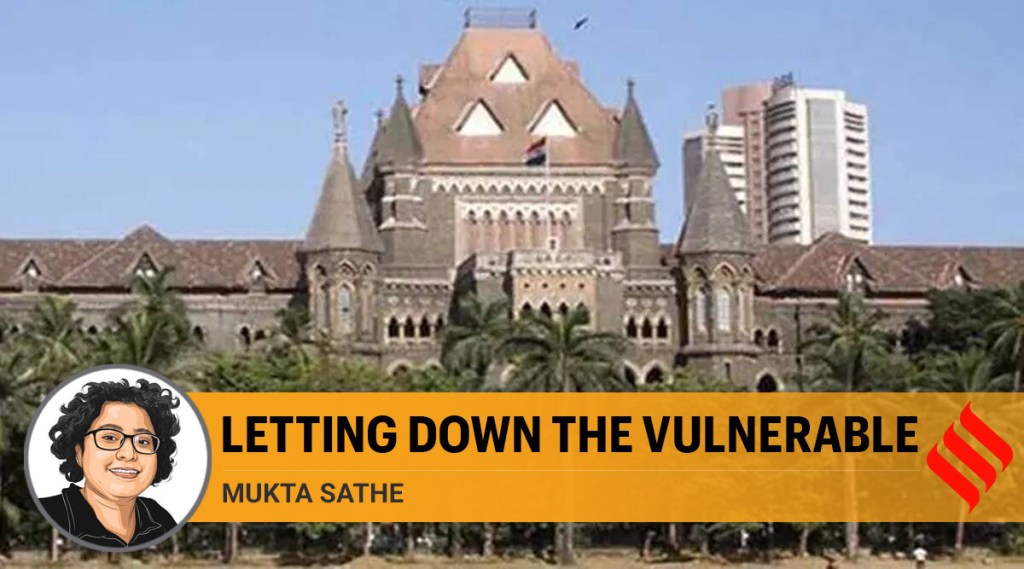 The Bombay High Court (File Photo)


 Share


