Written by: Harshita Sinha, Bhargabi Ghosh
4 min readApr 17, 2026 12:27 PM IST
First published on: Apr 17, 2026 at 07:02 AM IST
When an evacuation flight touches down in New Delhi, it is seen as a moment of national pride. India’s ability to coordinate the return of over 4.75 lakh citizens from West Asia by the end of March reflects logistical capacity and diplomatic reach. But that visibility can obscure a harder policy question: Whether India will continue to engage with migration only at moments of disruption rather than across the full continuum of mobility, work, welfare and return.
The Gulf is one of the central geographies of Indian mobility, household welfare, and labour-market dependence. The six GCC countries alone were estimated to host nearly 99.35 lakh Indians in December 2025, while the region accounted for 37.9 per cent of India’s remittance inflows in 2023–24. When instability deepens there, its effects travel quickly into districts, households, and state welfare systems. This is why the present moment is also a test of how India understands migration governance itself.

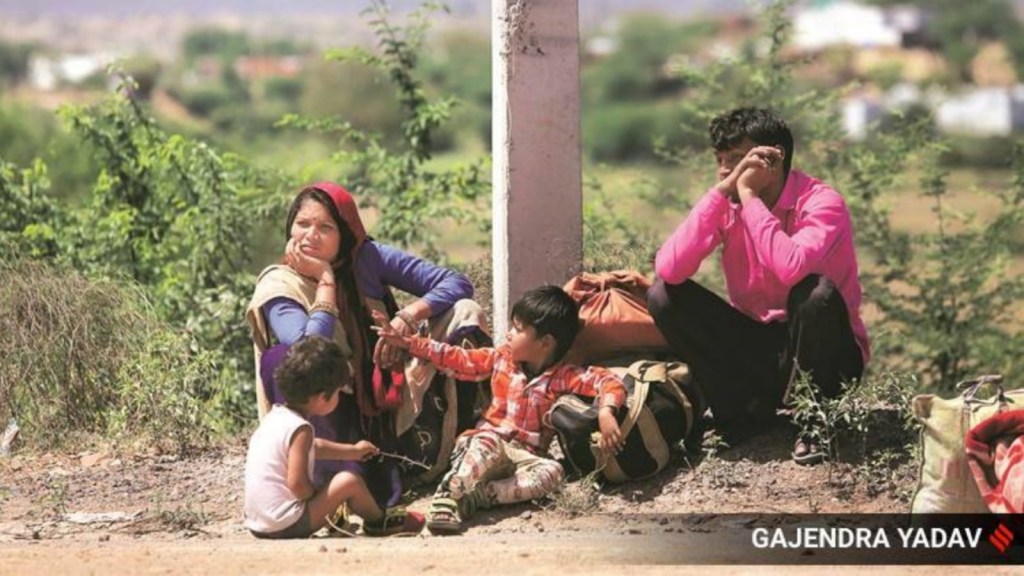
India’s mobility system, both internal and external, rests on interconnected chains that are often thinly institutionalised and highly sensitive to disruption. During Covid, this was visible in the sudden immobilisation of millions of internal migrants. Today, even without a formal lockdown, signs of stress are emerging again: Rising costs of living, increasing LPG prices, tightening mobility conditions, and sectoral slowdowns that do not always register as crisis signals but steadily erode worker stability.
The current response has demonstrated the value of diplomatic engagement, consular coordination, and repatriation mechanisms. But such crises also reveal the limits of a framework that becomes legible only once disruption is underway. By the time a state is arranging return flights, the more foundational questions have already been deferred: How workers were recruited, what forms of support existed at the destination, and what awaited them on return.
Moreover, many of the fragilities in India’s migration system emerge without immediately disrupting production itself. Workers may continue to move, work, and remit, even as the conditions around them become more precarious. It is this slow accumulation of stresses that policy frameworks often struggle to capture.
One reason is that India’s governance architecture was not built around migrants’ journeys, whether across districts or across borders. The Ministry of External Affairs manages emigration clearances and diplomatic coordination; the Ministry of Labour oversees recruitment and worker welfare; state governments run skilling programmes and welfare funds with widely varying capacity. But the worker’s journey does not mirror these clean mandates. It begins in a source district, passes through recruitment systems, crosses administrative and national boundaries, and eventually returns, sometimes with savings and skills, sometimes with debt or displacement. At each stage, the worker is visible to some part of the system, rarely to the whole.
That partial visibility is most consequential in data. India still lacks sufficiently granular and dynamic migration information for anticipatory governance. In ordinary times, this is an administrative gap. In extraordinary times, it becomes a welfare challenge.
This unevenness is not uniform across India. Kerala’s investment in migration data and institutions shows what sustained political attention can achieve. But this cannot be assumed across major sending states. Workers do not return to the Union government in abstraction. They return to district administrations, local labour markets, and households whose ability to absorb shocks varies.
The pending Overseas Mobility Facilitation and Welfare Bill provides an opportunity to embed welfare into the system’s architecture. Whether a worker leaves Jharkhand to work in Surat or in Riyadh, they are navigating variations of the same fragmented system. The policy challenge is to recognise them as parts of a connected mobility landscape that requires steady protections, coherent governance and assured accessibility.
India enters this moment with real foundations — a growing policy base, maturing bilateral relationships, and a growing role in local and global labour corridors. But that maturity now demands a shift to building a continuous architecture of visibility, coordination, welfare, and return across all forms of mobility. The question is whether India is willing to govern mobility, internal and international, as a connected social and economic system, before, during, and after a crisis.
Sinha is researcher, London School of Economics and Political Science. Ghosh is associate director, Strategic Communication & Public Policy Advisory, PDAG

 India enters this moment with real foundations — a growing policy base, maturing bilateral relationships, and a growing role in local and global labour corridors.


 Share


