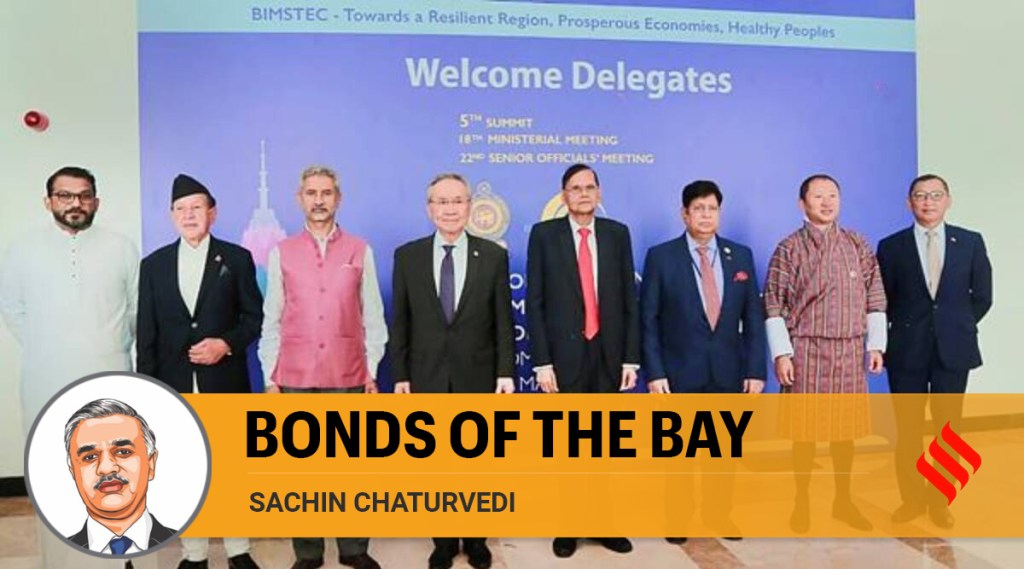
The celebrations to mark the 25th year of the Bay of Bengal Initiative for Multi-Sectoral Technical and Economic Cooperation (BIMSTEC) have been accompanied by the announcement of several new initiatives. The collective’s fifth summit that concluded in Colombo in the last week of March showcased member nations’ resolve to facilitate connectivity and security and enhance the prosperity of the region. The summit had three important outcomes: Expanding the grouping’s agenda, deepening cooperation between the member countries and planning systematically for consistency and coherence.
The Bay of Bengal Community was launched in 1997. But its charter, finalised last week, was more than two decades in the making. Almost all international organisations and regional groupings have charters to decide the frequencies of their meetings, modalities of programme delivery and the nature of engagement among partner countries. The 20-page document adopted at the fifth BIMSTEC Summit articulates the purpose, principles and legal standing of the organisation. It also delineates the process to admit new members – this requires the consensus of the members. A similar procedure will be adopted for increasing the number of observer countries of the organisation. The emphasis on consensus is important, given the sensitivities of the member countries. One important provision in the charter is to keep regular meetings on track and provide enough scope to the BIMSTEC Permanent Working Committee to keep the process energised.

The summit also succeeded in creating mechanisms to deepen cooperation. Amongst the important decisions is the one related to the BIMSTEC Master Plan for Transport Connectivity. The region requires seamless connectivity through multi-modal channels that improve links within and amongst the member countries.
These channels should be in sync with the regulatory frameworks of the member countries.
The council could also play a role in the projects being planned in the region. For instance, there are proposals to extend the trilateral highway project between Thailand, Myanmar and India to Laos and Cambodia. Bangladesh, Bhutan and Nepal have also evinced interest in the project. Digitisation has enhanced cooperation in customs regulations and facilitated and improved cargo clearance procedures. All this will surely enhance investment linkages and improve regional trade. The early completion of the regional free trade agreement could provide a fillip to the organisation’s efforts.
Similarly, the MoU for legal assistance in criminal matters and additional MoUs for mutual cooperation between diplomatic academics and training institutes would help in creating an ecosystem of deeper knowledge-related cooperation. The technology transfer facility proposed in Colombo is likely to augment these efforts.
The Summit evolved a systemic approach to streamline the evolution of BIMSTEC. Establishing an Eminent Persons’ Group (EPG) for formulating a vision document for the region will help in articulating the aspirations of the collective. EPGs have been quite useful in the EU and ASEAN. For instance, the ASEAN-India Eminent Persons Group (AIEPG) was constituted in 2005 after the Eighth ASEAN-India Summit. Its recommendations still guide the grouping’s work. In 2011, the EU constituted an EPG under former German Foreign Minister Joschka Fischer to suggest a roadmap to address the challenges arising from the resurgence of intolerance and discrimination in Europe. In 2018, the G-20 constituted an EPG led by Singapore’s Deputy Prime Minister Tharman Shanmugaratnam to recommend reforms at the international financial institutions to promote economic stability and sustainable growth.
The fourth BIMSTEC summit at Kathmandu launched measures to strengthen the collective’s secretariat. India has promised $1 million to set up a Secretariat in Dhaka. India has identified several other areas where it will support the collective. Delhi will provide a $3 million grant to the BIMSTEC Centre for Weather and Climate, promote collaboration between industries and start-ups, and launch programmes that will help in the adoption of international standards and norms. Delhi has also suggested a regional value chain based agricultural trade analysis – this will be conducted by the RIS. The Asian Development Bank and the New Delhi-based ICRIER have stewarded awareness programmes on trade facilitating measures in the member countries.
Prime Minister Narendra Modi has rightly described BIMSTEC as an important instrument of connectivity, sustainability and prosperity. Extending the term of the Secretary-General would help in providing further stability to several of the collective’s initiatives.
The pandemic has created fresh challenges and aggravated old ones in the countries of the region, particularly Sri Lanka and Nepal. India’s support to these countries, especially in financial matters, could help in reducing undesirable external intervention in the region. The region that’s rife supply chain disruptions could well stave off further disruptions due to the efforts of the BIMSTEC.
Besides economic links, the Bay of Bengal countries share a cultural and civilisational legacy. The role of institutions like Nalanda University in promoting research on cultural and civilisational linkages and improving the adoption of sustainable practices would be equally significant.
This column first appeared in the print edition on April 9, 2022 under the title ‘Bonds of the bay’. The writer is Director General, and Information System for Developing Countries



 Share


