6 min readNew DelhiOct 27, 2023 01:24 PM IST
First published on: Oct 26, 2023 at 07:52 PM IST
The importance of marriage has existed almost since the beginning of human civilisation, but on the understanding that marriage is heterosexual: A union between man and woman — two persons of the opposite sex. The premises supporting the concept of marriage were (and remain) fundamental: That the human race must procreate in order to survive. Procreation occurs only through sexual relations between a man and woman committed to a bond. Over the centuries, society has recognised that bond as “marriage”.
Same-sex marriage is a phrase of recent import, an oxymoron, that is, a phrase using contradictory terms. However, same-sex relationships do exist and are accepted in society. Same-sex marriage is also gaining in popularity. So far, it has been established, only by law, in at least 34 different countries around the world (countries that account for 17 per cent of the world’s total population!); most of the Americas (North and South) and countries in Western Europe are included. But its spread has been uneven: South Africa is the only country in the continent of Africa, and Taiwan is the only country in the continent of Asia that have accepted same-sex marriage.

In Supriya Chakraborty and Anr v Union of India, a writ petition filed in the Supreme Court of India in 2022, under Article 32 of the Constitution for enforcement of a fundamental right — (along with similar writ petitions) — arguments in support of same-sex marriage were rooted in the Fundamental Rights Chapter (Part-III) of the Constitution, as well as in social, and policy considerations. The petitioners contended that same-sex couples should be permitted to affirm their commitment to one another through marriage — like opposite-sex couples — and that existing marriage laws should be so read and interpreted.
Now, under India’s Constitution, the people of India — through their representatives in Parliament and in state legislatures — are free to accept marriage as including a union of same-sex couples. But as a matter of constitutional law, neither a Constitution Bench of five Judges, nor even the full complement of 34 judges of the Supreme Court, have the authority to so declare.
Under India’s Constitution, the power to make laws — including laws as to marriage — vest exclusively either with Parliament at the Centre or with a state legislature in a state — by reason of provisions contained in Article 245 (1) and Article 246(2) of the Constitution read along with Item 5 in the Concurrent List.
In the Supriya Chakraborty case, judgments were handed down on October 17 by the five justices on the Constitution Bench. The first two senior-most judges in the Court (Chief Justice Chandrachud and Justice Kaul) — in separate but concurring opinions — held that though there was no fundamental right to marry, and although the Court could not treat same-sex couples on the same basis as a marriage between two persons of the opposite sex, declarations were granted and directions were issued to alleviate the hardships experienced by same-sex couples living together. However, the remaining three justices on the Bench (Justices Ravindra Bhat, Hima Kohli and P S Narasimha), whilst also holding that there was no fundamental right to marry, expressly disagreed with the declarations granted and directions issued by the first two senior-most judges. Consequently, the two senior-most judges in the Court are in a minority; their judgments have to be reckoned as dissenting opinions: Having no greater force or validity than “an appeal to the brooding spirit of the future…”.
The operative majority opinion is that expressed in the judgments of the remaining three Justices viz Ravindra Bhat, Hima Kohli and P S Narasimha. A summary of their findings (now the opinion of the Court) is as follows: One, there is no unqualified right to marriage except that recognised by statute or custom; two, legal recognition of the right to a union — akin to marriage or civil union — can only be through enacted law; three, courts cannot enjoin or direct the creation of a legal or regulatory framework resulting in the conferment of legal status on same-sex couples, nor can same-sex couples be granted the right to adopt; four, that it is not possible to read provisions in existing statutes governing marriage in a gender-neutral manner; five, the constitutional challenge to the Special Marriage Act, 1954, the Hindu Marriage Act, 1955, and the Foreign Marriage Act of 1969 is rejected; six, despite the above, separate directions have been given to the Union of India for setting up a high-level committee (under the cabinet secretary’s chairmanship) to help ameliorate the manifold difficulties (including discrimination) experienced by same-sex couples living together.
In a decision of the US supreme court upholding the constitutional validity of same-sex marriage, reported in 576 US 644 (2015), Chief Justice Roberts (along with three colleagues), differed with the majority view expressed by Justice Kennedy (along with four other colleagues). Chief Justice Roberts opened his dissenting opinion with these stirring words: “Understand well what this dissent is about: It is not about whether, in my judgement, the institution of marriage should be changed to include same-sex couples. It is instead about whether, in our democratic republic, that decision should rest with the people acting through their elected representatives… The US Constitution leaves no doubt about the answer.”
In Supriya Chakraborty and Anr v Union of India, the Supreme Court of India (majority opinion of three out of five Judges) has held that under India’s Constitution, the question as to whether same-sex marriage should be accepted rests not with the courts, but with the country’s Parliament and state legislatures — and so far, it has not been recognised in any law.
The writer is a constitutional jurist and senior advocate to the Supreme Court

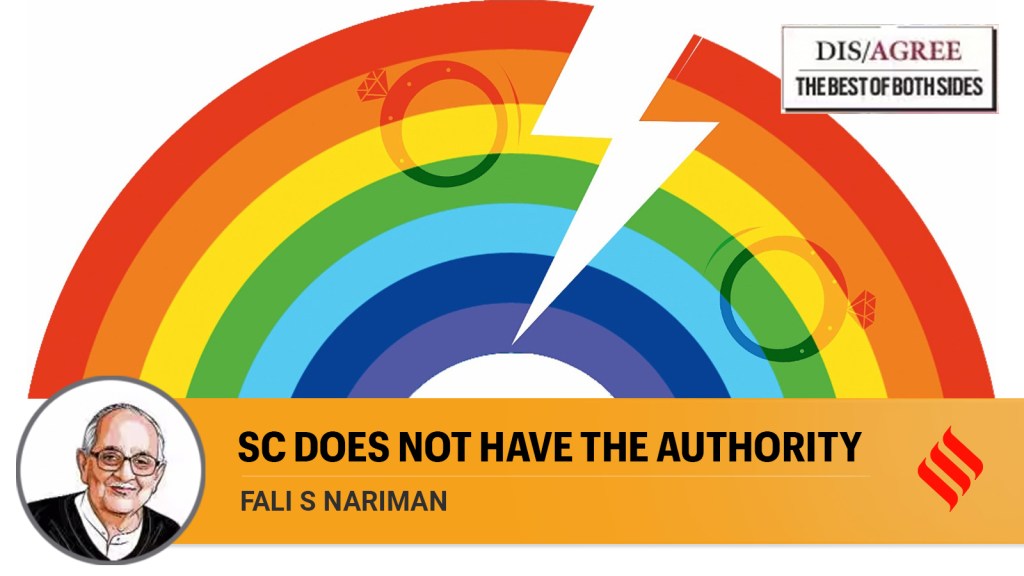 Same-sex marriage is a phrase of recent import, an oxymoron, that is, a phrase using contradictory terms. (Illustration by C R Sasikumar)


 Share


