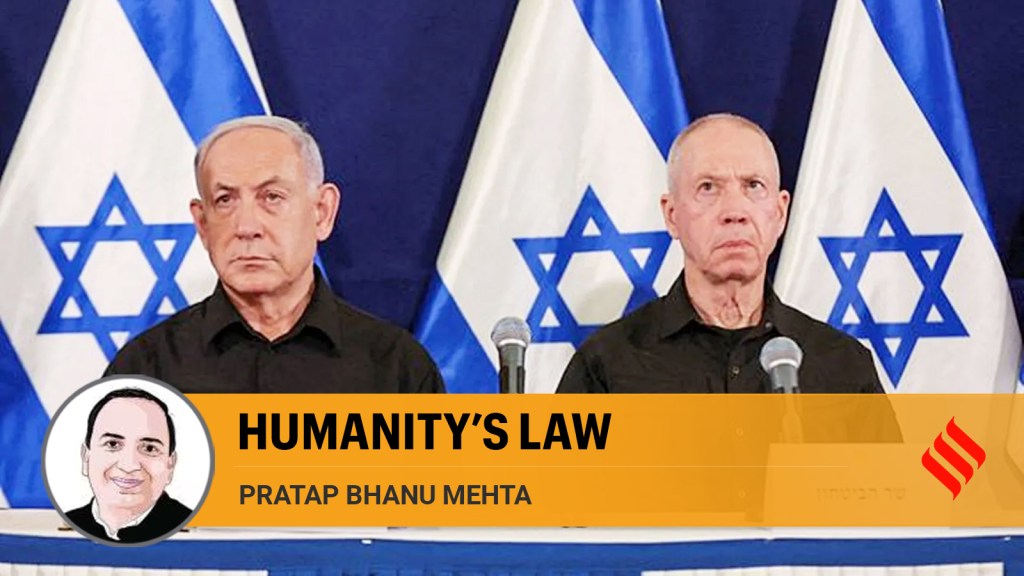
The International Criminal Court (ICC) prosecutor has thrown down the gauntlet by seeking arrest warrants for Israeli Prime Minister Benjamin Netanyahu, Defence Minister Yoav Gallant and three Hamas leaders, including Yahya Sinwar. A bench of the ICC may still deny the warrants, but the prosecutor’s request is backed by the unanimous opinion of a panel of five leading lights of international law. There is a resounding power to this group’s claim that “the law we apply is humanity’s law, not the law of any given side.”
There is good reason to be cynical of the ICC. It has been accused of selective attention. Many of its rulings go unenforced, even by its own member states. Three of the five permanent members of the Security Council are not members of the ICC. International law has almost always been subject to Great Power exceptionalism. In this case, none of the Great Powers, including China, India and the United States, are signatories to the ICC. Its broader legitimacy has always been under question: Even signatories worry that it was a tool to exercise power over small nations and petty dictators. There has always been the real worry that the juridification of deeply-political conflicts can often be counterproductive. The fear of prosecution might entrench the parties in their determination to fight, and close the room for compromise. Although, in this case, the British prosecutor Karim Khan has presented what seems like a prima facie cogent case for considering the warrants, the ICC could still take a legal route out, exploiting ambiguities in the law over jurisdiction.

The ICC prosecutor seeking arrest warrants is significant precisely because it operates against this background of well-warranted scepticism. It has potentially created a high-stakes situation. First, the seeking of an arrest warrant against Netanyahu is a blow to Israel’s reputation. Israel will, understandably, chafe at being put in the same category as Hamas. Israel has the right to self-defence. But it has been obvious that Israel’s military operations in Gaza are a humanitarian catastrophe, if not genocide, as Aryeh Neier has recently argued in The New York Review of Books. Israel will doubtless deny this accusation. It is arguing, a little incredulously, that the ratio of civilian to combatant deaths in this war is lower than for most wars in the 20th century. The warrant does not take a stand on the sources of this conflict. It does accuse Israel of deliberately starving civilians, and both Israel and Hamas of violating the laws of armed conflict.
Second, it is not an insignificant fact that an arrest warrant is being sought against an Israeli Prime Minister, a key ally of the United States. This is not just international law against the weak or as an instrument of liberal powers against authoritarians. The United States has publicly condemned the ruling, and several prominent senators have, in turn, threatened ICC officials with sanctions. That the United States is tearing up the “liberal international order” is old news. But ignoring the ICC is one thing; having your political class threatening it is a new form of intimidation of international institutions, all the more ironic in light of the fact that the same ICC’s ruling against Putin was welcomed.
It is precisely this reaction that makes seeking the arrest warrant more relevant. ICC member states are not only obliged to execute its warrants, they are potentially also obliged to defend the ICC against intimidation. This will put the United States’ allies in a bind. Third, ICC is different from the International Court of Justice in that in ICC the prosecutions are brought against individual parties. While the warrant does not go into the root causes of the conflict, it is a powerful statement on behalf of moral limits that have to be recognised in the pursuit of political ends. Both sides will chafe at the equivalence: Israel for being equated with Hamas; Hamas for not recognising the enormous disparity of power that currently characterises the relationship between Israel and Palestinians. We need a Palestinian cause that is not reliant on and tethered to the barbarism of Hamas; and a defence of Israel that does not give it licence to such extraordinary violence or such a whole-scale denial of the right of Palestinians. Ideally, you would want such a warrant to have domestic reverberations. For Israel to recognise that, it needs to radically change its strategy; and for Palestinians, to acknowledge that Hamas cannot be their face and future. It gives international opinion (all law, including constitutional law, is ultimately effective only if opinion backs it) a mobilising focus.
On the other hand, it could entrench both parties’ positions to the point where even the smallest sliver of compromise on humanitarian aid or releasing hostages becomes impossible. It is astonishing that almost no power that has actual leverage in the region — from the United States to the assorted Arab States from Saudi Arabia to the UAE — has shown a minimal willingness to act to stop the carnage. In this context, it is more than likely that the debate over the ICC warrants will simply exacerbate global nihilism on the rule of law. But, at least, the ICC will have done us the service of showing that almost all states have morally no place to hide. The international order is beyond even the redeeming comforts of organised hypocrisy.
When the campus protests were on in the US most students were open to reasonable discussions. But there was, in many sections, an odd discomfort with the language of resistance that had Gandhi and Mandela at its centre. Imagine a pro-Palestinian encampment that had a shrine to the Israeli hostages at the centre of its iconography. Or, the powerful letters calling attention to anti-Semitism equally drawing attention to the atrocities in Gaza.
But such gestures are passé. Without denying historical specificities or even at the risk of false equivalences, it has to be said, there were common moral refrains underlying both groups: Don’t target people for being who they are; every group is entitled to a life of safety and dignity. The moral intuitions were shared but the empathetic gesture of what existential threats might feel like to the other side was missing. It is a tragedy that Hamas and Israel and all the great powers will unite in their condemnation of the ICC, rather than take seriously the claim that what we need in a world drifting towards catastrophic power politics is “humanity’s law, not the law of any given side.”
The writer is contributing editor, The Indian Express



 Share


