6 min readJan 19, 2024 09:09 AM IST
First published on: Jan 19, 2024 at 07:00 AM IST
In the past two decades, schooling and basic learning (or foundational literacy-numeracy as it is now called) have been at the forefront of educational debates and discussions in India. These deliberations have influenced significant shifts in policies and priorities in recent times. More than 10 years ago, the Right to Education (RTE) Act became a law; it gave legislative backing to the goal of universal elementary schooling. More recently, the new National Education Policy (NEP) was launched in 2020. This policy takes a more comprehensive view on how to provide quality education for the entire age range — age three to university — in order to strengthen our education system and prepare students well for the future.
Unlike the usual country-wide ASER surveys, ASER 2023 is not large in scale; only one or two rural districts in each state have been surveyed. The main aim was to understand the current status of the age group 14 to 18 with a wide-angled lens. The launch of this report provides a timely opportunity to look at policies and practices from the point of view of this relatively understudied age group.

The Right to Education law is applicable up to age 14 or Std VIII — the end of the elementary school stage. At the other end of this age range, one needs to be at least 18 years old to be employed full-time in the formal sector. With its focus on adolescents, does ASER 2023 bring any new inputs or insights into the current thinking for what more can be done for and by young people in India?
Available data points to the fact that for the elementary school age population, enrolment levels are close to being universal. UDISE data shows that Std VIII enrolment in India doubled from 11 million in 2005-2006 to 22 million in 2020-21. The transition rate from elementary school (Std VIII) to secondary school (Std IX) also is high at 88.81 per cent nationally. In short, today more children in India have more years of schooling than ever before.
Universal secondary enrolment is a national goal. The ASER 2023 data shows that in the surveyed rural districts, more than 85 per cent of youth (age 14-18) are currently enrolled in some kind of educational institution. However, this laudable progress is accompanied by rising pressures on individuals and institutions. ASER 2022 data showed that more than 80 per cent of mothers and fathers of students enrolled in Std VIII in 2022 had less than 10 years of schooling. It is very likely that such parents aspire for a future for their children that they themselves could not have. These aspirations translate into acute academic competition, widespread coaching, heavy expenditure by families. All of these add to examination pressures often accompanied by severe disappointments for the student and the family, if exam results are poor.
NEP 2020 speaks of the goal of 100 per cent secondary school enrolment, to be achieved through “careful tracking of students’ enrolment, attendance, and learning levels, so that they can be provided suitable opportunities to re-enter school and/or catch up”. Examination pressure can be reduced by reforming how and when assessments can happen. NEP 2020 has several recommendations for examination reform and flexibility. Further, if more and more youth remain enrolled longer, this gives the education system additional time and space to equip them for the life that is ahead of them.
Trends on basic learning have remained relatively unchanged over the last decade. Although the National Achievement Survey (NAS) and ASER use different metrics and methods for assessing learning, both point to the fact that basic learning levels of elementary school children need significant improvement. NEP 2020 clearly states the urgent need for ensuring that by Std III, children have acquired basic reading and arithmetic skills. NIPUN Bharat is the government’s operational plan for implementation of programmes for achieving this goal. For Std I and II, in most states, energetic and focused action is currently visible under NIPUN Bharat. The combination of the launch of NEP 2020 and schools opening after a long period after the pandemic has led to early grades getting much needed and focused attention.
But what about the middle school children? ASER data for the eight-year period from 2014 to 2022 highlights two major trends: First, learning trajectories over these grades are relatively flat. For example, the difference between learning levels in Std VII versus that in Std VI or V is not very much. Second, levels of basic learning in Std V-VIII have not seen much improvement in the last decade. A comprehensive strategy for learning improvement, starting with basic skills, is urgently needed for upper primary grades.
ASER 2023 data from the surveyed districts is an extension of these trends. Forty-five per cent of youth in the age group 14-18 have basic arithmetic proficiency. The rest need “catch up” for these basic skills. Low levels of foundational numeracy affect the ability of youth in tackling everyday calculations where they need to apply measurement or use the unitary method in practical situations, or even do simple financial computations such as managing a budget, applying a discount or calculating repayment of a loan. Data from ASER 2023 indicates that building foundational literacy and numeracy may be needed for about a fourth of youth in the 14-18 age group.
NEP 2020 has re-imagined the “foundation stage” (age 3 to 8). The government’s NIPUN Bharat mission has begun to rework structures and practices. Some of these changes are already visible on the ground. Across school education, a variety of initiatives are taking off that include “catch up” efforts for basic learning, streamlining and building up assessment mechanisms at state and central levels. Like the pathway linking NEP to NIPUN in early grades, similar efforts are needed for translating middle school and secondary school reform ideas into action. A close tracking of outcomes will be key to improvements and eventual success.
The writer is CEO, Pratham Education Foundation

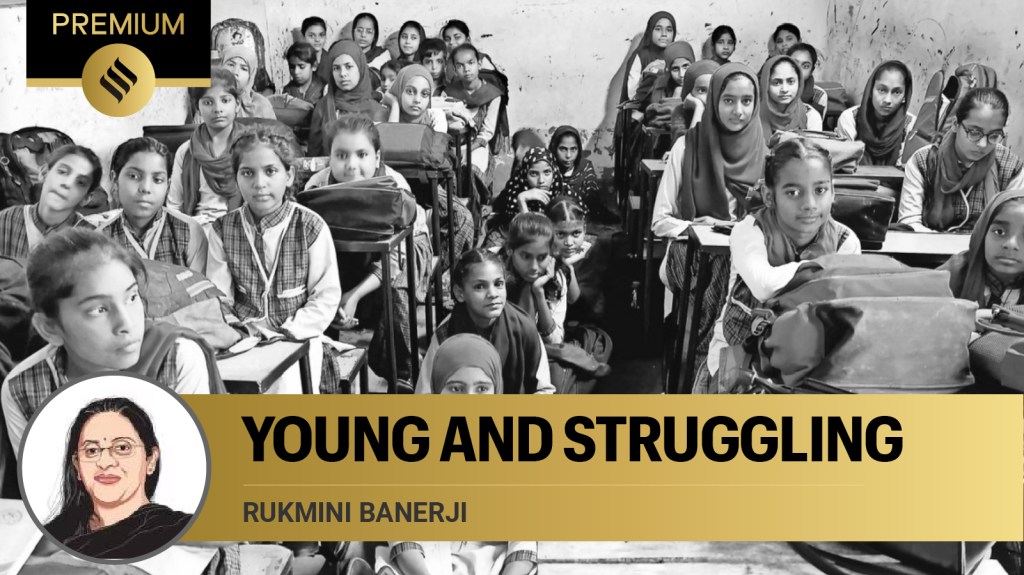 The ASER 2023 data shows that in the surveyed rural districts, more than 85 per cent of youth are currently enrolled in some educational institution.


 Share


