
As India looks west
Delhi must come to terms with a changing Middle East and the opportunities it presents
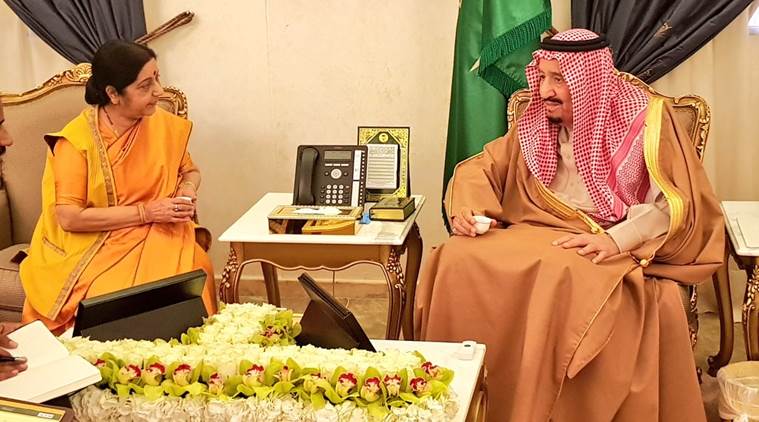 External Affairs Miniter Sushma Swaraj with His Majesty the King of Saudi Arabia Salman bin Abdulaziz Al Saud earlier this week. (Source: Twitter/@MEAIndia)
Women in Iran are taking off their head scarves in a bold protest against Iran’s rule on compulsory wearing of the veil in public. It was among the first prohibitions imposed by the Islamic Republic after the 1979 revolution. Women in Saudi Arabia are learning how to drive as they await legal sanction this summer. Riyadh has also lifted a four decade-old ban on movie theatres. The current clamour for liberation from social controls imposed in the name of religion is one of the many surprising turns in the Middle East.
Another one is the quest for “moderate Islam”. Key leaders of the region, President Abdel Fattah al-Sisi of Egypt, Mohammed bin Zayed, the crown prince of the United Arab Emirates, and Mohammed bin Salman, crown prince of Saudi Arabia, have all made reclaiming Islam from the extremist groups an important political priority. For decades now, the region’s political leadership has been under pressure to yield to the conservative religious flank. Any reversal, of course, would be hugely consequential for India and the world.

As it intensifies its engagement with the Middle East this week and the next, Delhi must come to terms with a changing region and the opportunities it presents. External Affairs Minister Sushma Swaraj visited Saudi Arabia this week and Prime Minister Narendra Modi is traveling to Palestine, Oman and the United Arab Emirates. India is expected to host President Hassan Rouhani of Iran next month.
Although Delhi’s relations with the Middle East have gained greater traction, many feel there is need for the articulation of objectives and a strategy to achieve them. Suggestions have often been made for the formulation of a “Look West Policy” that puts India’s relations with the region on a sound basis. The success of India’s “Look East Policy”, many believe, provides a persuasive precedent. The transformation of India’s engagement with South East Asia was celebrated last month by the presence of the 10 ASEAN leaders at the annual Republic Day celebrations.
But comparisons between the regions to India’s east and west are not very useful.
One big difference between the two regions is an institutional framework that facilitates India’s regional diplomacy. If the Association of South East Asian Nations has been the vehicle for India’s expanding partnership with South East Asia, there is no similar forum in the Middle East.
Groupings such as the Arab League, or the Organisation of Islamic Conference, were never really effective. Even more narrowly focused organisations like the Gulf Cooperation Council are beginning to crack amid the region’s turbulence. Once formed to counter the Iranian threat, the GCC is badly divided today. The Saudi-UAE effort to marginalise another member of the GCC is part of the story.
The ASEAN’s process-driven diplomacy, with multiple lines of continuous engagement, puts pressure on India to stay focused on its Look East Policy. In the Middle East, the principal impulse has to be India’s own strategic appreciation of the region matched by a vigorous bilateralism. Rapport at the leadership level is critical for success in a region ruled mostly by monarchs and strong rulers. The PM’s personal diplomacy in the region, however, has not been matched by the ability of Delhi’s bureaucracy to follow through on declarations and joint statements.
One important reason for Delhi’s success east of India has been the absence of domestic political discord over the region. Ideological, political and religious divisions in India over the Middle East have long complicated Delhi’s thinking of the region. The Partition of the Subcontinent produced a set of outcomes that complicated India’s relations with the Middle East.
In the first decades after Independence, India had bet that its commitment to pan-Arabism and anti-imperialism would counter Pakistan’s claims for special affection of the region as a state founded on Islam. While religion remains important, pan-Islamism is no longer a dominant force in shaping the politics of the region. The rise of sectarianism has undercut pan-Islamism while individual national interests have blunted the idea of ethnic Arab solidarity.
After the Cold War, India gingerly stepped out to pursue a more practical policy towards the region. Even as India’s economic ties deepened after the economic reforms launched in 1991, Delhi appeared defensive in the region. If too much of political grand-standing marked India’s engagement with the region before the Cold War, Delhi appeared too timid since the 1990s. While the politics of the region evolved, Delhi seemed to be tied down by the past.
Consider, for example, Delhi’s persistent tendency to view the region in terms of the conflict between Israel and Arab states. There is a perception that Modi’s visit to Palestine is part of Delhi’s perceived need to find a balance between the two relationships, especially after the PM traveled to Israel last year. The purported “de-hyphenation” of India’s ties with Israel and Palestine has not reduced the compulsion of seeing the two relationships as tightly interlinked.
This seems at odds with what is happening in the region. Israel, which once embraced Shah Reza Pahlavi’s Iran to balance the Arabs, is now partnering the Sunni Arabs to defeat the growing influence of Shia Iran. It also collaborates with the conservative Arab regimes in fighting the Sunni extremists.
Meanwhile, the Sunni monarchies that traditionally looked to the United States to ensure their security, are taking matters into their own hands to shape the regional security architecture. Troops backed by Saudi Arabia and the UAE are battling groups backed by Iran across the region. That the conflict between Iran and the Sunni Muslims today is stronger than that between Arabs and Israel hardly makes an impression on the Indian debate.
Navigating the multiple internal contradictions of the Middle East has never been easy for external powers. India may not need a formal “Look West policy” to realise the new opportunities in the region if Delhi views the Middle East on its own merits, pays sustained political attention, and delivers on the Indian economic and security commitments made at the highest levels.
 Share


