A few days ago, the residents of Madrasi camp in Jangpura were told that May 31 would be their last day in what they had called home for the past five to seven decades. On June 1, the camp was bulldozed as part of the recent anti-encroachment drive of the newly elected Bharatiya Janata Party (BJP) government. It is noteworthy that the camp is not the first slum to be demolished, but is rather one of the many such slum complexes, inhabited by migrant workers.

In Delhi, posh colonies like Vasant Kunj, Green Park, and Defence Colony all have their respective satellite slums — hidden from the eyes of the average driver on the road, almost impossible to spot if you are not already looking for them — but still very much there. These slums are situated next to every such middle-class or upper-class locality, and are populated by immigrant families, coming from diverse ethnicities and speaking different languages. Most of these slums have seen more than one generation. A large number of the present inhabitants are not always immigrants themselves, but were rather born and raised in these slums (or, “camps”).
Most of these camps were set up when these localities were being constructed or developed, to house the migrant workers who were working on such construction. With time, the individuals grew into families and built communities, and became an inseparable part of Delhi. Each of these localities houses middle-class and upper-class families, whose domestic lives are invariably run by the domestic labour of the women who live in the satellite slum of the locality. The younger men of these slums provide bike-taxi, food delivery, and other similar services, or are engaged in other blue-collar employment. The children, in most cases, are enrolled in the neighbouring government schools.
The visible localities and their satellite slums are symbiotic assimilations, where the residents of the localities provide gainful employment to the residents of the slums, while the residents of the slums provide all forms of necessary labour that make the localities liveable.
The “tragedy of the commons”, a concept historically weaponised to justify the enclosure of communal lands in 18th-century England, has resurfaced in Delhi’s urban policy as a tool of dispossession. By framing slum dwellers as “encroachers” harming public resources, authorities deflect blame from systemic failures, essentially a dire shortage of affordable housing. This dynamic reveals a hegemonic alliance between the state and private capital. Governments and developers collaboratively construct a vision of the “global city” — orderly, sanitised, and exclusionary — which necessitates the erasure of informal settlements. The urban middle class, seduced by the aspirational rhetoric of progress and legality, becomes complicit in this project. Media and state discourse frame slum clearance as a collective good, masking its function as a mechanism of class-based spatial control.
The true tragedy lies in the ideological triumph of this framework. Beyond displacing communities, it corrodes the very notion of urban citizenship, recasting segregation as lawful and dignity as conditional. By naturalising expulsion, the narrative entrenches an urban order where the poor are deemed incompatible with modernity.
The disturbing trend that emerges is the urban middle-class/upper-class understanding of the urban aesthetic of the “city” and what urban infrastructure means — clear roads where cars can move without being interrupted, parks with green grass and swings, and shopping centres. Further, it is nobody’s case that these are unrealistic demands or do not improve the quality of life for the residents. When this understanding of the aesthetic becomes a weaponised tool for the politics of development, it invariably comes at a cost.
The anti-encroachment drive is no longer just a policy, it seems to have become a public performance. It is a carefully staged show of strength, designed to prove that the state is in control. The camera loves the spectacle of crumbling walls and cleared ground, showing it as a neat, satisfying story of a problem being solved.
This obsession with procedure is a neat trick for the higher official who signs the paper, the middle-level officer who stands guard, and for the citizens who watch silently. The excuse is always the same: “There are court orders; we are just following the law.” This legality is a powerful shield against the tragedy of domicide.
The life-altering act of making a family homeless is laundered into something clean, legal, and administrative. We have become so fixated on the performance of restoring a fictional, sanitised order that we have forgotten what the real order should be built on: Dignity and security of all the people who call a city their home.
Mani is a human rights lawyer practicing at the Supreme Court, currently serving as Org Secretary, People’s Union for Civil Liberties. Krishna is a law researcher working on subjects of human rights and gender; and a trade unionist at the All India Central Council of Trade Unions

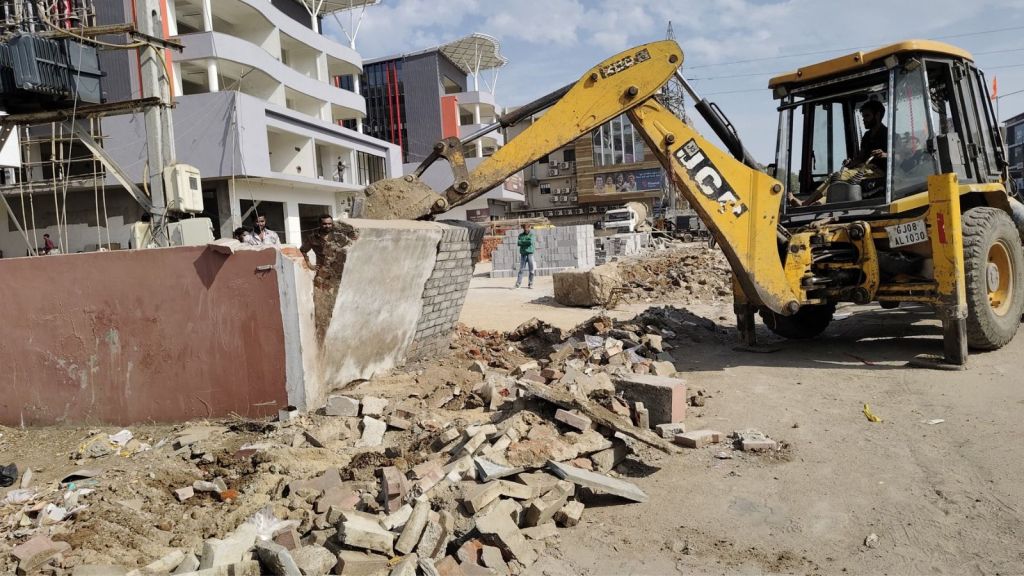 We have become so fixated on the performance of restoring a fictional, sanitised order that we have forgotten what the real order should be built on: Dignity and security of all the people who call a city their home (Image: Mc_Mahesana/X)


 Share


