5 min readOct 30, 2022 05:03 PM IST
First published on: Oct 30, 2022 at 04:26 AM IST
“Land to the tiller” was a prominent promise of the independence movement. It made sense from an equity as well as efficiency paradigm and was considered a legitimate demand across different ideologies. From the early 1950s, the Ambedkarite Dalit land movement in Maharashtra raised a follow-up slogan: kaseltyanchijamin, naseltyanchekaay (land to the tiller, but what about non-tillers or those without traditional rights over land)?”
Historically, Dalits were prohibited from holding productive and knowledge resources, especially land, because of their caste status. Land reforms failed except in a few states: the tenancy reforms primarily benefited the middle-castes but the distribution of ceiling-surplus land to the landless failed miserably.The National Sample Survey Office reveals that more than 58% of all rural Dalit households in India were landless in 2013. The list of top three states in this regard — Haryana (92%), Punjab (87%) and Bihar (86%) — suggests that Dalit landlessness remains unaffected by agricultural development (or the lack of it).

Dr B R Ambedkar’s perspective on agrarian problems are under-discussed in academic research or popular discourse. In fact, there is a tendency to diminish his large body of work on rural socio-economic transformation to his oft-quoted views on the regressive nature of the village.
In his framework, widespread poverty in India was due to the preponderance of uneconomic smallholdings that, along with the scarcity of capital, resulted in low levels of productivity and poor standards of life. Additionally,India’s village society was segregated on physical and social lines, wherein Dalits lived in the “ghettoes”. Dalits remained “economically dependent” on village society due to the latter’s almost complete monopoly over productive resources, especially land.
In Ambedkar’s own words, “a person holding land had a higher status than a person not holding land”. Naturally, he considered kisan a misnomer as it included the landlord as well as the landless. Think about the Punjab Land Alienation Act, 1900, that prevented Dalits from buying farmland or even accessing village commons because they were considered “non-agriculturalist castes”.This was even though Dalits had always worked in agriculture as village servants, “bonded” and hired workers. Expectedly, the post-Independence land reforms, almost by design, meant to give land only to those recognised as traditional kisans.
Has the situation changed? Almost every Indian language has a name for Dalit caste ghettos: Mahar/Mangwada in Marathi or Beda in Punjabi. The recent farmer’s movement success comes with a lesser-known fact: during the COVID-19 pandemic, many villages in Punjab announced social boycotts of Dalit agricultural workers for demanding better wages.
In Ambedkar’s framework, therefore, landholding is not simply about individual asset-ownership but is constitutive of economic freedom and social dignity. Landholding determines who is recognised as a kisan and their access to village commons. Therefore, its fair distribution opens the doors to an inclusive village “public” and equal citizenship. But landownership without self-respect is undesirable as is evident in Ambedkar’s early legislative interventions for the abolition of Maharwatan land tenures that kept Mahars tied to compulsory village services. Similarly, not many people know of his sustained opposition to land reforms because it reinforced existing land inequality through the creation of peasant proprietors, but without much support to make these smallholdings sustainable.
According to Ambedkar, at the fundamental level, only the annihilation of caste could destroy the exploitative dependence that made human beings unfree and forced them to lead an undignified life, devoid of a common humanity. Alongside, he advocated the nationalization of land and collectivization of agriculture along with modern industrialisation. In the early 1950s, he led and inspired land movements in Maharashtra, as also Punjab, Uttar Pradesh, and Andhra Pradesh.
Over the years, under the banner of the Republican Party of India, and later the Bhumiheen Hakk Sanrakshan Samiti, Manavi Hakk Abhiyan and Jameen Adhikar Aandolan, this movement made a pragmatic demand: redistribution of grazing lands, perhaps due to the hegemony of landed castes and unsympathetic local state apparatus. But even this limited demand has, without exception, resulted in violence against Dalits in Maharashtra and more recently, in Punjab.
Despite high growth, industrialisation in India has failed to produce enough decent jobs. Thus, Ambedkar’s ideas for rural transformation are more relevant than ever, to realise social justice and agricultural development. Land for Dalits can be a step in dislodging caste hegemony in villages and dignity and citizenship for Dalits. It can also be the meeting ground of hitherto disparate movements working towards an egalitarian India.
The writer is a British Academy Newton International Fellow at the University of Edinburgh

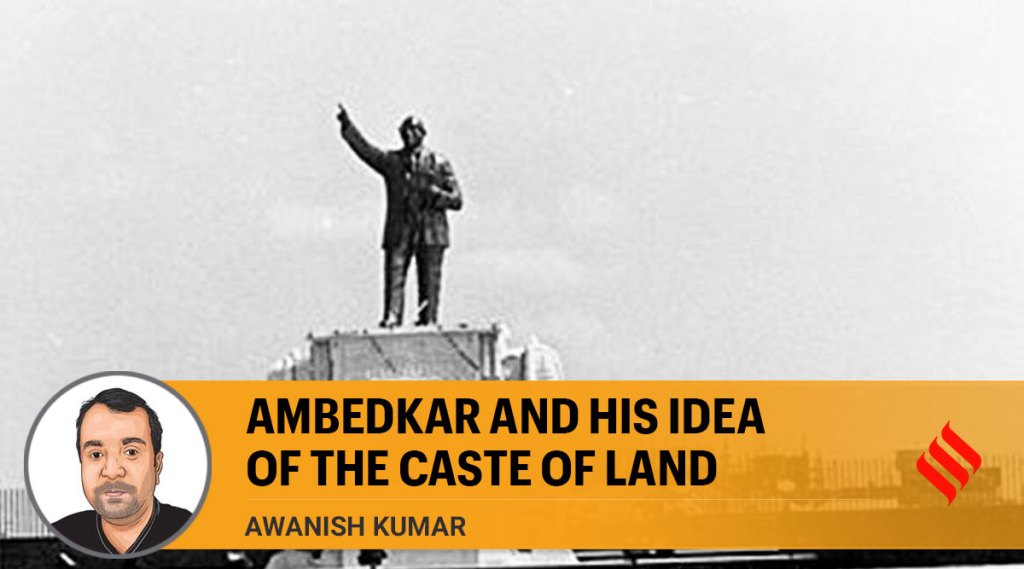 A statue of Dr BR Ambedkar at Ambedkar in Lucknow. (Express archive)


 Share


