
Let this be a new town, symbolic of freedom of India, unfettered by the traditions of the past — an expression of the nation’s faith in the future.” Standing on a podium in Chandigarh’s Sector 9 park, Pandit Jawaharlal Nehru delivered an impassioned speech, outlining his vision for the new city that defined a new India — Chandigarh.
At the centre of a now-shelved proposal to alter its constitutional status, Chandigarh began as an idea, envisioned by Nehru but executed by bureaucrats and builders who were ahead of their time.

Torn apart by Partition, Punjab had lost Lahore and was in dire need of a new capital. Alternatives were suggested — Ambala, Ludhiana, Patiala, Phillaur, Shimla, Jalandhar, Karnal and Amritsar — but Nehru was adamant that the capital would rise anew. And thus was born Chandigarh, a city “without an umbilical cord”, as author Vibhor Mohan describes the “caesarean birth” of this town in his book, Chandigarh — The Backstory & the City it Couldn’t Be.
The years from 1948 to 1951 were crucial — the new capital needed land, town planners, architects and builders. In 1948, the Punjab government appointed a panel under P L Varma, Chief Engineer. An aerial reconnaissance was undertaken by Varma, Deputy Commissioner Swaroop Singh and Executive Engineer R N Dogra. A site was in sight — on the foothills of the Shivalik range, northwards from Ambala to Shimla, flanked by two riverbeds.
Chandigarh fell in Ambala district, and derives its name from the temple of Goddess Chandi on the Kalka-Pinjore road. It was finalised on account of the land, its gradient for natural drainage, panoramic blue hills, moderate climate, proximity to Delhi and sufficient water supply.
Then, came the first of many hurdles. Over 50 villages had to be displaced for the new city. The challenges related to land acquisition were resolved, shares Deepika Gandhi, former director, Le Corbusier Centre, Chandigarh.
The Chandigarh Capital City plan now needed those who could execute it — architects, builders, designers, town planners. Budget being one of the biggest constraints, Nehru was inclined to pick someone closer home. He chose to connect with American town planner Albert Mayer, who was in India since 1945 and was working on remodelling Indian villages. Polish architect Matthew Nowicki came on board too, but his demise in a plane crash in 1950 and the rising dollar rate forced India to look elsewhere. French-Swiss architect Le Corbusier seemed an “affordable option”.
During that time, says historian and author Rajiv Lochan, Corbusier was more of an urban town planner whose philosophies on modern architecture didn’t have too many takers. He signed a contract that required him to stay in India for at least three years. He quickly sent his cousin and collaborator, architect Pierre Jeanneret, to seal the deal. They were soon joined by British architect couple Maxwell Fry and Jane Drew, pioneers in tropical architecture with work in developing countries such as Africa.
In one of her interviews, Drew mentioned how Varma and P N Thapar, Chief Administrator, Chandigarh, refused to leave her drawing room till she and Fry agreed to come. While the bureaucrats insisted on a city inclined towards educational institutions, Gandhi adds that on the advice of A L Fletcher, Punjab’s Officer on Special Duty, green belts were incorporated in the plan.
“Usually, the green cover is an afterthought, but Fletcher mooted the idea of a garden city. The city’s industrial area was pushed to the periphery and was earmarked for non-polluting industry,” says Gandhi.
The city was made in record time by engineers and architects, and workers from Rajasthan and Hisar, and, in the later years, the people of Punjab. By 1955, the High Court building was ready. On many occasions, a cash-strapped government wanted to halt the project, notes Gandhi, but Varma and then Punjab CM Partap Singh Kairon fought to keep it going. They sold plots in advance to raise funds for the construction.
When it was finally completed, Corbusier’s Chandigarh, with its geometric grid and brutalist architecture, was very different from the original fan-like plan of Nowicki and Mayer, who had rooted for a more village-like aesthetic.
Tejbans Singh Jauhar, who owns Tejee Studios and is one of the oldest residents of the city, says, “The first cabaret in Sector 17 was called Calypso, the first disco was started by Mr Denny from Mombasa…This town saw an influx of Punjabis from different corners —there were people from Uganda who had fled dictator Idi Amin’s regime, from Delhi post 1984 riots, from Burma too.”
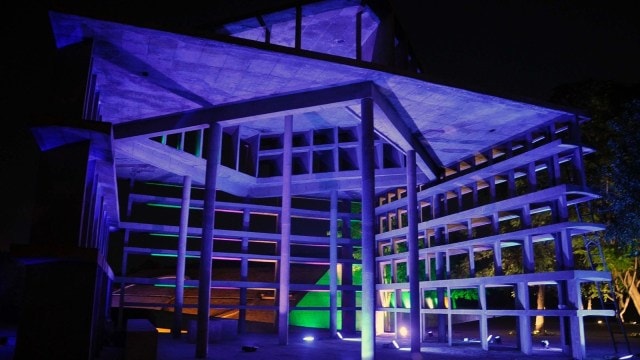
The brutalist architecture, says Gandhi, was not the starting point. It was a pragmatic way to keep costs down. “Dams were being built simultaneously at that time, Bhakra being one of them. So, cement was available easily. The planners knew this area was rich in clay, and there was abundance of bricks, especially the Nanakshahi bricks. The masons too were experts in brick laying, and so the structures we see today, which we define as brutalist, were made with local material. The exposed brick and cement walls were a conscious call to cut costs, including future costs of whitewash and maintenance. There were no machines, no cranes, no technology. Chandigarh is a city made by hand,” she says.
The writer is a freelancer based in Chandigarh


