
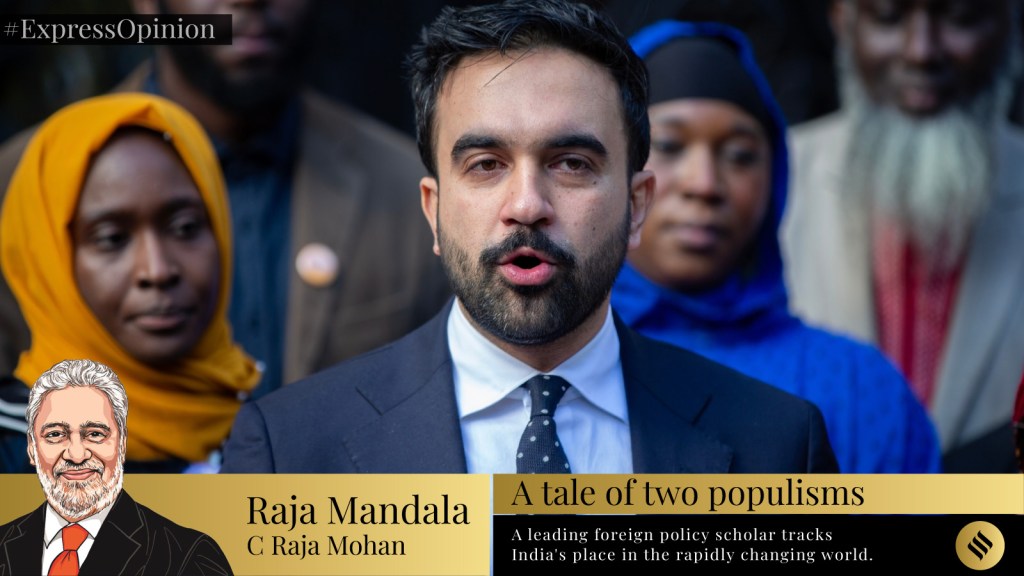
Just when there is growing anxiety about “America First” nationalism and hostility to Indian immigration in the US, a very different story has unfolded in New York, America’s most important city. It is about the meteoric political rise of Zohran Mamdani in New York’s mayoral race this week. By the time you chance upon this column, Mamdani, who is enjoying a comfortable lead in Tuesday’s election, could be declared the winner.
Only 34 years old, Mamdani was born in Uganda to Indian parents, who are well known in the Subcontinent. Meera Nair, his mother, is a successful filmmaker, and his father, Mahmood Mamdani, is a reputed academic. Zohran is now all set to become New York’s first Muslim, Indian and South Asian mayor.

His rise is less about India than about the unfolding transformations in American politics. To be sure, his populist agenda — free bus rides, rent freeze, government-run grocery stores, and free childcare facilities — would vindicate the growing welfarism of our own political class. That he is a Muslim, has criticised Prime Minister Narendra Modi’s policies in the past, and is a radical political figure has also divided the Indian American voters in the US. All that, however, is a sideshow compared to Mamdani’s potential impact on contemporary American politics.
In a deeply polarised political landscape dominated by the noise of MAGA populism and a widespread fatigue with liberal extremism, Mamdani’s campaign has tapped into a different current — one that puts the economic concerns of ordinary Americans at the top of the political agenda. That someone calling himself a “Democratic Socialist” is winning a major race in the US would surprise many who see socialism and America as antithetical.
Although left-wing politics has had a difficult time at the heart of modern capitalism, socialist and progressive forces have had a long tradition in America. Mamdani belongs to the Democratic Socialists of America (DSA), which was founded in 1982 through a merger of several progressive movements and has now become the largest socialist organisation in the US. The DSA traces its roots to earlier socialist movements of the early 20th century and the anti-Vietnam War activism of the 1960s. Its founding coalition combined the old left’s focus on labour issues and the new left’s interest in a range of social justice questions.
The DSA has experienced a significant rise in influence since the 2010s amid growing economic inequality. This is the sentiment that Donald Trump on the Republican side and Bernie Sanders on the Democratic side sought to mobilise in the 2016 presidential election. Trump was successful.
Although he lost the Democratic party’s presidential nomination to Hillary Clinton, Sanders brought democratic socialism into the national conversation, lending the organisation a new political vigour, and expanding its reach among younger and progressive voters. For many young Americans, socialism is no longer an American taboo. These are voters who grew up in the shadow of 9/11, the 2008 financial crash, and the pandemic — each eroding the faith in the American Dream.
Mamdani’s rise as a leading voice of the American left defies convention. He began as a hip-hop musician and tenant organiser before entering the New York State Assembly. Mamdani’s coalition includes working-class Black, Latino, Asian, and Arab voters, along with young White professionals. His success in putting together this diverse coalition is said to lie in organisational skills — focused on campaigning at the neighbourhood level, multilingual outreach, direct voter contact. His skills at political communication have been compared to those of Trump.
Like Trump, Mamdani has successfully fended off sharp criticisms that he is a communist, Islamist jihadi, an anti-semite, inexperienced and has never held down a serious job. His relentless focus on “affordability” in New York has kept him in a consistent lead over his rival, the former Democratic Governor Andrew Cuomo, who is running as an independent after losing to Mamdani in the primary. Many professional political consultants in the US are analysing Mamdani’s strategies of mobilisation. Many activists on the European left, on the back foot from the attacks by a rising right, have descended on New York to pick up a trick or two from Mamdani.
Is Mamdaini a flash in the political pan? Many are convinced that Mamdani’s agenda of “tax the rich and feed the poor” is unimplementable in New York or elsewhere in America. But it has struck real resonance in urban America, where the Democrats get most of their votes.
Mamdani’s rise has posed a problem for the Democratic Party. The centrists fear that his religious identity, socialist economics, and political radicalism will be deployed with great effect by Trump and the Republicans to mobilise middle America against the Democrats in the midterm elections due in November 2026. But many on the left see Mamdani as the saviour of the party — with a clear message, sharp focus on economic hardship and the zest to take on the Republicans, Mamdani is what the Democrats need to break the political dominance of Trump.
Whether he succeeds as mayor of New York or not, Mamdani shines a light on the current churn in US domestic politics and the unfolding contest for the political soul of America. The MAGA populism is rooted in resentment — in part against immigrants and minorities. Mamdani’s populism in contrast channels hope for an inclusive future for an increasingly diverse America — in ethnic and religious terms. Together, they remind us that to know where America is headed in the world, it is important to have a better sense of its changing domestic politics.
The writer is contributing editor on international affairs for The Indian Express and a distinguished professor of American Studies at the Motwani Jadeja Institute of American Studies, Jindal Global University, Delhi

 Share


