
A right to anonymity
France’s burqa ban stokes a debate on rights and duties in the modern state.
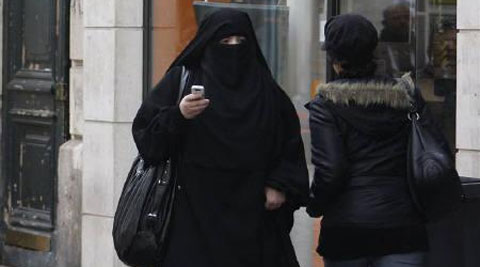 Would the right to wear a veil be protected by the freedom of religion guaranteed under Article 25 of our Constitution? (Source: Reuters)
Last month, the European Court of Justice delivered its verdict in the burqa ban case. The court upheld the French law imposing a blanket prohibition on wearing veils that conceal the face in public places. The ban was challenged by a French citizen, a young woman of Pakistani origin, who complained that the prohibition offended her freedom of religion, her freedom of expression and the guarantee of privacy under the European Convention on Human Rights. France defended its position with the assertion that the practice of covering the face in public was at odds with the values of the French republic expressed in the maxim, “liberty, equality and fraternity”. The practice of wearing a veil, asserted France, was incompatible with secularism, symbolic of subservience, and constituted infringement of liberty, dignity and gender equality. Further, France argued that the face-covering burqa represented a denial of fraternity, constituted a negation of contact with others, violating the French principle of “vivre ensemble” or living together.
The argument that impressed the European Court was that the burqa, which entailed concealment of the identity of the wearer from the rest of society, raised a barrier against fellow citizens, offending their “right to live in a space of socialisation which makes living together easier”. The veil restricts social access, a fundamental facet of the right to fraternise in a multicultural democratic society. The court found that religious freedom does not always guarantee the right to behave in the public sphere in a manner that is dictated by one’s religion or beliefs. It ruled that in democratic societies where several religions co-exist, it may be necessary to place limitations on the freedom to manifest one’s religion in order to reconcile the interest of others.

It may be worth examining how this issue would be treated in India were it ever to arise. Traditionally, our society recognised purdah nashin women and, even today, archaic provisions exist to protect legal arrangements executed on behalf of such women. Unlike in Europe, the veil worn by Muslim and some non-Muslim women is not culturally alien in India. Yet, is there a protected right to anonymity in the modern state?
Would the right to wear a veil be protected by the freedom of religion guaranteed under Article 25 of our Constitution? Article 25 protects only those practices that are absolutely essential or integral to religion. Experts on Islamic jurisprudence have opined that there is no religious compulsion in Islam for a woman to cover her face. If so, the right to wear a face-concealing burqa is unlikely to be regarded as an essential part of religious practice, which qualifies for protection under Article 25.
Would protection be available under freedom of expression under Article 19(1)(a) ? The right to dress as one pleases is inherent in that freedom. Choice of attire is an important facet of identity, personality and personal autonomy. It defines how a person wishes to present herself or be looked upon by society. In a recent judgment, recognising the constitutional status of transgenders, the Supreme Court drew on the Yogyakarta principles on the application of international human rights law in relation to sexual orientation and gender identity.
These stipulate: “Everyone has the right to freedom of opinion and the expression of identity or personhood through speech, deportment, dress, bodily characteristics”. It may be argued that if some women can be permitted to wear as little as they sometimes do, why should others not be allowed to cover up all of themselves if they so choose? Neither can be stretched to the extreme. The right to dress is subject to reasonable restrictions on grounds such as public order, morality or decency. In a country as vast and varied as ours which gladly accepts both burqas and bikinis, contemporary standards may be difficult to determine. However, it is doubtful whether attire that swaddles an individual in anonymity can be regarded as compatible with the rights and duties of a modern citizen. Indeed, the burqa by barring social access, impedes the realisation of fundamental rights and the fulfilment of fundamental duties.
Yet, the burqa flourishes in India. Unlike France, India does not impose a forced fraternity on its citizens. Rather, India interprets vivre ensemble in the spirit of deference to diversity. A more mature approach, embedded in the philosophy of accommodation and assimilation are the values, sarva dharma sambhava and vasudeva kutumbakam.
The writer is a Supreme Court lawyer
express@expressindia.com
 Share


